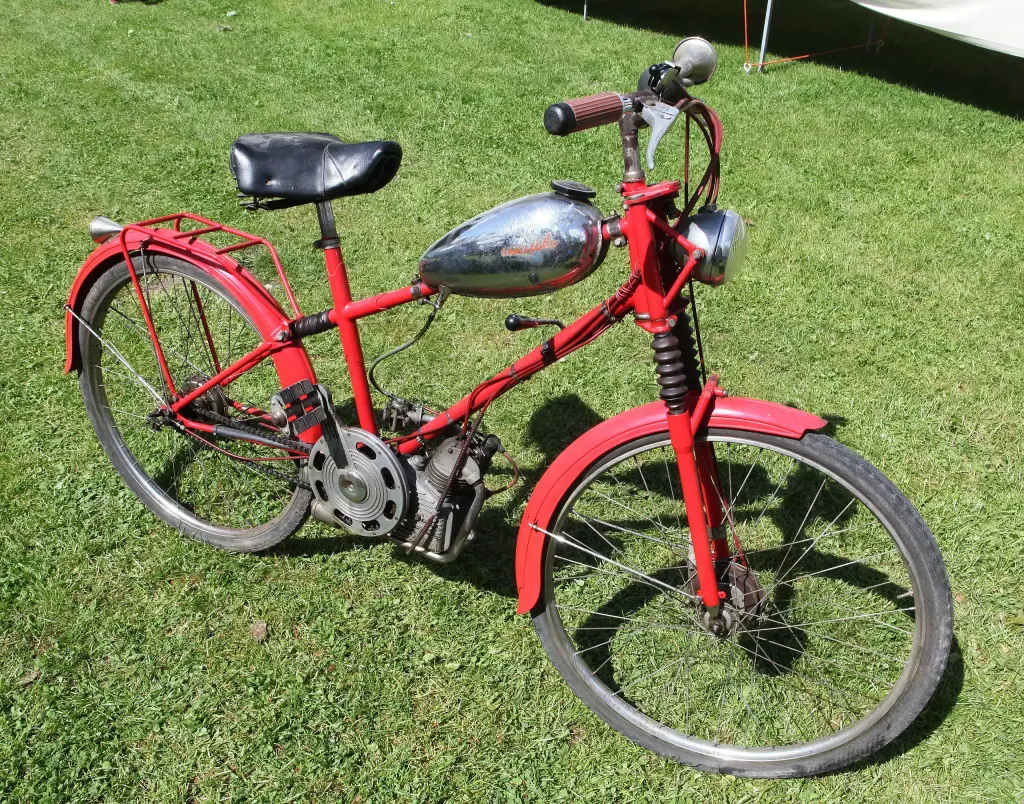
The Ducati Cucciolo was a four-stroke clip-on engine for motorised bicycles, conceived during and shortly after the Second World War by the Turin lawyer Aldo Farinelli and developed with the self-taught engineer Aldo Leoni. Ducati built it under licence and it became the company’s first motorcycle product.
Ducati Cucciolo at a glance
| Type | clip-on four-stroke engine for bicycles |
|---|---|
| Designers | Aldo Farinelli, Aldo Leoni |
| First prototype | autumn 1944, Turin |
| Weight | 7.7 kg |
| Fuel economy | 180 miles per US gallon on a bicycle |
| On sale | from 26 July 1946, by Siata |
| Ducati production | from 1946, under licence |
| 1946 output | 15 engines |
| Sold by 1952 | 200,000 |
| First complete Ducati moped | model 48, 1952–1954 |
| End of the line | 1958, when the 65 models were dropped |
History of the Ducati Cucciolo
Born in Turin
During the war Aldo Farinelli began working with the small Turin firm Siata, Società Italiana per Applicazioni Tecniche Auto-Aviatorie, with the idea of a small engine that could be mounted on a bicycle. Farinelli’s and Leoni’s first prototype was running on the streets of Turin in the autumn of 1944. The yapping sound of its short stubby exhaust inspired the name Cucciolo, “puppy”.
Siata finds a manufacturer
On 26 July 1946, barely a month after the official liberation of the country, Siata announced that it would sell Cucciolo engines to the public. It was the first new automotive design to appear in postwar Europe. Some businessmen bought the engines in quantity and installed them in frames, offering complete units for sale. Demand soon outstripped Siata’s limited production capacity, so the company found a manufacturing partner at Borgo Panigale near Bologna.
Ducati takes over
Ducati was a well-known name in electronics and appliances and, in the postwar years, was looking for new work for its factory and workers. A licensing agreement with Siata was reached. Production rose from 15 units in 1946 to more than 25,000 in the following years, when Ducati obtained an exclusive agreement for production.
From clip-on to moped
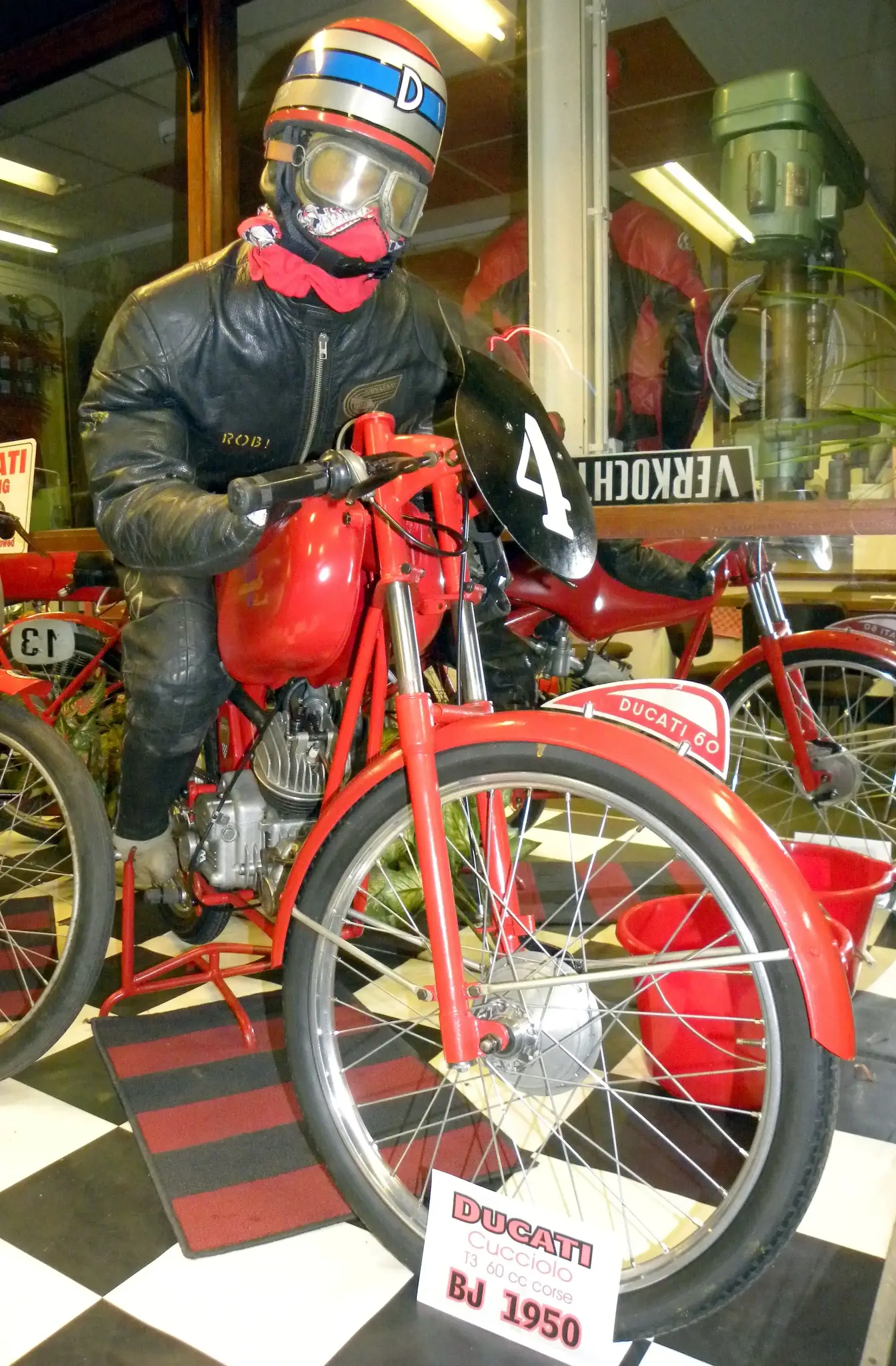
In 1952, with 200,000 Cucciolos sold, Ducati offered its own complete moped based on the little pull-rod engine, with the pedals removed and a three-speed gearbox added: the model 48, produced until 1954, and the 55E and 55R. The 48 had its fuel tank integrated into the frame and swingarm rear suspension. Later models became real motorcycles with pressed-steel frames, and capacity grew to 60 cc with the 60 and 60 Sport, and to 65 cc with the 65 Sport, 65T, 65TL and 65TS. The Cucciolo engine was replaced by the 98 line from 1952, and its production ended when the 65 line was dropped in 1958.
Design and features
- The original clip-on: a four-stroke engine weighing a little over 7.7 kg, mounted on an ordinary bicycle.
- Economy: 180 miles per US gallon when installed in a bicycle.
- Ducati’s entry: the licence from Siata that put Ducati into motorcycle production.
- Scaled up: from clip-on engine to the complete model 48 moped and the 55, 60 and 65 lines.
Ducati Cucciolo versions
- Cucciolo engine: the clip-on unit sold from 1946.
- Model 48 (1952–1954): the first complete Ducati moped, with a three-speed gearbox.
- 55E and 55R: the models that followed the 48.
- 60, 60 Sport, 65, 65 Sport, 65T, 65TL, 65TS: the later pressed-steel motorcycles.
The Cucciolo line led to the small singles described in the Ducati 125 and Ducati 200 Elite articles. The whole story is in the Ducati collection.
Video: Ducati cucciolo – Rapida
Video by Joao graça on YouTube.
Sources
- Ducati Cucciolo, English Wikipedia: design, Siata, Ducati production, later models