The Dodge Super Bee is a mid-sized muscle car marketed by Dodge for the 1968 through 1971 model years. The original was based on the Dodge Coronet two-door coupé and was Dodge’s low-priced muscle car, rebranded and mildly distinguished from the Plymouth Road Runner.
Dodge Super Bee at a glance
| Built | 1968 to 1971 model years |
|---|---|
| Base car | Dodge Coronet two-door; in 1971 the Charger platform |
| Shown | 1968 Detroit Auto Show |
| Wheelbase | 117 inches, against 116 for the Road Runner |
| Weight | about 65 lb (29 kg) more than the Road Runner |
| Standard engine, 1968 | 383 Magnum, 335 hp |
| Hemi | 426 cu in, 425 hp; 125 cars in 1968, 166 in 1969, 22 in 1971 |
| 440 Six Pack | 390 bhp, A12 package in mid-1969; 1,907 built |
| 1970 production | 15,506 |
| 1971 production | 5,054, at $3,271 |
This page is based on English Wikipedia only (a trusted source); the facts were not cross-checked against a second source.
History of the Dodge Super Bee
Plymouth’s Road Runner sold well enough that Dodge’s general manager Robert McCurry asked the Dodge styling office for a similar model. Senior designer Harvey J. Winn won a contest with the name “Super Bee” and a new logo based on the Dodge “Scat Pack” bee medallion; the name’s origin is the “B” body designation of Chrysler’s mid-sized cars. The design was influenced by the 1968 Coronet convertible, the show car’s interior was built by the Alexander Brothers, and it was shown at the 1968 Detroit Auto Show.
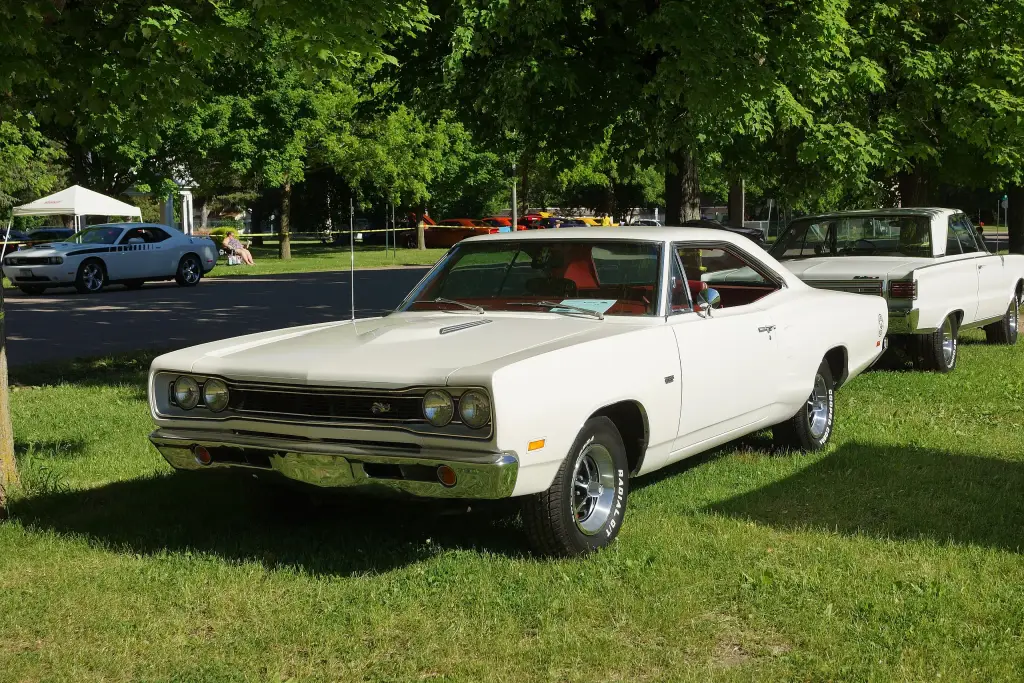
1968
The two cars looked alike, but the Super Bee was slightly heavier and rode on a 117-inch wheelbase. It had larger rear wheel openings, a bumblebee tail stripe, a fancier grille and taillight ornamentation, and real die-cast chrome-plated “Bee” medallions. It used the Charger’s dash cluster, and four-speed cars got a Hurst Competition-Plus shifter rather than the Road Runner’s cheaper Inland linkage. The higher quality made it more expensive, which hurt sales. The 1968 car was available only as a two-door coupé with a 335 hp 383 Magnum or the 426 Hemi rated at 425 hp; the Hemi raised the price by 33% and 125 were sold.
1969 and 1970
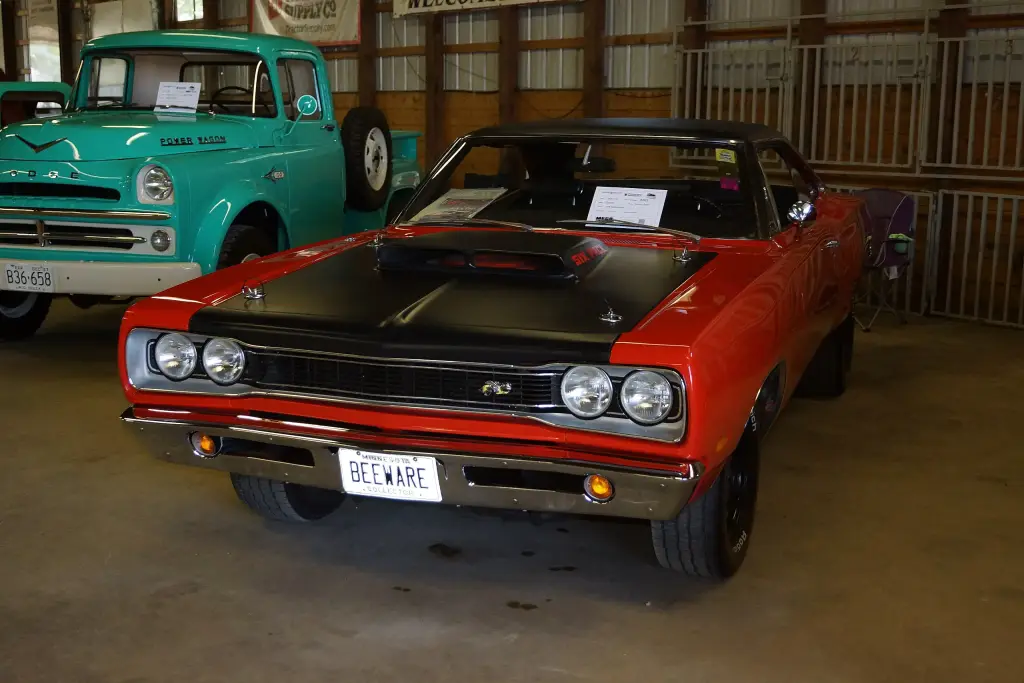
A hardtop joined the coupé in 1969, with a more aggressive front end and new horizontal tail lights. A twin-scooped air-induction hood, the “Ramcharger” (option N96), was the counterpart of the Road Runner’s “Coyote Duster”. Mid-year Dodge added a 440 with three two-barrel Holley carburettors rated at 390 bhp. These special-order 1969½ cars, coded A12 with an M in the VIN, also had a Dana 60 axle with 4.10 gears, a lift-off flat black scooped bonnet, heavy-duty engine parts and 11-inch drum brakes; 1,907 were produced, and the package cost $463, half-way between the standard engine and the Hemi. For 1970 the Super Bee got a new front end with a twin-looped bumper that Dodge called “bumble bee wings”, a “C-stripe” option, high-back bucket seats and a “pistol grip” Hurst shifter. Sales fell, partly because of higher insurance rates on performance cars, a problem the Road Runner and Plymouth Duster also faced.
1971 and later
In 1971 the Coronet line was built only as a four-door sedan and wagon, and the Super Bee moved to the platform of the Charger. Since a Charger R/T existed, the Super Bee was promoted as the low-priced model at $3,271. Production was 5,054, including 22 with the Hemi, and 1971 was the only year in which a small-block 340 four-barrel was available. The name was then dropped in the home market until the 2007 version of the Charger. In Mexico, Chrysler introduced its own Super Bee in 1970, based on the compact Valiant A-body as a replacement for the Plymouth Barracuda, with a 318 V8 of 270 hp; it was built until 1976.
Design and features
- Price: a cheaper muscle car in the Road Runner mould, with Charger instruments and a Hurst shifter.
- Hoods: the twin-scoop Ramcharger air-induction hood, option N96.
- Look: a bumblebee stripe around the tail and chrome bee medallions.
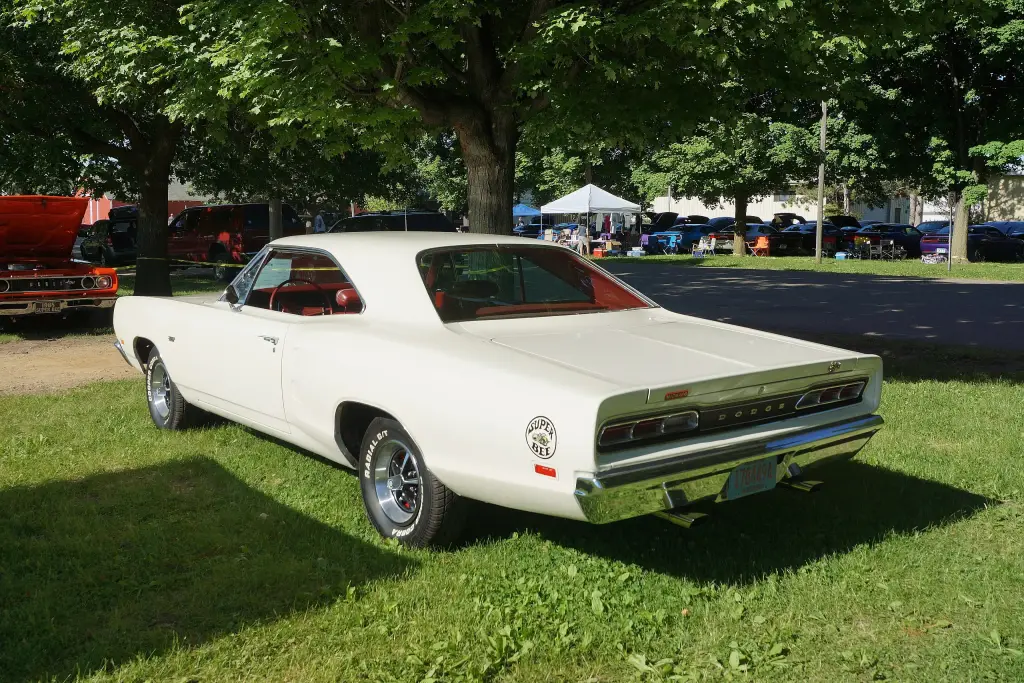
Dodge Super Bee versions
- 1968: the Coronet coupé with a 383 Magnum or Hemi.
- 1969½ A12: the 440 Six Pack cars, 1,907 built.
- 1970: the restyled car with the twin-loop bumper.
- 1971: the Charger-based car, with only 5,054 built.
- Mexican Super Bee (1970–1976): a Valiant-based version.
Its rival was the Plymouth Road Runner, and it shared the winged-car story with the Dodge Charger Daytona. For the engines see Muscle car engines decoded, and for more, our Dodge collection.
Sources
- Dodge Super Bee, English Wikipedia: history, years, engines and production figures