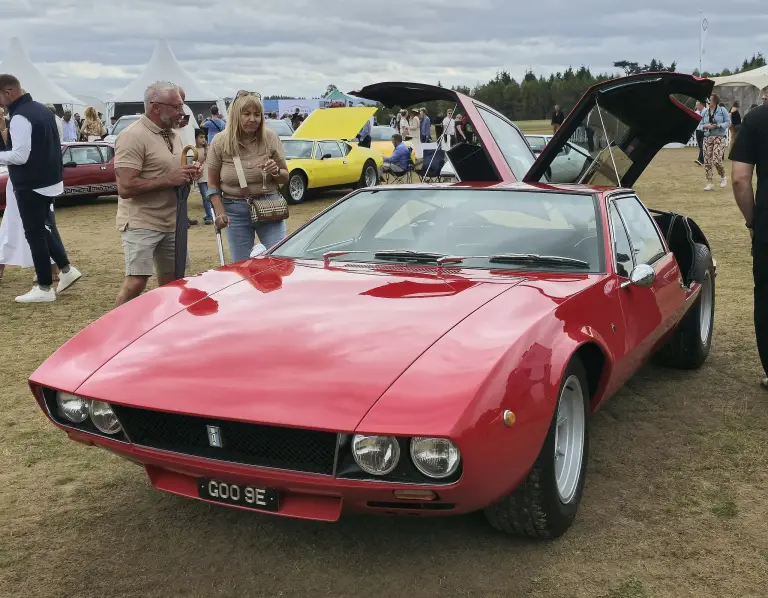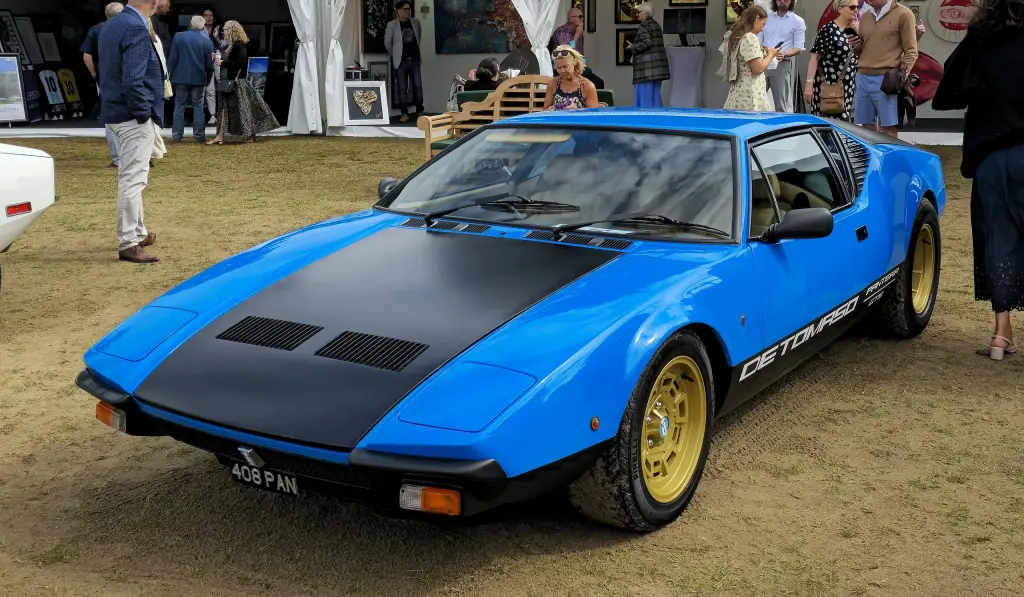
The De Tomaso Pantera was a mid-engined sports car built by the Italian firm De Tomaso from 1971 to 1992. It was the company’s most popular model, with more than 7,000 cars made over a twenty-year run, and more than three quarters of them were sold from Lincoln-Mercury dealerships in the United States between 1972 and 1975.
De Tomaso Pantera at a glance
| Maker | De Tomaso, Modena |
|---|---|
| Production | 1971–1992 |
| Designer | Tom Tjaarda of Carrozzeria Ghia |
| Layout | mid-engine, rear-wheel drive |
| Chassis | steel monocoque, a first for De Tomaso |
| Engine | 5.8 L (351 cu in) Ford Cleveland V8 |
| Power, 1971 | 335 PS (246 kW; 330 hp) |
| Gearbox | ZF transaxle |
| US distribution | Ford, through Lincoln-Mercury dealers, 1972–1975 |
| GTS, spring 1972 | 350 PS DIN, wider wheels, ventilated discs |
| Pantera L | August 1972, US model with large black front bumper |
| Built | more than 7,000 |
Based on one source, the English Wikipedia article on the Pantera.
History of the De Tomaso Pantera
Replacing the Mangusta
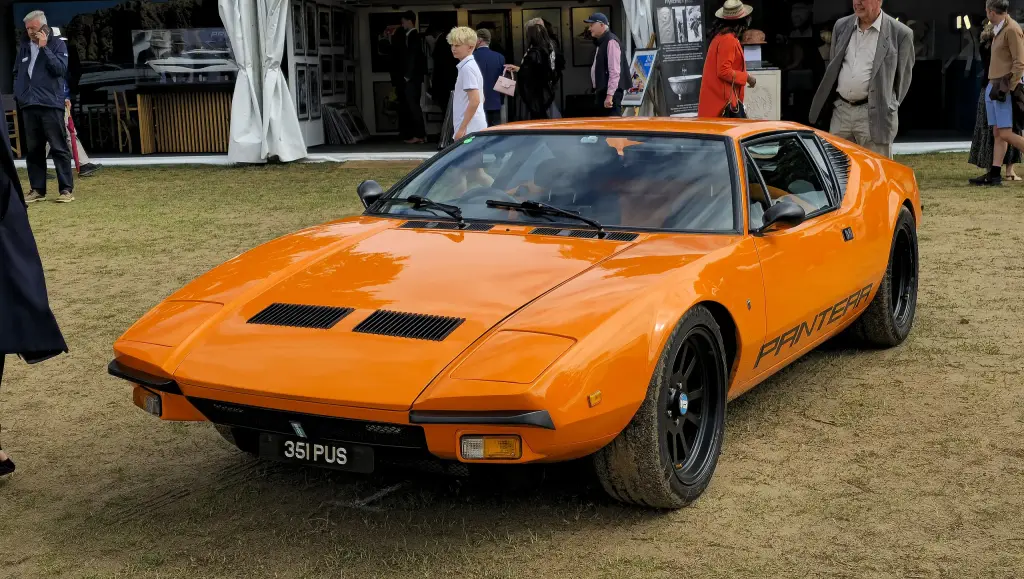
The Pantera was designed by Tom Tjaarda, the American-born stylist at Carrozzeria Ghia, and replaced the Mangusta in the De Tomaso range. Where the Mangusta used a steel backbone chassis, the Pantera sat on a steel monocoque, the first De Tomaso built this way. The car was shown in Modena in March 1970 and at the New York Motor Show a few weeks later; the first production cars reached customers about a year afterwards, by which time output had risen to three cars a day.
Ford takes the American market
De Tomaso sold Ford the rights to distribute the Pantera in the United States through its Lincoln-Mercury network, while Alejandro de Tomaso kept the European sales rights. Ford began importing late in 1971: the first 75 cars were European cars with push-button door handles and hand-built Carrozzeria Vignale bodies, and 1,007 Panteras reached the United States that year. Rust-proofing was minimal and the finish of these early cars was poor. Ford later tightened production with precision-stamped body panels.
The engineering
The first 1971 cars used a 5.8-litre Ford Cleveland V8 rated at 335 PS (246 kW; 330 hp). Its high torque made the Pantera easy to drive in town without constant gear changing. The ZF transaxle came from the Mangusta, and the same unit also appeared in the Maserati Bora launched in 1971. Power-assisted four-wheel disc brakes and rack-and-pinion steering were standard. Car and Driver recorded 97 km/h (60 mph) in 5.5 seconds in 1971.
GTS and Pantera L
In the spring of 1972 De Tomaso added the more sporting GTS for Europe, developed for Group 3 racing. It had 350 PS DIN from a compression ratio of 11.0:1, larger Holley carburettors, a forged aluminium intake manifold and freer exhaust headers, plus wider wheels, a quicker steering rack, ventilated discs, altered spring rates and matte black body details. For 1972 the American engine dropped to 8.6:1 compression to meet emissions rules, but gained the Cobra Jet camshaft and a dual-point distributor. The Pantera L followed in August 1972 as a 1972½ model, with a large black front bumper that included an airfoil to cut front-end lift and a US-rated 264 hp (197 kW). It was refined enough to be named Road Test magazine’s Import Car of the Year for 1973. The dashboard became a single angled unit during 1973.
Design and features
- Mid-mounted Ford V8: 351 Cleveland power with strong low-speed torque.
- Steel monocoque: the first De Tomaso without a backbone chassis.
- Transatlantic equipment: electric windows, air conditioning and power-assisted brakes were standard.
- Racing-derived GTS: higher compression, wider wheels and matte black trim.
- Long life: the same basic car stayed in production for twenty years.
De Tomaso Pantera versions
- Pantera (1971): the original European and American car with the 335 PS engine.
- GTS (1972): European sporting version with 350 PS and Group 3 racing development.
- Pantera L (1972): US luxury model with the single black front bumper.
- Later US cars: detuned engines and revised dashboards for emissions and safety rules.
- Late European cars: small-volume production into the early 1990s.
The Pantera replaced the Mangusta and shared its ZF transaxle, and it used the same Ford Cleveland V8 as the Deauville saloon. More De Tomasos are in the De Tomaso collection.
Video: Detomaso Pantera GTS START-UP engine and Accelerate
Video on YouTube.
Sources
- De Tomaso Pantera, English Wikipedia: history, design, engines, GTS, US distribution, Pantera L