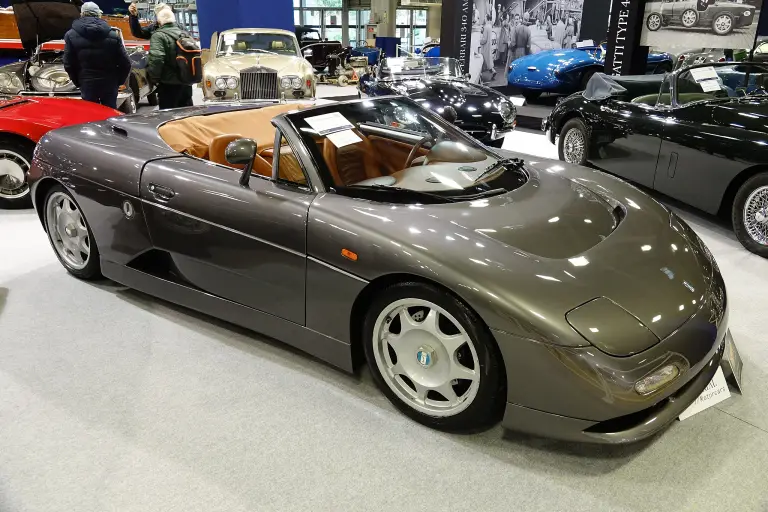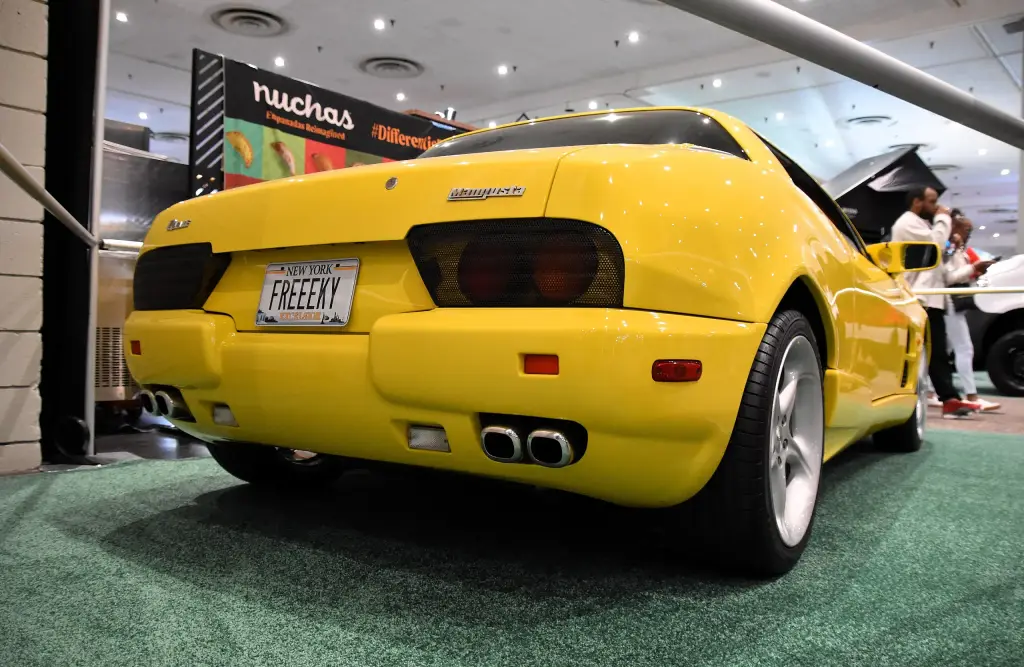
The De Tomaso Biguà was a sports car concept shown at the 1996 Geneva Motor Show. It was developed as a new De Tomaso with a Ford V8 and styling by Marcello Gandini, but a dispute with the backer who paid for its development meant that the production car was sold under the Qvale name from 1999 until 2002.
De Tomaso Biguà at a glance
| Shown | 1996 Geneva Motor Show |
|---|---|
| Internal code | ETX |
| Designer | Marcello Gandini |
| Chassis | Enrique Scalabroni |
| Layout | front mid-engine, rear-wheel drive |
| Engine | 4.6 L Ford Modular V8 |
| Gearbox | five-speed BorgWarner manual or four-speed automatic |
| Body panels | resin transfer moulding by Stratime Cappelo Systems |
| Roof | Gandini roto-top with an electrically rotating rear section |
| Torsional stiffness | 1,450 kg/m/deg |
| Production car | Qvale Mangusta, 1999–2002 |
The English Wikipedia page for the De Tomaso Biguà redirects to the article on the Qvale Mangusta, which covers the concept and the production car, so this article is based on one source.
History of the De Tomaso Biguà
An Italian TVR
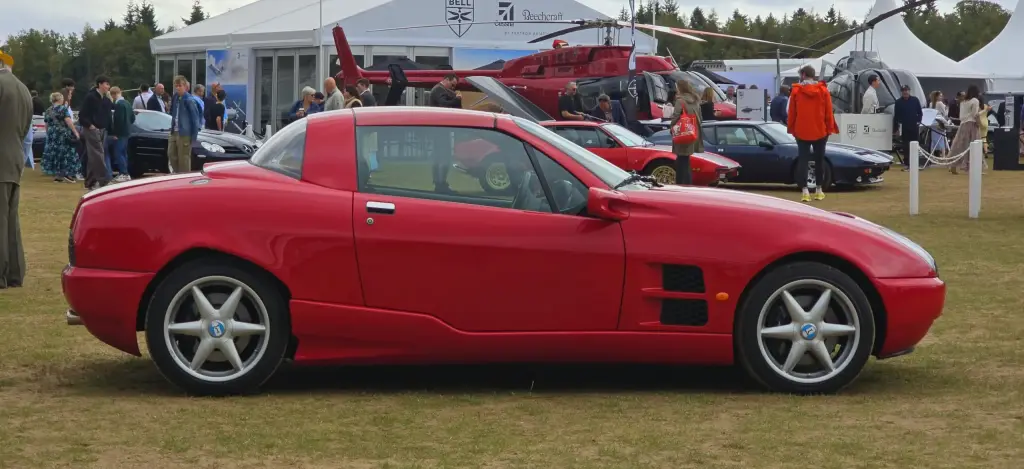
In 1993 and 1994 Giordano Casarini, technical director at Maserati, travelled to Britain and saw the TVR Griffith; he was impressed by the style and sales success of such a low-volume car. Alejandro de Tomaso had suffered a stroke in 1993, and after recovering he asked Casarini what should become of De Tomaso. Casarini suggested an Italian equivalent of the TVR, using an existing, inexpensive V8 to keep purchase and maintenance costs down. In the tradition of De Tomaso cars he wanted a Ford V8, and explored the new Ford Modular 4.6-litre engine. When Ford was not yet ready to sell it, Casarini was pointed towards Holden Special Vehicles in Australia, which could supply engines and transmissions; the project was given the internal code name ETX.
Ford and Gandini
Soon afterwards Ford told Casarini that it could supply the Modular V8 together with transmissions, ancillaries and electrical systems. Alejandro de Tomaso had long admired Marcello Gandini’s work, so Gandini was called to Modena and driven around in a TVR Griffith to show him the character wanted. He was commissioned to style the car, with the instruction that its folding roof should work like the multi-position roof of the Griffith. A prototype was displayed at the 1996 Geneva Motor Show as the De Tomaso Biguà, although it still needed development before production.
The Qvale dispute
De Tomaso needed capital to continue. An appeal to the Italian government failed because of Alejandro de Tomaso’s declining health, so the company approached the Qvale family, whose head Kjell Qvale had imported the original De Tomaso Mangusta into North America in the 1960s. Qvale agreed to fund development on the understanding that the finished car would be sold as a De Tomaso Mangusta. Licensing and distribution problems soured the agreement, and Bruce Qvale, then managing Qvale, decided to produce the car under the Qvale name after investing more than US$30 million in its development. In 1997 the company Qvale Modena SpA was set up to build it in a renovated and modernised building in Modena, certified to ISO 9001.
Engineering
The chassis was designed by the former Formula 1 engineer Enrique Scalabroni, who had worked for Dallara, Williams and Ferrari. Each chassis was made of welded laser-cut steel sections and galvanised by Vaccari & Bosi, while the body panels were produced by resin transfer moulding at Stratime Cappelo Systems of Villers-Cotterêts in France, the company that had also made the bodywork of the Alfa Romeo SZ and the Lotus Elan M100. Scalabroni emphasised torsional rigidity because the design had no structural roof: measured stiffness was 1,450 kg/m/deg, more than four times that of a typical open car of the time. Suspension was double wishbones with coil springs and anti-roll bars at both ends. The roto-top roof, designed by Gandini and inspired by the Griffith, had a removable centre panel like a targa and a rear section that rotated electrically forwards. Power came from the 4.6-litre Ford Modular V8 through a five-speed BorgWarner manual or a four-speed automatic.
Design and features
- Gandini styling: a compact sports car shaped by the designer of the Miura and Countach.
- Ford Modular V8: American power chosen to keep costs down.
- Scalabroni chassis: very stiff welded steel structure without a structural roof.
- Roto-top: a targa-like roof whose rear section rotates electrically.
- Composite panels: resin transfer moulded bodywork from a French specialist.
De Tomaso Biguà versions
- Biguà concept (1996): the show car that began the project.
- De Tomaso Mangusta: the name planned for the production car.
- Qvale Mangusta (1999–2002): the production version, sold under the Qvale name.
- Manual and automatic: five-speed BorgWarner or four-speed automatic.
The Biguà was intended to revive the name of the Mangusta, and it followed the Pantera in the De Tomaso story. More De Tomasos are in the De Tomaso collection.
Sources
- Qvale Mangusta, English Wikipedia: concept, history, chassis, body, roof, engines