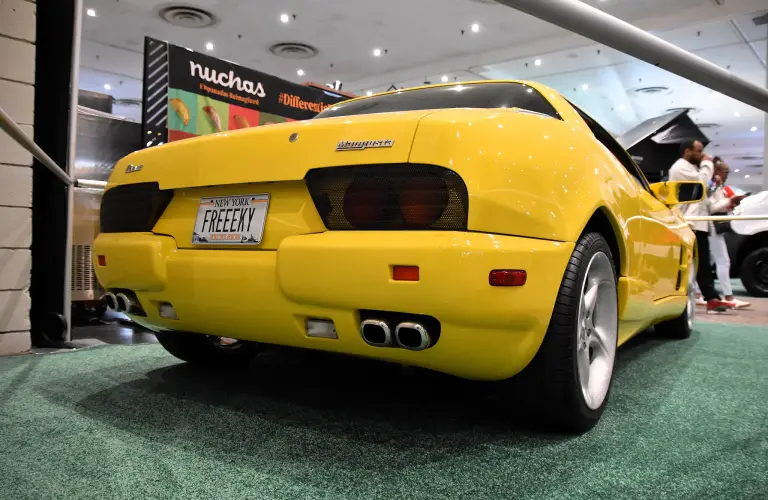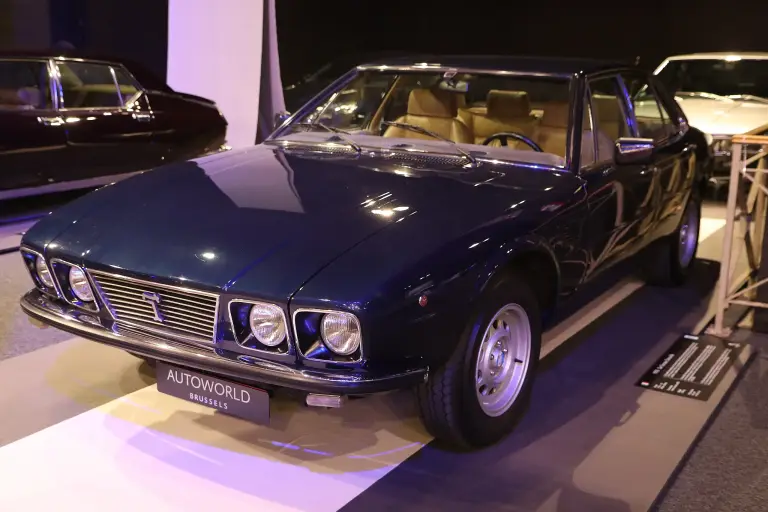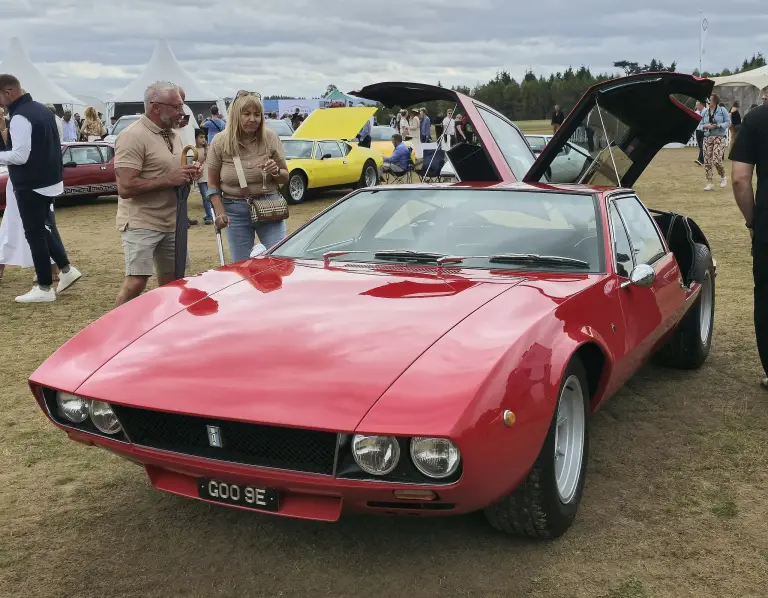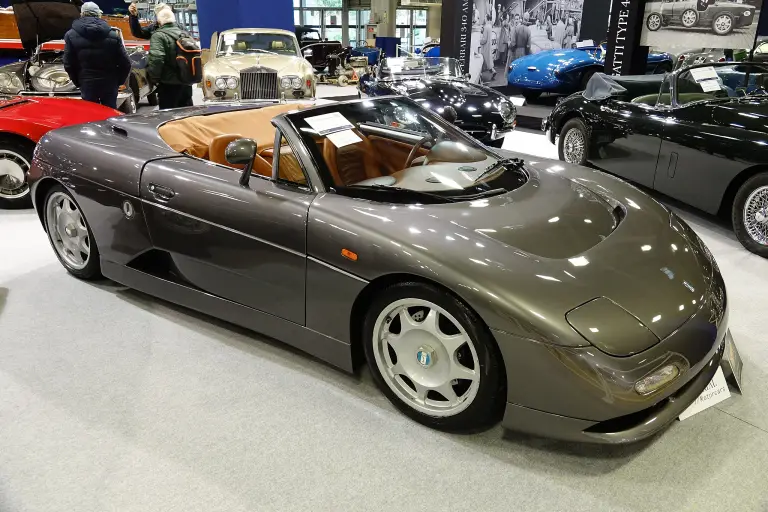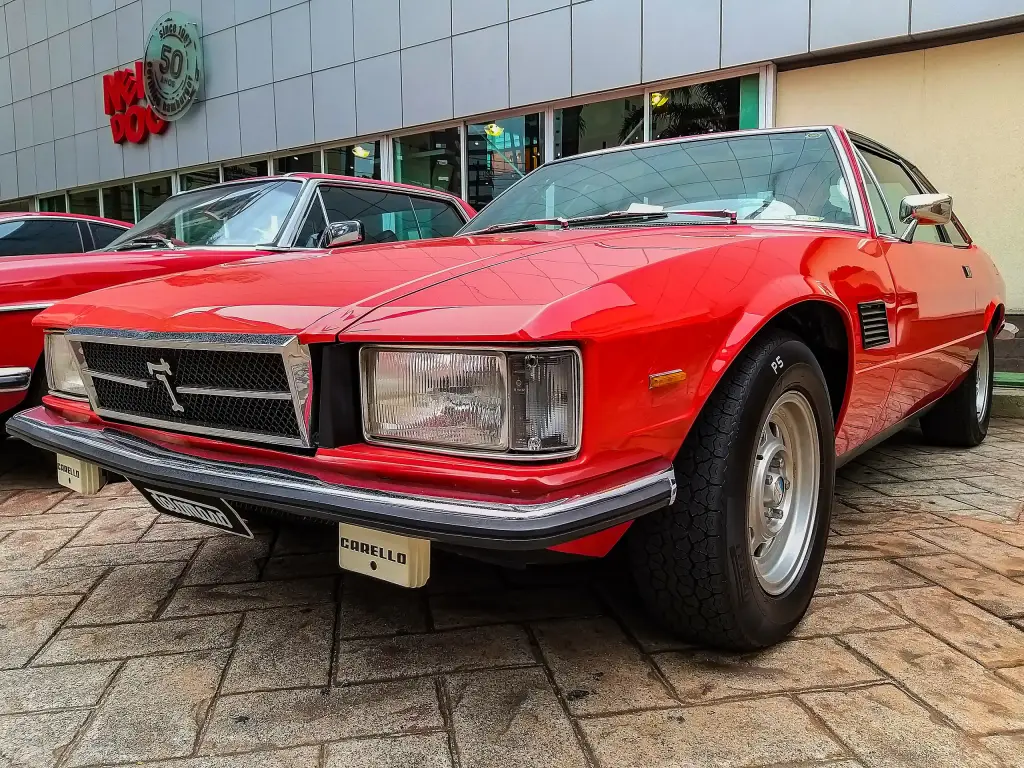
The De Tomaso Longchamp was a grand tourer produced by De Tomaso from 1972 to 1989. It used a shortened version of the Deauville saloon’s chassis with the same suspension, engine and transmission, was styled by Tom Tjaarda at Ghia, and was offered first as a two-door 2+2 coupé.
De Tomaso Longchamp at a glance
| Maker | De Tomaso, Modena |
|---|---|
| Production | 1972–1989 |
| Designer | Tom Tjaarda of Ghia |
| Based on | De Tomaso Deauville, shorter wheelbase |
| Engine | 351 cu in (5,769 cc) Ford Cleveland V8 |
| Power | 335 PS (246 kW; 330 hp) |
| Top speed | 240 km/h (149 mph) |
| Gearbox | three-speed Ford C-6 automatic; about 17 cars with a five-speed ZF manual |
| Series 2 | 1980 model year |
| GTS | 1980 Turin Motor Show |
| Spyder | converted by Carrozzeria Pavesi |
| Built | 409 (395 coupés and 14 spyders) |
Based on one source, the English Wikipedia article on the Longchamp.
History of the De Tomaso Longchamp
A coupé from the saloon
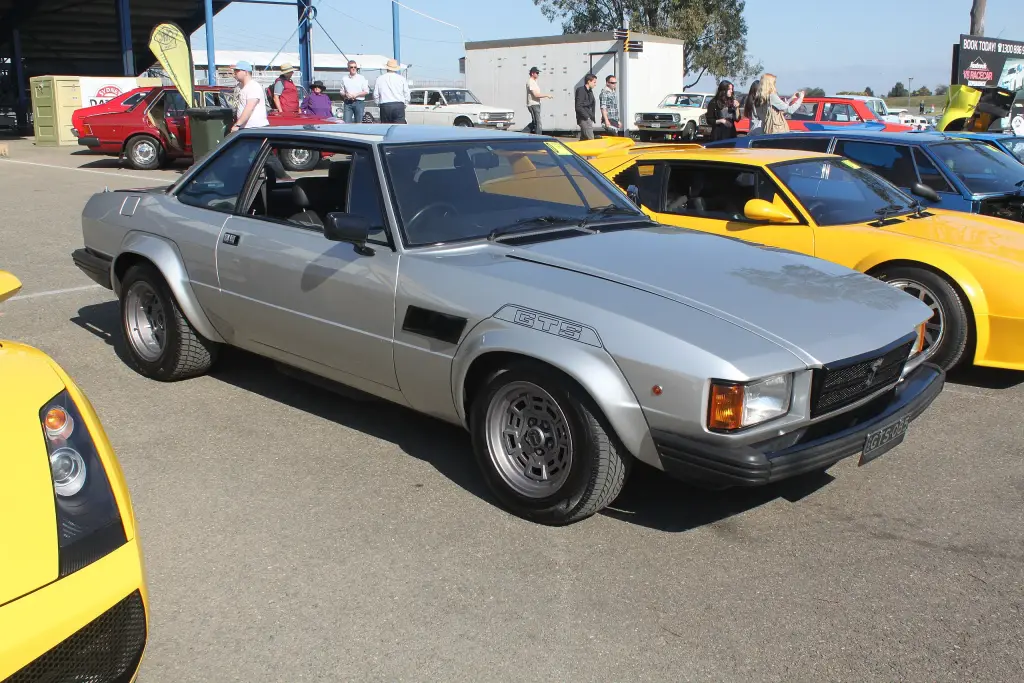
The Longchamp was derived from the Deauville four-door saloon, using a shorter wheelbase chassis with the same suspension, engine and transmission. The Deauville and the Longchamp were the only front-engined production cars De Tomaso ever built. The same platform also underpinned the Maserati Kyalami coupé and the Maserati Quattroporte III saloon, because De Tomaso owned Maserati at the time. The Longchamp was first shown at the 1972 Turin Motor Show, initially only as a two-door 2+2 coupé.
Tjaarda’s styling
Tom Tjaarda of Ghia designed the body, influenced by his earlier Lancia Marica prototype. The taillights were the same units used on the Alfa Romeo 1750 and 2000 saloons, while the headlights and front indicators came from the Ford Consul and Granada. The name probably refers to the Longchamp Racecourse in Paris or to Longchamps in Buenos Aires, near the birthplace of Alejandro de Tomaso. A long, wide bonnet made room for the American powertrain, the 351 cubic inch Ford Cleveland V8 rated at 335 PS (246 kW; 330 hp), the same engine as in the Pantera. It gave the car an official top speed of 240 km/h (149 mph). When Ford stopped building the 351 in the United States, De Tomaso bought the engines from Ford Australia.
Chassis and interior
The standard gearbox was a three-speed Ford C-6 Cruise-o-Matic automatic, although around 17 cars received a five-speed ZF manual. Suspension was independent front and rear with wishbones and coil springs, steering was power-assisted rack and pinion, and the car had ventilated disc brakes all round with the rear discs mounted inboard. The interior was almost fully upholstered in leather, though Ford-sourced parts such as the steering wheel and gear lever lowered the impression of luxury.
Series 2 and GTS
Series 1 production began in 1973. The modernised Series 2 arrived for the 1980 model year. A sporty GTS was introduced at the 1980 Turin Motor Show with wider wheels, flared wheel arches and revised suspension settings to use Campagnolo wheels with Pirelli P7 tyres. A Spyder cabriolet was introduced alongside it, built by Carrozzeria Pavesi of Milan, and Pavesi also converted a number of older coupés. With Australian engines tuned in Switzerland, power outputs of 270, 300 or 330 PS were available. The top-of-the-range GTS/E of the eighties had twin round headlights, extra spoilers, skirts and a rear wing. Bodyshells for the Longchamp and the Kyalami were built by Embo S.p.A. from 1979. Total production was 409 cars between 1972 and 1989, the vast majority to Series 1 specification, and the Longchamp was never officially sold in the United States.
Design and features
- Shortened Deauville chassis: the saloon’s suspension and V8 in a two-door body.
- Ghia styling: Tom Tjaarda’s shape with Alfa Romeo and Ford parts bin lights.
- Ford Cleveland V8: 335 PS and a 240 km/h top speed.
- Luxury cabin: almost fully leather-trimmed, with some Ford controls.
- GTS and Spyder: a flared-arch sports version and a Pavesi convertible.
De Tomaso Longchamp versions
- Series 1 (1973–1979): the original coupé, the majority of production.
- Series 2 (1980): modernised car with detail changes.
- GTS (1980): wider wheels, flared arches and revised suspension.
- Spyder: convertible conversion by Carrozzeria Pavesi, 14 built.
- GTS/E: eighties top version with twin round headlights and spoilers.
The Longchamp shared its chassis with the Deauville saloon and its engine with the Pantera. More De Tomasos are in the De Tomaso collection.
Video: De Tomaso Longchamp GTS being unloaded
Video on YouTube.
Sources
- De Tomaso Longchamp, English Wikipedia: history, design, engine, gearbox, Series 2, GTS, Spyder, production