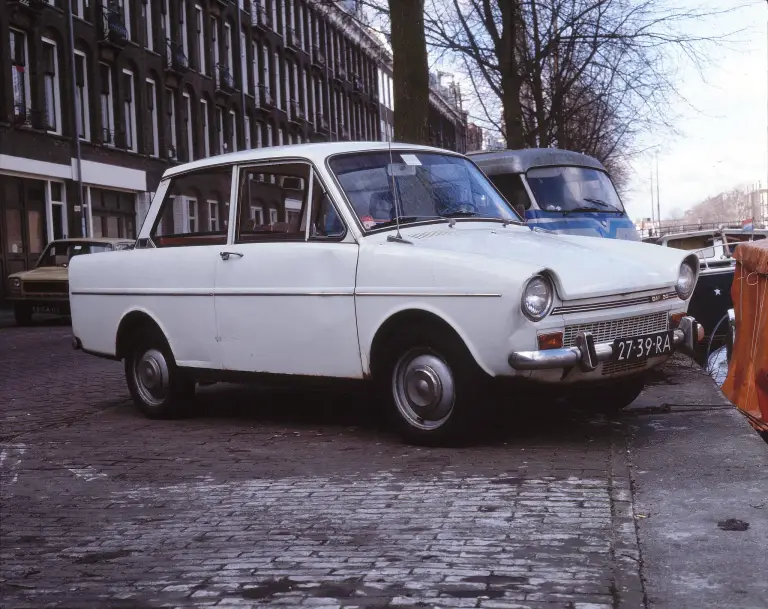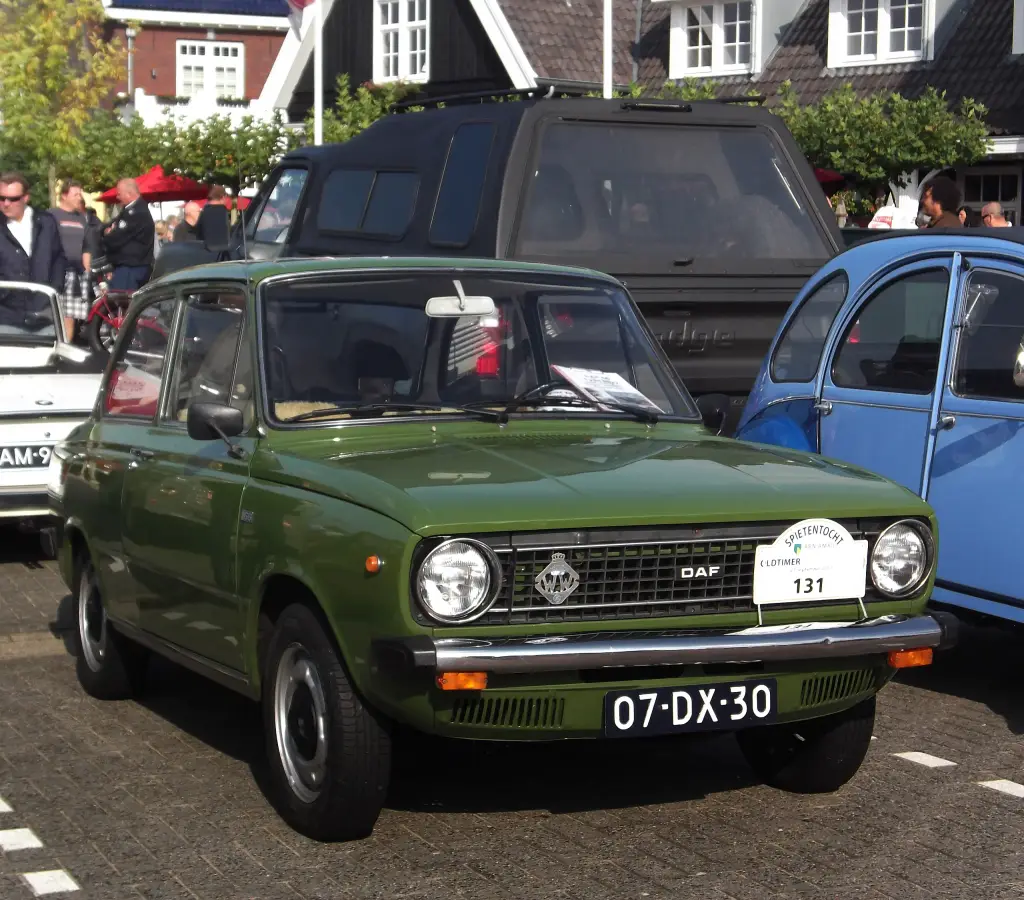
The DAF 66 was a small family car produced from September 1972 to 1976. It replaced the DAF 55 and was the last four-cylinder car to wear the DAF badge; after it the same design continued as the Volvo 66. Under the restyled body sat a thoroughly reworked rear end and a stronger Variomatic.
DAF 66 at a glance
| Maker | DAF, Born |
|---|---|
| Production | September 1972 – 1976 |
| Predecessor | DAF 55 |
| Successor | Volvo 66 |
| Engine | Renault C-series four, 1,108 cc |
| Power | 53 PS in normal models, 60 PS in the 1100 Marathon |
| 1300 Marathon | 1,289 cc, 57 PS, from 1973 |
| Transmission | Variomatic CVT with a differential |
| Rear axle | leaf-sprung De Dion tube |
| Body styles | 2-door saloon, 2-door coupé, 3-door estate, van |
| Top speed | about 135 km/h |
| Built | 146,297 |
History of the DAF 66
An evolution of the 55
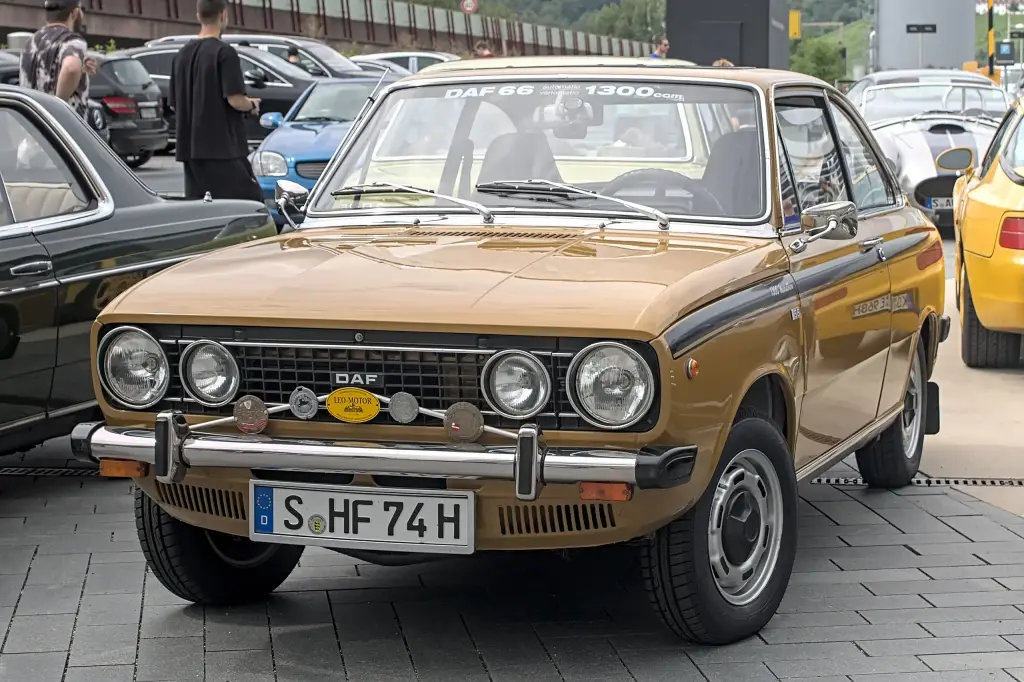
The 66 was an evolution of the 1967 DAF 55 rather than a clean-sheet design. The body was restyled with a full-width grille and a boxier front, and narrower rear lights, but the biggest changes were underneath. The rear suspension and the Variomatic were completely redesigned using what DAF had learned in Formula Three racing. The Variomatic became much more robust and now had a differential of its own for smoother manoeuvring at low speed, and the unpredictable swing axles of the 44 and 55 gave way to a leaf-sprung De Dion tube axle, which improved both handling and comfort. The Renault 1108 cc engines were reworked for lower emissions, giving 53 PS in the normal cars and 60 PS in the 1100 Marathon.
Three trim levels
The 66 was launched as a wide range: a two-door saloon, a three-door estate and a two-door 2+2 coupé, with a van added later. Buyers could choose between De Luxe, with drum brakes and vinyl seats, Super Luxe, with front discs and reclining cloth seats, and Marathon, with extra power and wider wheels. Each combination had its own factory type number, from 6622 for a De Luxe saloon to 6627 for a Marathon estate. Cheaper models had drum brakes all round, while the higher specifications kept the front discs of the 55.
The 1300 Marathon and the military car
In 1973 the original 1.1-litre Marathon was replaced by the 1300 Marathon, which used a 1,289 cc 57 PS version of the Renault C-series engine and could be recognised by foglights in the grille. It had a centre console with room for extra gauges and high-backed cloth sports seats, while the less torquey but more powerful 1108 cc Marathon engine stayed available as an option on every model. In 1974 the Dutch armed forces asked DAF to build a small personnel carrier: the YA 66 was an adaptation of the 1108 cc saloon with an open, Jeep-like body. Mechanically it was very similar to the civilian car, and it had little or no off-road ability because it had no four-wheel drive; 1,201 were built and all were sold off in the early 1990s. The 66 also appeared on television: a white saloon featured in the opening credits of the second series of the British detective series Van der Valk. Production ended in 1976 after 146,297 cars, and the design carried on as the Volvo 66 after Volvo took over DAF’s car business.
Design and features
- De Dion rear axle: a big step in handling over the swing axles of the 44 and 55.
- Improved Variomatic: stronger belts and a separate differential for low-speed work.
- Three trim levels: De Luxe, Super Luxe and Marathon, each with factory type numbers.
- 1300 Marathon: a 1,289 cc engine with 57 PS and foglights in the grille.
- YA 66: a military personnel carrier built on the same mechanicals.
DAF 66 versions
- Saloon: the standard two-door car.
- Coupé: a two-door 2+2.
- Estate: the three-door load carrier, with a van version.
- Marathon: 60 PS and wider wheels; replaced in 1973 by the 1300 Marathon.
- DAF YA 66: the military open-bodied version, 1,201 built.
The 66 replaced the DAF 55 and took over the rear axle idea from the DAF 46; its Variomatic story began with the DAF 600. More cars are in the DAF collection.
Sources
- DAF 66, English Wikipedia: chassis, trim levels, Marathon, YA 66
- DAF 66, Dutch Wikipedia: engines, top speed, body versions