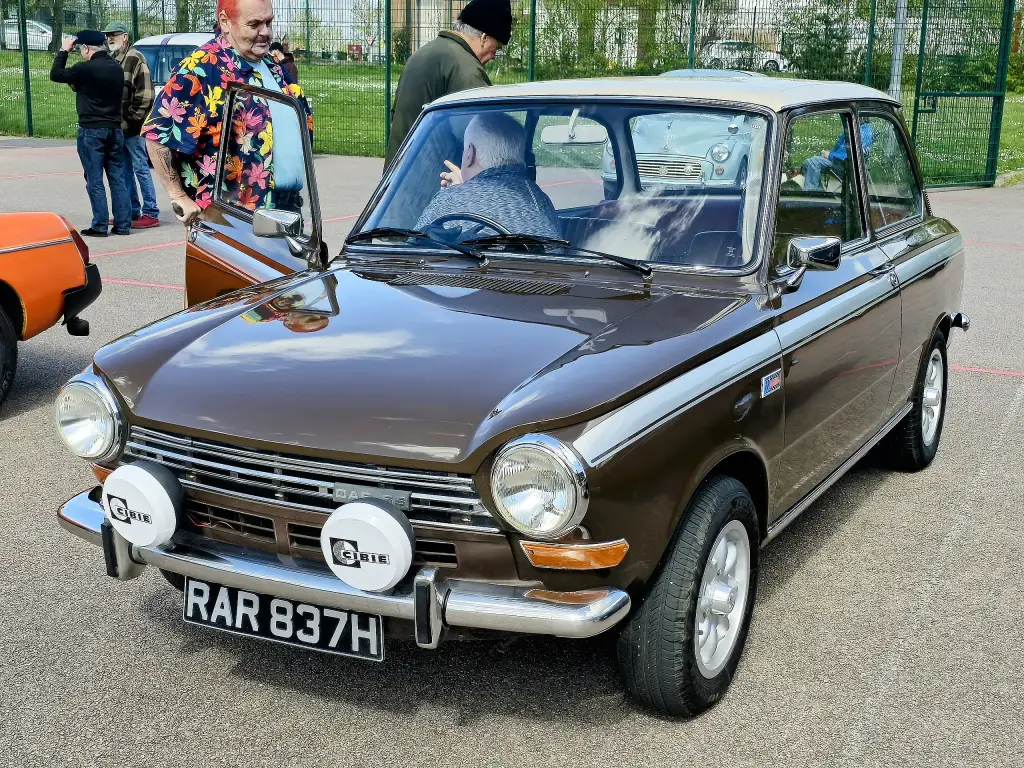
The DAF 55 was a small family car produced from December 1967 to September 1972, when the DAF 66 replaced it. It was the more powerful development of the DAF 44, and the first DAF to use an engine from another maker: a Renault-designed 1108 cc four.
DAF 55 at a glance
| Maker | DAF, Eindhoven |
|---|---|
| Production | December 1967 – September 1972 |
| Predecessor | DAF 44 |
| Successor | DAF 66 |
| Engine | Renault Cléon 1108 cc four, type B110 |
| Power | 50 bhp |
| Top speed | 136 km/h |
| Transmission | Variomatic CVT, no manual option |
| Front suspension | longitudinal torsion bars |
| Brakes | dual circuit, front discs |
| Body styles | 2-door saloon, 3-door estate, 2-door coupé |
| Built | 164,231 |
The DAF 55 name was used both for this passenger car and for a truck of the 45/55 range; this page is about the car.
History of the DAF 55
A Renault engine in a DAF
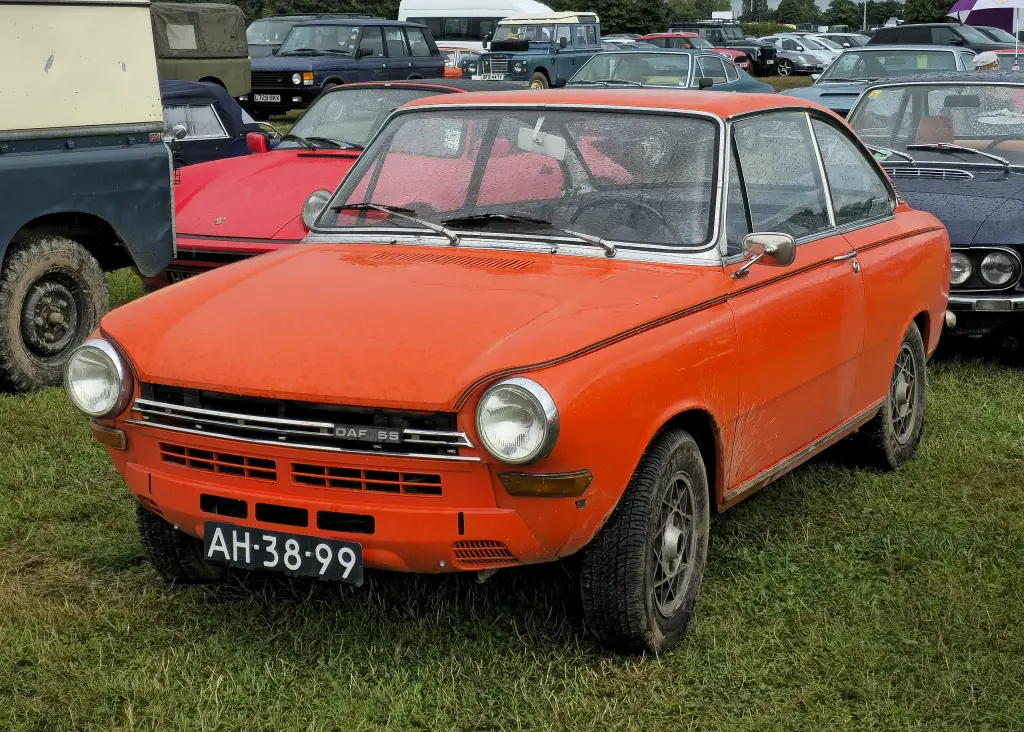
The 55 was developed as a more powerful version of the 1966 DAF 44, and the redesign was extensive. The two-cylinder DAF boxer had reached the end of its development, so DAF partnered with Renault and used a 50 bhp version of the 1108 cc water-cooled Cléon four, called the B110. The front suspension changed from the 44’s transverse leaf spring to longitudinally mounted torsion bars, while the rear kept the swing axles and the Variomatic. For safety DAF added a dual-circuit brake system and front disc brakes in place of the 44’s drums, and the front panel was reshaped to feed air to the radiator. The result was a top speed of 136 km/h.
Saloon, coupé and estate
The saloon was launched at the end of 1967 and the coupé followed three months later, in March 1968. The coupé was the more elegant car: a lower, gently sloping roof, pillarless doors, reclining seats, carpet instead of rubber mats and fake wood on the dashboard. It turned the four-seater into a 2+2, yet it was a great success — one in eight DAF 55s sold was a coupé. The estate arrived in September 1968. A minor facelift came in August 1969 together with a delivery version, essentially an estate without a rear seat. In 1971 the coupé received conventional doors with pillars, because the pillarless design had proved leaky and noisy at speed.
Marathon and motorsport
After a DAF 55 did well in the 1968 London–Sydney Marathon, dealers were offered a “Marathon” package with alloy wheels, interior parts, uprated suspension and parts to raise the B110 to 65 bhp. In 1971 the factory took over the idea with the 55 Marathon: a 63 bhp BR110 engine, 145 km/h, wider steel wheels, exterior stripes and a brake booster, sold as a saloon or a coupé. DAF used motorsport to show that the Variomatic was reliable as well as sporty: a 55 won the 1968 Alpine Rally, and Rob Slotemaker finished 17th out of 100 in the London–Sydney Marathon. Jan de Rooy later built his own four-wheel-drive 55 with a mid-mounted Ford BDA engine and a special Variomatic for rallycross. Because the transmission allowed maximum speed in reverse, the 55 also became a favourite of reverse-gear racing in the Netherlands. In total 164,231 cars were built.
Design and features
- Renault power: a 1108 cc Cléon four of 50 bhp in place of DAF’s flat-twin.
- Variomatic only: no manual gearbox was offered at all.
- Better brakes: dual circuit and front discs, where the 44 had drums.
- Coupé body: a lower roofline and a more luxurious interior.
- Marathon: a factory performance version with 63 bhp and 145 km/h.
DAF 55 versions
- Saloon: the standard two-door car, from late 1967.
- Coupé: from March 1968, pillarless until 1971.
- Estate: from September 1968.
- Delivery: an estate without a rear seat, from 1969.
- 55 Marathon: the 1971 factory version with the BR110 engine.
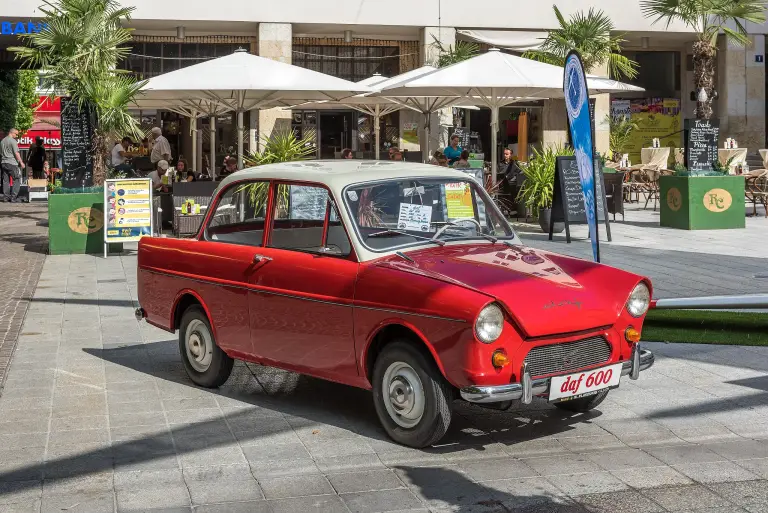
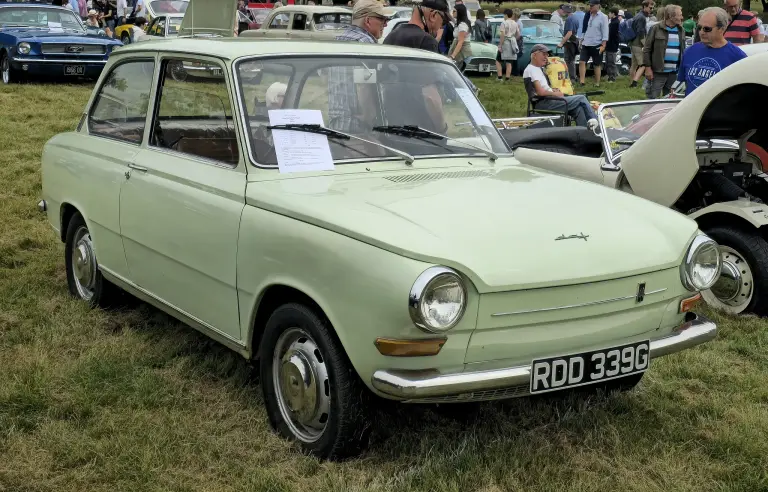
The 55 was developed from the DAF 44 and replaced by the DAF 66; the engine story starts with the DAF 600. More cars are in the DAF collection.
Sources
- DAF 55, English Wikipedia: engine, chassis, chronology, motorsport
- DAF 55, Dutch Wikipedia: the car and truck of the same name