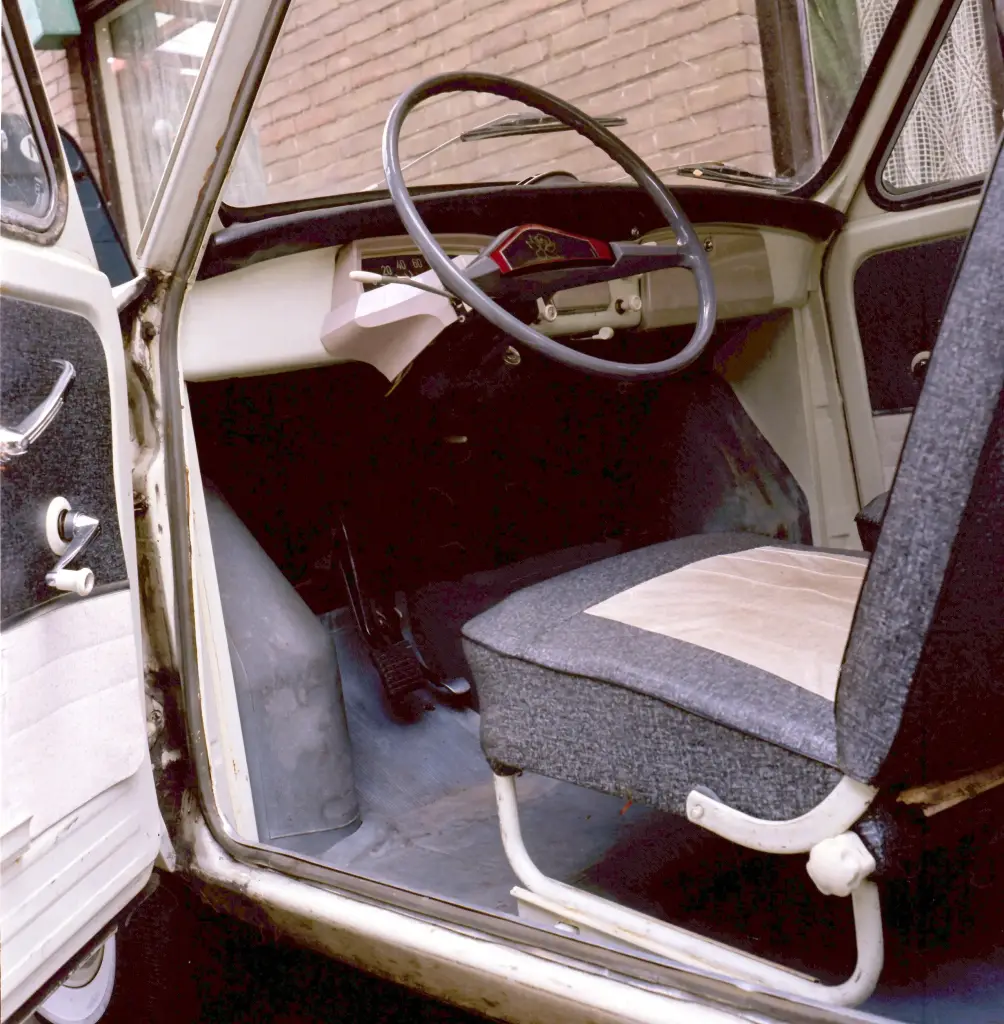
The DAF Daffodil was an economy small family car built from 1961 to 1967. It arrived together with the cheaper DAF 750 as a replacement for the DAF 600, and although it was designed as the export version, it was the Daffodil that survived while the 750 went out of production in 1963.
DAF Daffodil at a glance
| Maker | DAF, Eindhoven |
|---|---|
| Production | 1961–1967 |
| Introduced with | DAF 750 |
| Replaced | DAF 600 |
| Replaced by | DAF 33 |
| Engine | air-cooled flat-twin, 746 cc |
| Bore and stroke | 85.5 mm × 65 mm |
| Power | 30 bhp |
| Top speed | 105 km/h |
| 0–80 km/h | 29 seconds |
| Transmission | Variomatic, no manual option |
| German names | DAF 30, then 31 and 32 |
History of the DAF Daffodil
Export model, domestic success
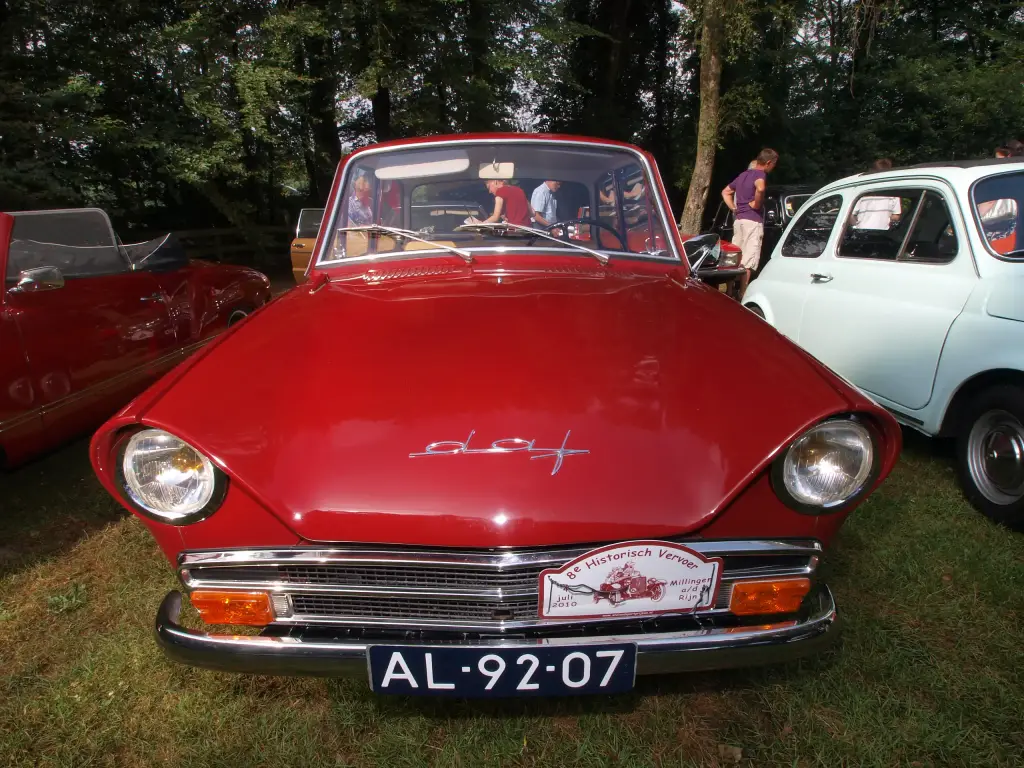
The Daffodil and the DAF 750 appeared in 1961 as replacements for the DAF 600. The 750 was in effect the same car with fewer luxuries and less chrome, while the Daffodil was conceived as a more luxurious export version aimed at markets such as the United States, which is why it carried so much brightwork. Buyers did not follow the plan: the 750 was dropped in 1963, while the Daffodil went through a series of mild facelifts and stayed in production until 1967, when the very similar but slightly more powerful DAF 33 replaced it.
The engine
The engine was DAF’s air-cooled four-stroke flat-twin of 746 cc. It kept the stroke of the 600 but the bore grew from 76 mm to 85.5 mm, and claimed output rose from 22 bhp to 30 bhp. The claimed top speed was 105 km/h, and the American Consumers Union measured 29 seconds from standstill to 80 km/h.
Variomatic, and how it worked
Like the 600, the 750 and the Daffodil came only with the Variomatic, with no conventional gearbox offered. Centrifugal weights moved two variable-diameter driving pulleys, helped by inlet manifold vacuum, and rubber V-belts took the drive to two similar driven pulleys held together by springs. Two separate transmissions under the rear seat drove the two rear wheels, one for each wheel, so no differential was needed: belt slip allowed the inner and outer wheels to turn at different speeds in a corner. The arrangement worked as a rear transaxle and gave a favourable weight distribution, and the duplication was a safety net, since the car could still be driven on one wheel if a belt broke. As with other early DAFs, reverse had the same maximum speed as forward motion until later cars locked the transmission in its lowest ratio when reverse was selected.
Names and updates
The name worked in some markets but not in Germany, where the more luxurious version of the 750 was sold as the DAF 30. The 1963 update, with Michelotti input that sharpened the angles and added more prominent fins, brought the name DAF 31, and the 1965 update the name DAF 32, with further changes to the body panels and a better interior. In the factory the cars carried type numbers 30, 31 and 32. The first Daffodil had a picture of the flower on the steering wheel, a rectangular speedometer and a wide grille; the 31 followed both the 750 and the old Daffodil and was sold as a saloon, pick-up, estate and van; the 32 arrived in 1965, with a slightly higher bonnet and boot lid. A special Daffodil S had an uprated engine and front disc brakes. The car also had a life outside the showroom: it appeared in the 1960s spy series The Baron, driven by Cordelia, and it gave its name to the Manchester band The New Fast Automatic Daffodils, after an advertisement that called it “The New, Fast Daffodil — fully Automatic”.
Design and features
- Chrome and comfort: the Daffodil was the well-equipped version of the 750.
- 746 cc flat-twin: 30 bhp and 105 km/h, with 29 seconds to 80 km/h.
- Two Variomatic belts: one transmission per rear wheel, so no differential was needed.
- Michelotti facelifts: the 1963 and 1965 updates sharpened the body.
- Daffodil S: an uprated engine and front disc brakes.
DAF Daffodil versions
- Daffodil (type 30): the 1961 car, with the flower on the steering wheel.
- DAF 31 (type 31): the 1963 update, in saloon, pick-up, estate and van form.
- DAF 32 (type 32): the 1965 update.
- Daffodil S: a sportier version with more power and front discs.
The Daffodil replaced the DAF 600 and was replaced by the DAF 33; the bigger DAF 44 came in 1966. More cars are in the DAF collection.
Sources
- DAF Daffodil, English Wikipedia: production, engine, Variomatic, names
- DAF Daffodil, Dutch Wikipedia: types 30, 31 and 32, Daffodil S, body versions