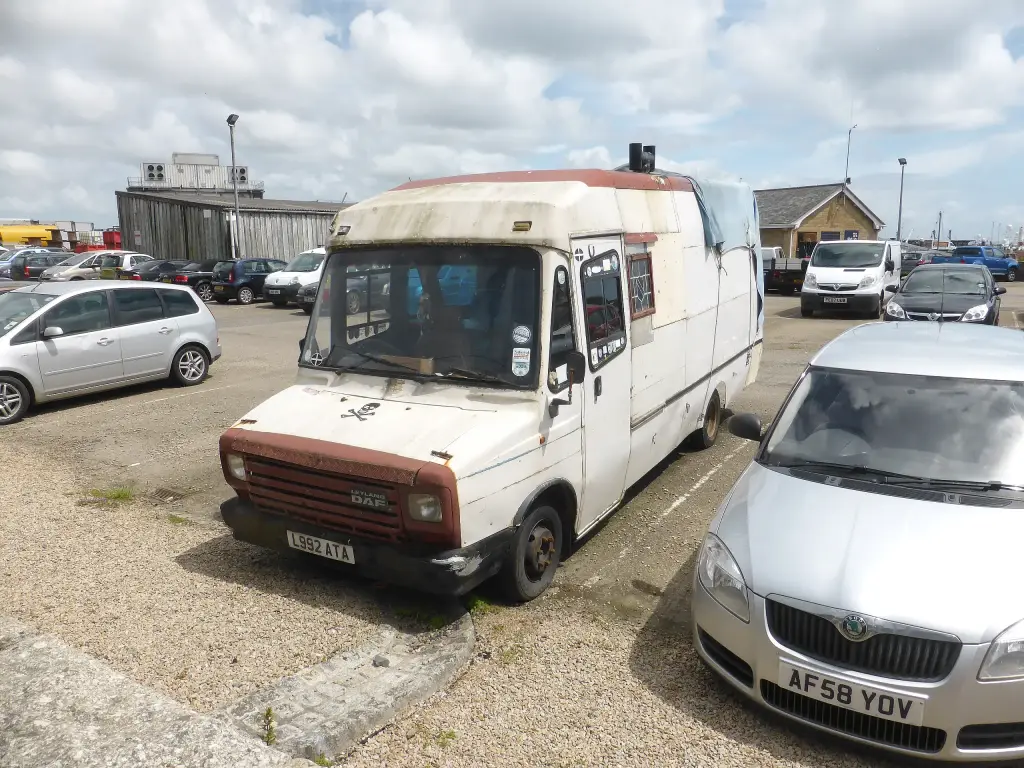
The DAF 200 and DAF 400 were two sizes of delivery van built by the Eindhoven truck maker between 1987 and 1995. Both came from the Leyland Sherpa family: the narrow Freight Rover 200 became the DAF 200, the wider Freight Rover 300 became the DAF 400. The 400 was voted Van of the Year in the Netherlands in 1992.
DAF 200/400 at a glance
| Maker | DAF, Eindhoven |
|---|---|
| Production | 1987–1995 |
| Origin | Leyland Sherpa, developed as the Freight Rover |
| DAF 200 | former Freight Rover 200, narrow body |
| DAF 400 | former Freight Rover 300, wider body |
| Engine | 2.5-litre Peugeot diesel |
| 400 EN | naturally aspirated, 55 kW |
| 400 ET | turbocharged, 70 kW |
| Grille | black on the standard 400, body colour on the turbo |
| Award | Van of the Year 1992 (DAF 400) |
| Successors | LDV Pilot and LDV Convoy |
Based on one source: the Dutch Wikipedia article on the DAF 200/400.
History of the DAF 200/400
From Freight Rover to DAF
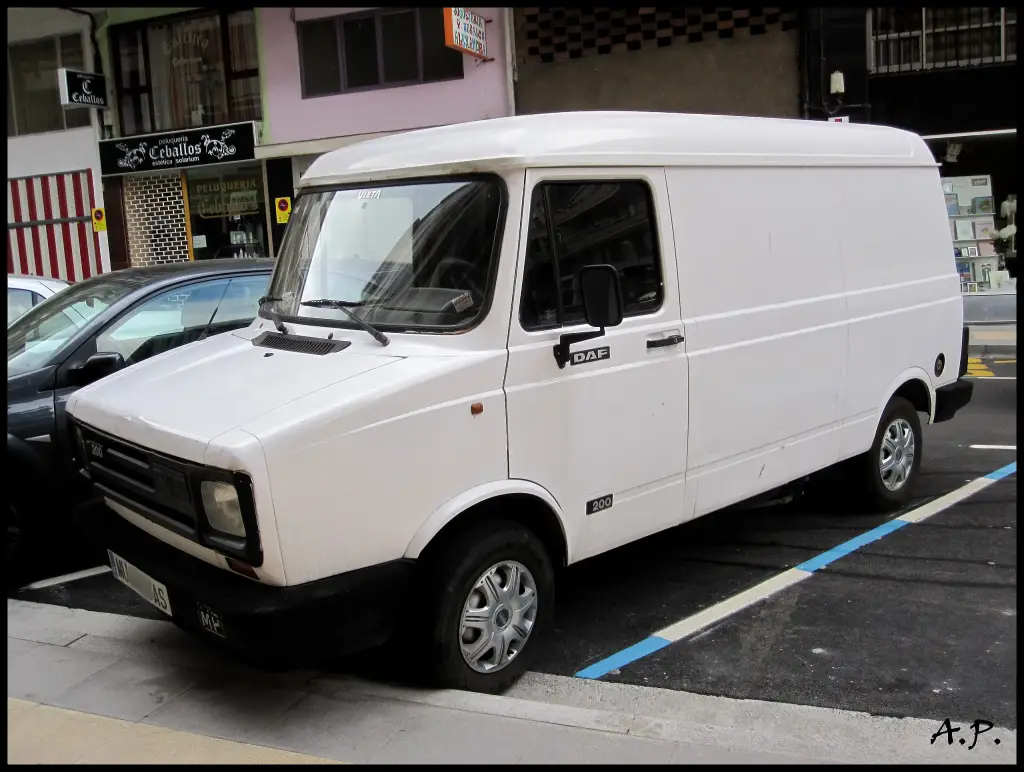
The vans were not designed in Eindhoven. They descended from the Leyland Sherpa, which was developed further as the Freight Rover after the Rover Group reorganised its light commercial business. When the Rover Group and DAF set up Leyland DAF together, Leyland Trucks and Freight Rover were placed inside the new company, and the vans took DAF badges for continental Europe. The Freight Rover 200 was sold from then on as the DAF 200, while the wider Freight Rover 300 became the DAF 400.
The 400 and its Peugeot diesel
The DAF 400 was the more capable of the two. It was offered with a 2.5-litre Peugeot diesel in two forms: the EN without a turbocharger, rated at 55 kW, and the ET with a turbocharger and 70 kW. The two were easy to tell apart from outside: the ordinary 400 had a black grille, while the grille of the turbocharged version was painted in the colour of the body. In 1992 the DAF 400 was chosen as Van of the Year in the Netherlands.
After DAF
DAF went bankrupt in 1993, and the van production was taken over by the management of LDV. LDV carried the two models on as the Pilot, which was the former 200, and the Convoy, which was the former 400, after a facelift in 1997. When the Pilot and Convoy were replaced by the LDV Maxus, the production equipment went to the Turkish maker BMC, which built the van on as the BMC Levend. LDV itself closed in 2009 in the recession, and the factory was bought by SAIC in China, which brought the Maxus back to the market in 2011 as the Maxus V80.
Design and features
- Two sizes, one family: the 200 was the narrow van, the 400 the wide one.
- Peugeot diesel: a 2.5-litre unit, naturally aspirated or turbocharged.
- Visual difference: a black grille marked the standard 400, a body-coloured grille the turbo.
- Award-winning: the 400 was Van of the Year in 1992.
DAF 200/400 versions
- DAF 200: the narrow van, formerly the Freight Rover 200.
- DAF 400: the wider van, formerly the Freight Rover 300, with the 55 kW EN diesel.
- DAF 400 turbo: the 70 kW ET diesel and a body-coloured grille.
- LDV Pilot and Convoy: the same vans built on by LDV after 1993.
The vans sat below the light trucks of the DAF 45/55 series in the range, and they share their period with the heavier DAF F218 trucks. More models are in the DAF collection.
Sources
- DAF 200/400, Dutch Wikipedia: origin, engines, award, later history