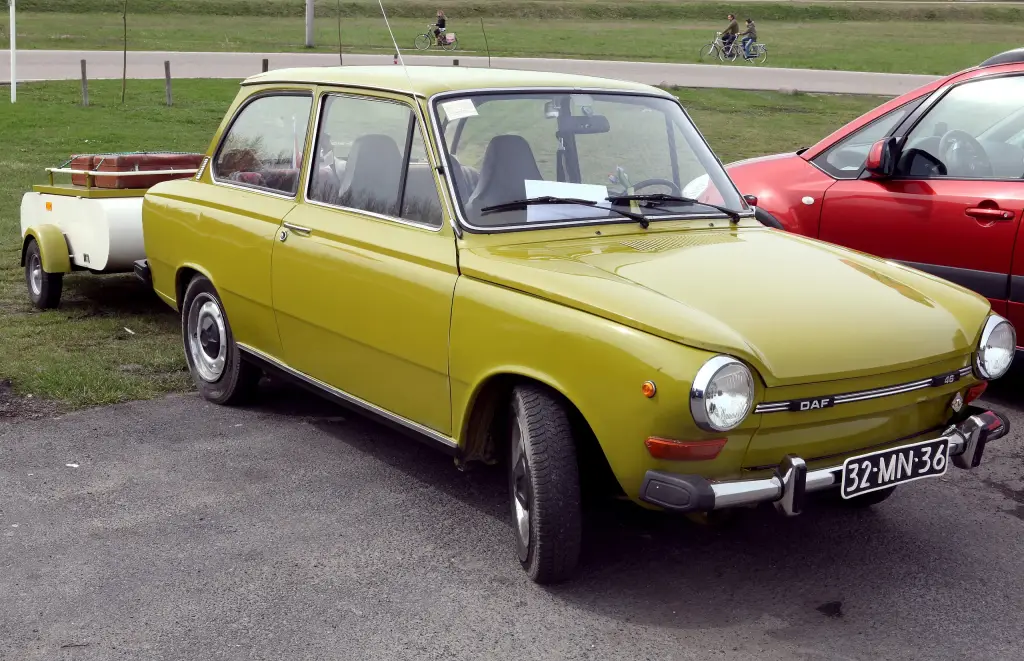
The DAF 46 was presented in November 1974 as the successor to the DAF 44, and it turned out to be the last passenger car sold under the DAF name. Under a body almost identical to the 44’s it hid DAF’s final development of the Variomatic: a single belt, a conventional differential and a De Dion rear axle.
DAF 46 at a glance
| Maker | DAF, Eindhoven |
|---|---|
| Production | 1974–1976 |
| Presented | November 1974 |
| Designer | Giovanni Michelotti (body from the 44) |
| Engine | air-cooled flat-twin, 844 cc |
| Power | 25 kW |
| Transmission | Variomatic with one belt and a differential |
| Rear axle | De Dion |
| Body styles | saloon, estate, van |
| Trims | Deluxe and Superluxe |
| Claimed top speed | 123 km/h, 117 km/h measured |
| Built | 32,353 |
History of the DAF 46
A 44 with a new name
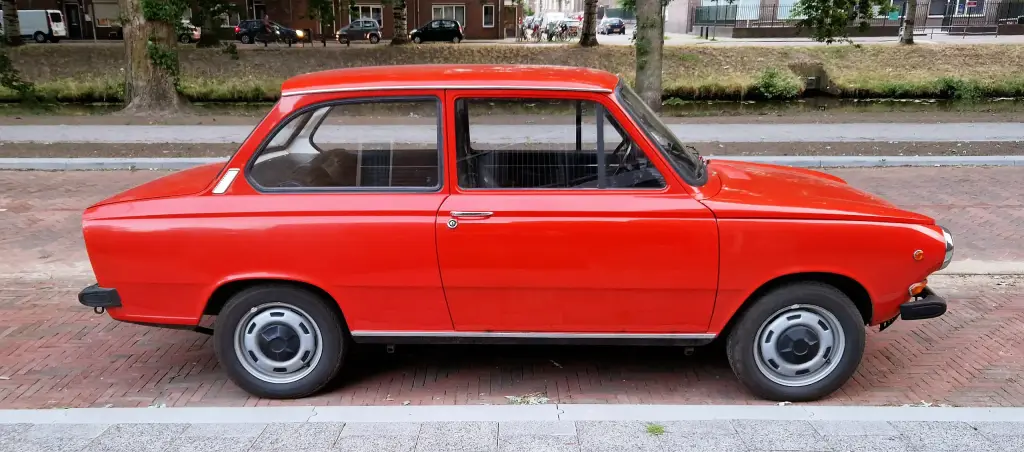
The 46 replaced the 44 in November 1974, although DAF announced that the two would be sold alongside one another, which suggests that large stocks of the older car were still waiting for customers. The body was the same Michelotti design as the 44, and the visible differences were small. The “DAF” and “46” badges stood apart on the chrome strips of the front, the door gained an extra window pillar, the wing indicators became round, and the new door mirrors had a nylon-covered ball joint.
A new Variomatic
The important changes were underneath. DAF had fitted a De Dion rear axle two years earlier to the DAF 66, and the 46 received the same layout together with a conventional differential. In earlier DAF cars the Variomatic itself did the work of the differential, which meant the belts twisted in tight corners; the new arrangement separated the two jobs, and DAF said it lowered noise and extended belt life. The 46 was also the only DAF built with a single-belt Variomatic instead of the usual two. The advantage of two belts was that a car could still be driven home if one broke, and DAF argued that the single belt wore less and that belt quality had improved.
Equipment and road tests
Inside, the 46 was carpeted throughout and had cloth-covered reclining seats, a redesigned gear lever marked D, N and R, and extra warning lights in the dashboard edge for the handbrake and the choke. The estate and saloon came in Deluxe and Superluxe forms: the Deluxe had skai-covered seats, a black dashboard and no glovebox lid, while the Superluxe had cloth trim, a wood-veneer dashboard and a lockable glovebox. The Dutch magazine Autovisie complained about engine noise, especially when accelerating, and could not reach the claimed 123 km/h — the best it measured was 117 km/h — but it praised the improved handling and found the car more economical than the factory claimed, at 15 km per litre. DAF was taken over by Volvo in January 1975, and most 46s were therefore built under Volvo ownership. Production ended in 1976 after 32,353 cars.
Design and features
- Single-belt Variomatic: the only DAF car built with one belt instead of two.
- De Dion rear axle: taken from the DAF 66 for better wheel location.
- Separate differential: less belt twist in corners and longer belt life.
- Better trim: carpet throughout and cloth reclining seats.
- Handling: road testers found it safer than the 44, though slower.
DAF 46 versions
- Saloon: the standard two-door car.
- Estate: the load-carrying version.
- Van: an estate without a rear seat.
- Deluxe: skai trim, black dashboard, no glovebox lid.
- Superluxe: cloth trim, wood veneer and a lockable glovebox.
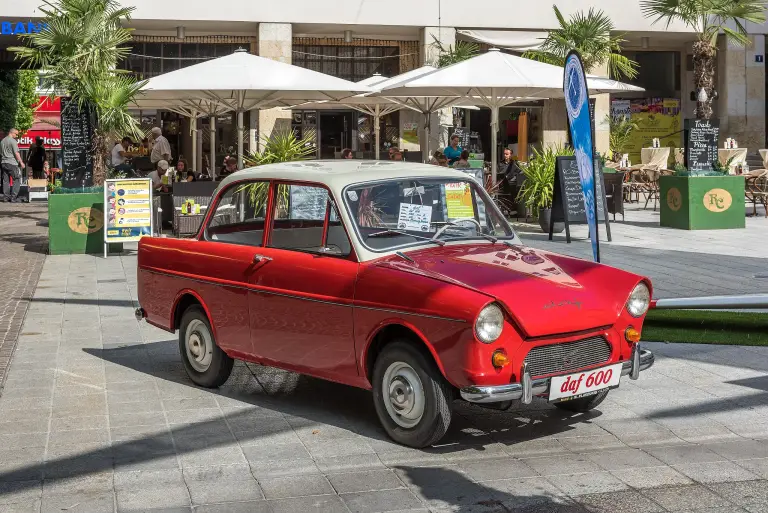
The 46 replaced the DAF 44 and used the rear axle of the DAF 66. Its Variomatic story began with the DAF 600. More cars are in the DAF collection.
Sources
- DAF 46, English Wikipedia: introduction, chassis, production total
- DAF 46, Dutch Wikipedia: trim, equipment, road test, Volvo takeover