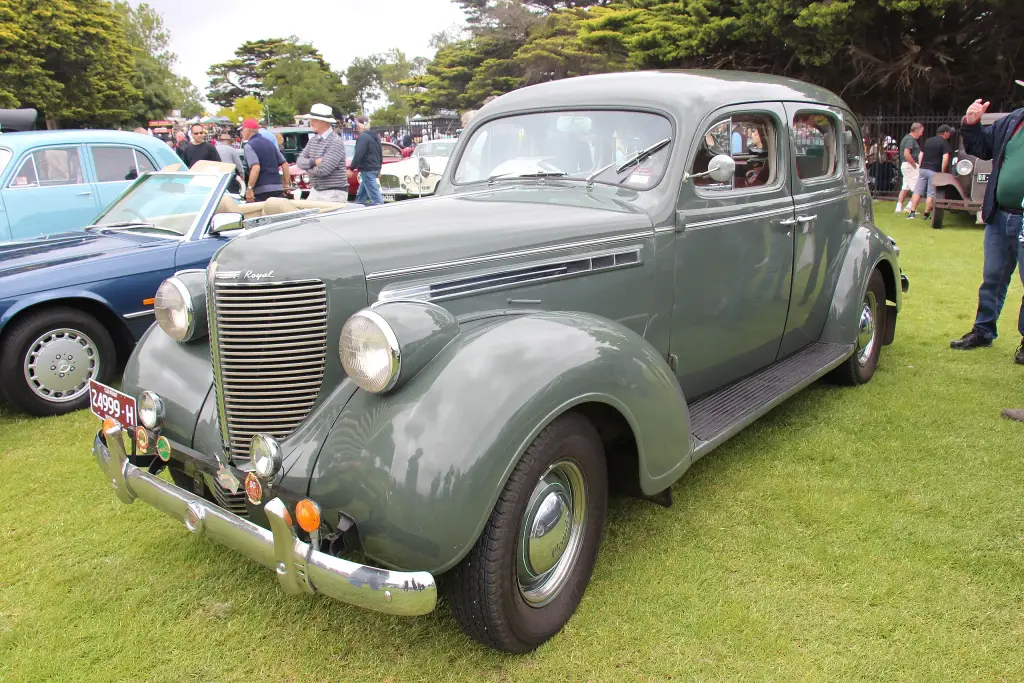
The Chrysler Royal was a full-size car sold from 1933 to 1934 and again from 1937 to 1950. First powered by Chrysler’s straight eight and later by its straight six, it was the most affordable car in the range yet still better equipped than a DeSoto Custom, Dodge Custom or Plymouth De Luxe, and it became the ancestor of the Windsor.
Chrysler Royal at a glance
| Production | 1933–1934 and 1937–1950 |
|---|---|
| Predecessor | Chrysler Six of 1924 |
| Engines | straight eight, then straight six |
| 1933 wheelbase | 120 in (3,048 mm); 128 in (3,251 mm) for the eight-passenger sedan |
| 1933 prices | US$895 to US$1,125 |
| 1937 prices | from US$715; four-door sedan US$815 |
| 1937 body styles | ten |
| 1939 change | Royal Windsor introduced as a trim package |
| 1941 change | Royal, Windsor and Highlander became separate models |
| Successor | Chrysler Windsor from 1951 |
History of the Chrysler Royal
The Chrysler Eight
For 1931 Chrysler introduced its first straight eight in the Imperial and offered it in the Chrysler Eight Series CD, which borrowed appearance influences from the Cord L-29. Its 240.33 cu in engine was smaller than the Imperial Series CG’s, and the 1932 Series CP followed with an upgraded 298.65 cu in unit, both on a 124-inch wheelbase. The Eight offered sweeping wings, rear-hinged doors, dual windscreen wipers, dual tail lamps and dual chrome trumpet horns, and shared its appearance with the 1931 Imperial Series CG. Buyers could choose from five two-door bodies seating two to five and three four-door bodies including a sedan convertible and two versions of the Royal Sedan in Standard and Special trim; prices ran from US$1,495 for the Sport Roadster to US$1,970 for the Dual Cowl Phaeton. A stripped Chrysler Eight Series CD Sport Roadster was entered with an Imperial roadster in the 1931 Le Mans but retired with radiator trouble.
The Royal of 1933
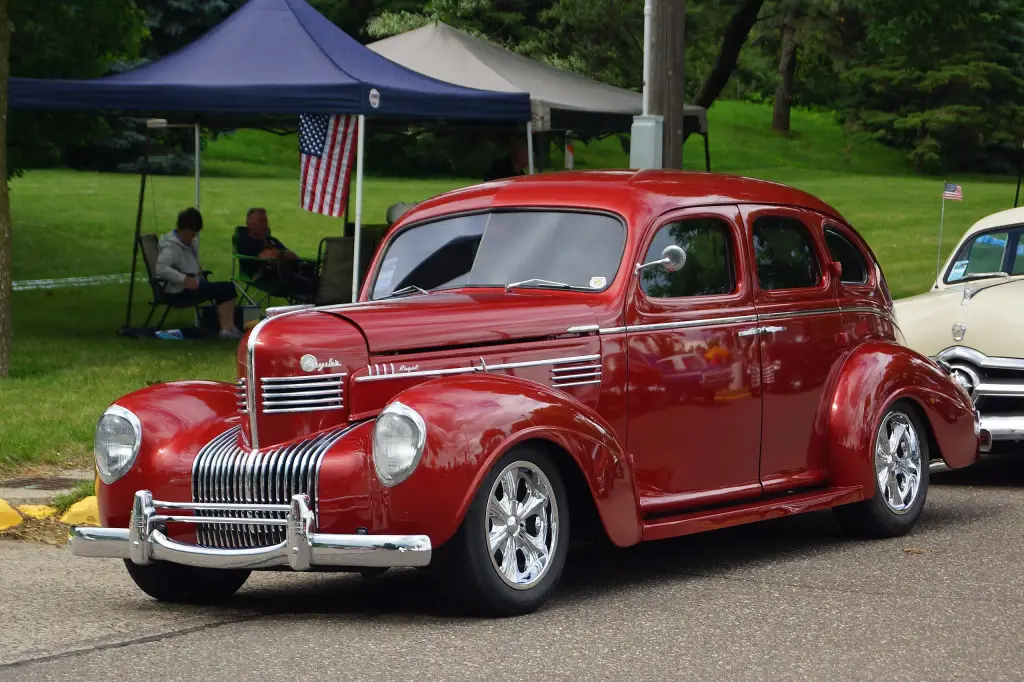
The Royal nameplate was added to the 1932 Chrysler Eight Series CP and appeared on its own in 1933 as the Chrysler Royal Series CT, having previously described a top trim package on sedans. It was originally fitted with the Chrysler straight eight and was only the second Chrysler whose name referred to nothing but itself, after the Imperial, with which it originally shared a shortened chassis. Bodies were a two-door Business Coupe, Roadster Coupe and Convertible Coupe, a two-door five-passenger Convertible Sedan and a four-door Sedan on a 120-inch wheelbase, while a 128-inch wheelbase served the eight-passenger sedan and was also available as a cowl and chassis for special coachwork, of which 95 are documented. Prices ran from US$895 for the business coupe to US$1,085 for the convertible sedan, with the long wheelbase at US$1,125, giving the appearance of the flagship Imperial at an affordable price.
Six cylinders and the end
The name was used for one year before the Airflow replaced the Royal in 1934, and was brought back in 1937 when the Airflow sold poorly; the Airflow continued alongside it with the straight eight. A November 1936 advertisement listed the 1937 Royal in ten body types from US$715, with the four-door sedan at US$815. The 1937 Series C-16 used the Chrysler straight six and took the entry-level position in the Chrysler hierarchy while sharing its body with the DeSoto Airstream. In 1939 the Series C-22 Royal introduced the “Royal Windsor” nameplate as a trim package, and in 1941 Royal, Windsor and Highlander became separate nameplates on the same wheelbase with only the straight six, the Windsor offering more standard features and a better interior. The Royal replaced the Chrysler Six that had started the company in 1925 and remained the six-cylinder entry model until it was dropped at the end of 1950, making the Windsor the entry-level Chrysler for 1951. Pre-war cars came on two wheelbases, with the seven-passenger sedan and limousine on the longer one. The name was later revived by Chrysler Australia in 1957, used as a Newport trim from 1970 to 1972 and applied to Dodge trucks into the early 1990s.
Design and features
- Straight eight, then straight six: the 1933 car had Chrysler’s eight, the 1937 car the six.
- Affordable luxury: Imperial looks at a much lower price, though above DeSoto, Dodge and Plymouth.
- Long wheelbase option: a 128-inch chassis for eight-passenger bodies and custom coachwork.
- Ancestor of the Windsor: the Royal Windsor of 1939 grew into a separate model in 1941.
- Body choice: ten body types in the 1937 range alone.
Chrysler Royal versions
- Chrysler Eight Series CD and CP: the straight-eight models the Royal grew out of.
- Royal Series CT (1933–1934): the first car to carry the name alone.
- Royal Series C-16 (1937): the straight-six entry model with ten body styles.
- Royal Series C-22 (1939): the car that introduced the Royal Windsor trim.
- Royal (1941–1950): the separate six-cylinder model, replaced by the Windsor.
The Royal was the ancestor of the Chrysler Windsor and sat below the New Yorker and Imperial; the first Chrysler of all is covered by the Chrysler Six. More cars are in the Chrysler collection.
Video: 1939 Chrysler Royal Business Coupe
Video by Jack R on YouTube.
Sources
- Chrysler Royal, English Wikipedia: Chrysler Eight, Royal models, prices, successors
- Chrysler Royal, Wikimedia Commons: photographs