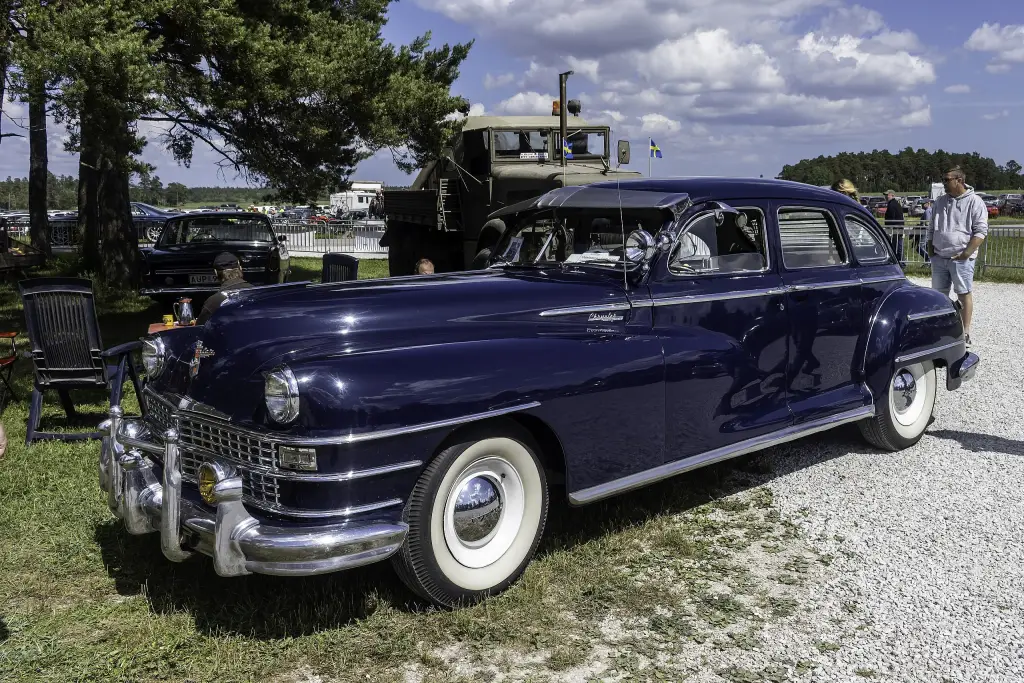
The Chrysler New Yorker was produced from 1940 until 1996 and, until its retirement, was the longest-running American car nameplate. For most of its life it was Chrysler’s most prestigious model, a flagship above the Windsor and Saratoga and a junior partner to the Imperial, and it ran through straight eights, Hemi V8s, the downsized 1980s and finally the front-wheel-drive LH platform.
Chrysler New Yorker at a glance
| Production | 1940–1996 |
|---|---|
| First appearance | 1938 New York Special, series C19 |
| Name adopted | 1939 |
| 1939 price range | US$1,223 to US$1,298 |
| Early engine | 298.7 cu in straight-eight |
| 1938 production (C36) | 12,145 cars |
| Post-war price | US$2,073 for the 1946 four-door sedan |
| Final generation | front-wheel-drive LH platform |
| Position | flagship, or junior to the Imperial |
| Retired | 1996 |
History of the Chrysler New Yorker
New York Special
The name began in 1938 as the New York Special, series C19, a distinct sub-series of the Chrysler Imperial offered as a four-door sedan with a 298.7 cu in straight-eight and generous space, plus a two-door Business Coupe of which no example is recorded as built. It had broadcloth upholstery unique to the model, two single-colour or four two-tone paint schemes and highly polished woodgrain instrument panels matched to the upholstery. For 1939 the range grew with two more coupes and a two-door sedan and took a larger, more powerful Imperial engine, and the car dropped “Special” to become the New Yorker; prices ran from US$1,223 for the two-passenger coupe to US$1,298 for the four-door sedan.
Before and after the war
The 1940 C26 was the first New Yorker considered a model in its own right rather than an Imperial version, and it introduced Fluid Drive, a fluid coupling between engine and clutch, with independent front coil suspension and a beam rear axle. The New Yorker Highlander brought tartan seats and trim. Bodies were lightly redesigned for 1941, with wider and lower shells, more glass and a Town Sedan whose rear doors were hinged at the front; a Vacamatic three-speed with overdrive called “Cruise and Climb” was offered. Production stopped at the start of February 1942, and 12,145 cars of the C36 series were built that year. When production resumed in 1946 the New Yorker became Chrysler’s top luxury trim while the Imperial Crown offered the same luxury on a 145-inch wheelbase; Chrysler changed little through 1948, keeping the die-cast “harmonica” grille and offering Fluid Drive with the Presto-Matic four-speed semi-automatic. The 1946 four-door sedan listed at US$2,073 and competed with the Cadillac Series 61, Buick Roadmaster and Packard Super Clipper.
Later generations
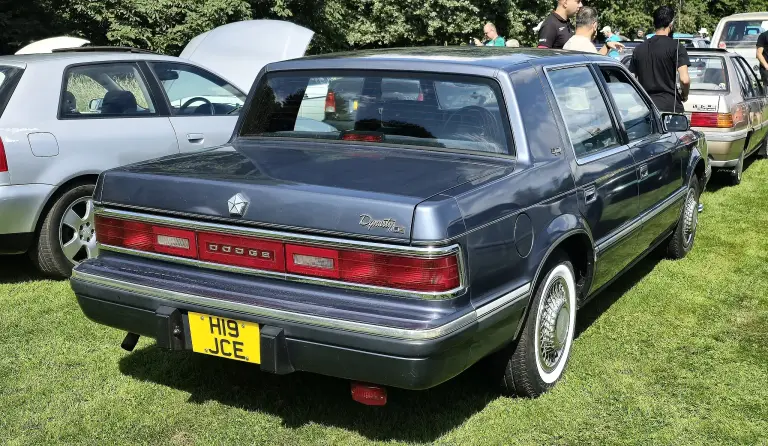
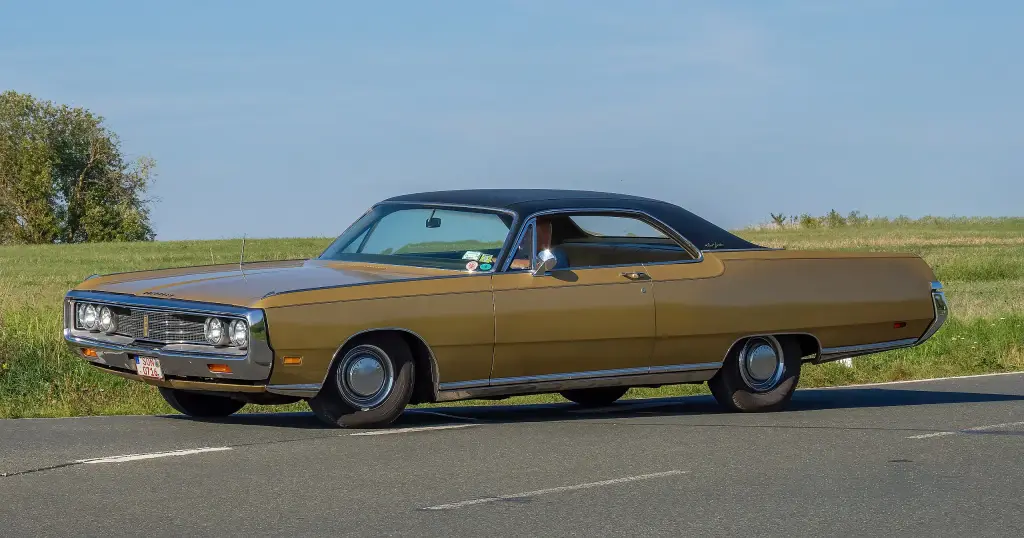
The New Yorker continued through the 1950s and 1960s as Chrysler’s prestige saloon, with Hemi V8 power and the 300 letter cars as its sporting relatives, and through the downsized 1970s and 1980s, when it shared its body with the Dodge Dynasty and gave its name to the Fifth Avenue package. In its final form it was a front-wheel-drive saloon on the LH platform, sharing its engineering with the Concorde and LHS, before the name was retired in 1996.
Design and features
- Longest-running nameplate: in production from 1940 to 1996, longer than any other American car name.
- Flagship status: Chrysler’s most prestigious model for most of its life, or junior only to the Imperial.
- Technical firsts for Chrysler: Fluid Drive in 1940 and the Presto-Matic semi-automatic after the war.
- Many body styles: sedan, coupe, convertible and station wagon over the decades.
- Final LH generation: front-wheel drive and cab-forward styling at the end of the run.
Chrysler New Yorker versions
- New York Special (1938–1939): the Imperial sub-series that started the line.
- C26 (1940): the first stand-alone New Yorker, with Fluid Drive.
- New Yorker Highlander: tartan-trimmed special edition.
- New Yorker Fifth Avenue: the luxury package of 1979–1981.
- LH-platform New Yorker (1990s): the final front-wheel-drive generation.
The New Yorker was the stablemate of the Windsor and Saratoga and sat below the Imperial; in the 1990s it shared its platform with the LHS and Concorde. More cars are in the Chrysler collection.
Video: Chrysler New Yorker 1995 3.5 V6
Video by CROWNVIC1 on YouTube.
Sources
- Chrysler New Yorker, English Wikipedia: origins, early models, post-war range
- Chrysler New Yorker, Wikimedia Commons: photographs