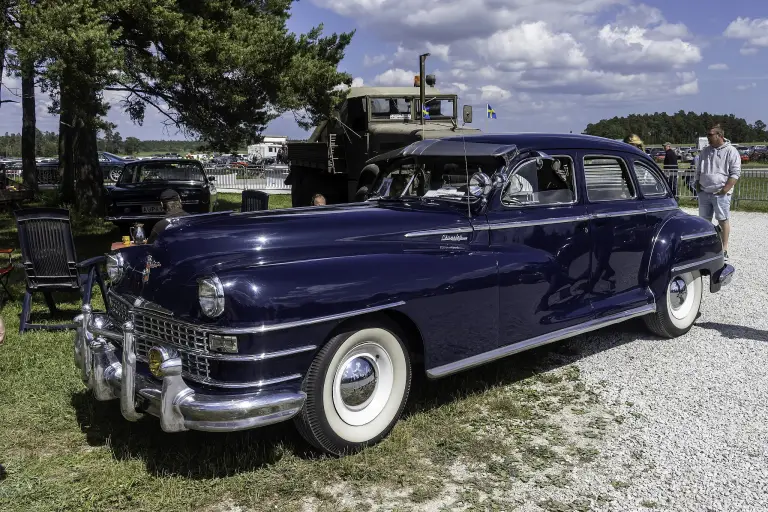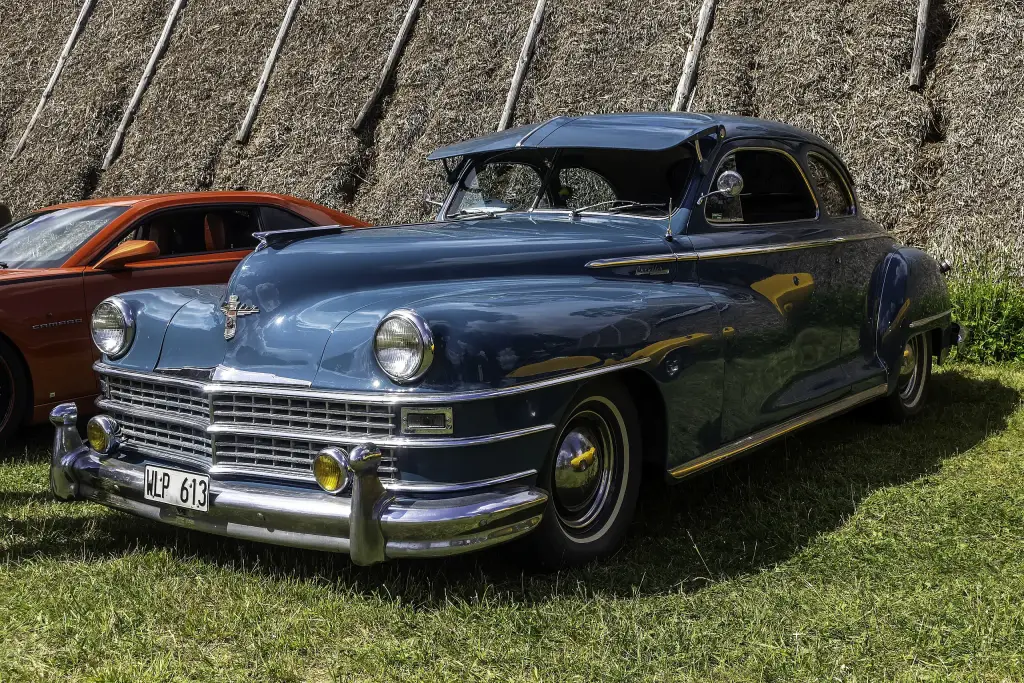
The Chrysler Windsor was a full-size car built from 1939 until 1961 in the United States and until 1966 in Canada. Almost identical to the more luxurious New Yorker in size, interior and equipment, it used Chrysler’s straight six instead of the eight, offering the same presence with a more modest and economical engine.
Chrysler Windsor at a glance
| Production | 1939–1961 in the US; to 1966 in Canada |
|---|---|
| First model | Series C-22 Royal Windsor, 1939 |
| Engine | Chrysler straight six |
| 1939 prices | US$1,175 sedan, US$1,185 Club Coupe |
| 1946 price | US$1,711 for the six-passenger sedan |
| 1946 share of sales | 62.9% of the company’s output |
| Wheelbases | short and long, shared with the Royal |
| Canadian 1961–1966 car | equivalent of the US Chrysler Newport |
| v8 from 1955 | Poly V8 introduced |
| Replaced by | the non-lettered Chrysler 300 in 1962 |
History of the Chrysler Windsor
Royal Windsor
The Series C-22 Windsor appeared in 1939 as the senior model to the Series C-22 Chrysler Royal and was called the Royal Windsor, with only the Chrysler straight six available. It shared the Royal’s short and long wheelbases, offered more standard equipment than the Royal, and sat below the C-23 New Yorker, Saratoga and Imperial, which came with the straight eight. Three two-door coupes were offered, the Business Coupe, Victoria Coupe and Club Coupe, plus a four-door sedan for five passengers; cars with rear quarter windows had them operating like vent windows. The Club Coupe listed at US$1,185 and the sedan at US$1,175, and 394 cowl-and-chassis units were produced for custom coachwork.
1940 to 1948
For 1940 the C-25 range was renamed Royal, Royal Windsor and Windsor Highlander, the last with moleskine leather and Scottish tartan interior, while the Royal and Royal Windsor came on long or short wheelbases as six-passenger sedans and coupes, a convertible, a two-door Victoria sedan and eight-passenger sedan and limousine. Sealed-beam headlamps arrived that year, along with a wider, simplified grille shared with all Chryslers, independent front suspension, 11-inch brakes and an “X girder” truss chassis. In 1941 the Windsor name became separate from the Royal and the Chrysler Windsor Town & Country station wagon appeared, designed by Chrysler president David A. Wallace; fog lights and bumper crash bars were optional. Production stopped in January 1942 for war work. After the war the Windsor returned with new front wings and grille but pre-war mechanicals under the skin, offering New Yorker appearance and interior refinement with the six-cylinder engine for buyers who wanted better fuel economy: it made up 62.9 per cent of the company’s sales, with the six-passenger sedan listed at US$1,711. For 1947 the Presto-Matic semi-automatic was offered alongside the three-speed manual, the Town & Country became a model line of its own, and a handbrake warning signal and new die-cast grille arrived; the Windsor Traveler came with a full-length roof rack as standard, the tank held 17 US gallons and instrumentation was complete.
1949 to 1966
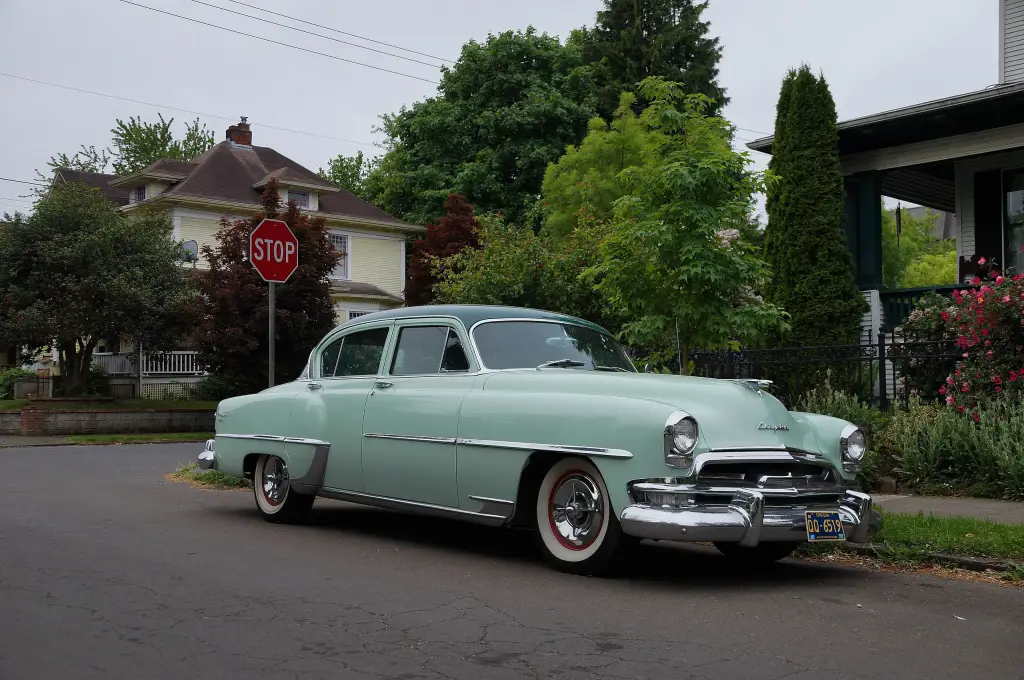
For Chrysler’s 25th anniversary in 1949 the Windsor was updated and shared a corporate look with the new Imperial sedan, gaining a padded dashboard with sponge rubber; it still used the six shared with DeSoto, Dodge and Plymouth. Highlander-trimmed cars with tartan fabric and leather continued from 1949 to 1952 on all bodies except the station wagon, with most options including full wheel covers and a radio fitted as standard, and the Traveler sedan with its roof rack continued into 1950. In 1951 the Windsor became Chrysler’s six-cylinder mainstay after the Royal was dropped, and in 1955 a Poly V8 was introduced. For 1961 the Newport took the market position the Royal had held, leaving the Windsor one level above it, and the last American Windsor was built in 1961. Canadian production continued to 1966, where the 1961–1966 Windsor was effectively the equivalent of the American Newport. Chrysler replaced the name in 1962 with the non-lettered 300 series.
Design and features
- Six-cylinder luxury: New Yorker size and trim with Chrysler’s economical straight six.
- Highlander trim: moleskine leather and Scottish tartan upholstery.
- Two wheelbases: short and long chassis shared with the Royal, up to eight-passenger bodies.
- Sales leader: 62.9 per cent of Chrysler’s output in 1946.
- Long Canadian life: built in Canada until 1966 as the equivalent of the US Newport.
Chrysler Windsor versions
- Royal Windsor (1939): the original senior model to the Royal.
- Windsor Highlander (1940 onwards): tartan and leather trim with most options standard.
- Windsor Traveler: a sedan with a full-length roof rack as standard.
- Windsor Town & Country (1941): the station wagon version.
- Post-1955 Windsor: the car with the new Poly V8 option.
The Windsor was the six-cylinder stablemate of the New Yorker and the successor to the Chrysler Royal, and it was replaced by the Chrysler 300 series. More cars are in the Chrysler collection.
Video: 1948 Chrysler Windsor convertible
Video by petersmotorcars on YouTube.
Sources
- Chrysler Windsor, English Wikipedia: models, prices, equipment, production
- Chrysler Windsor, Wikimedia Commons: photographs