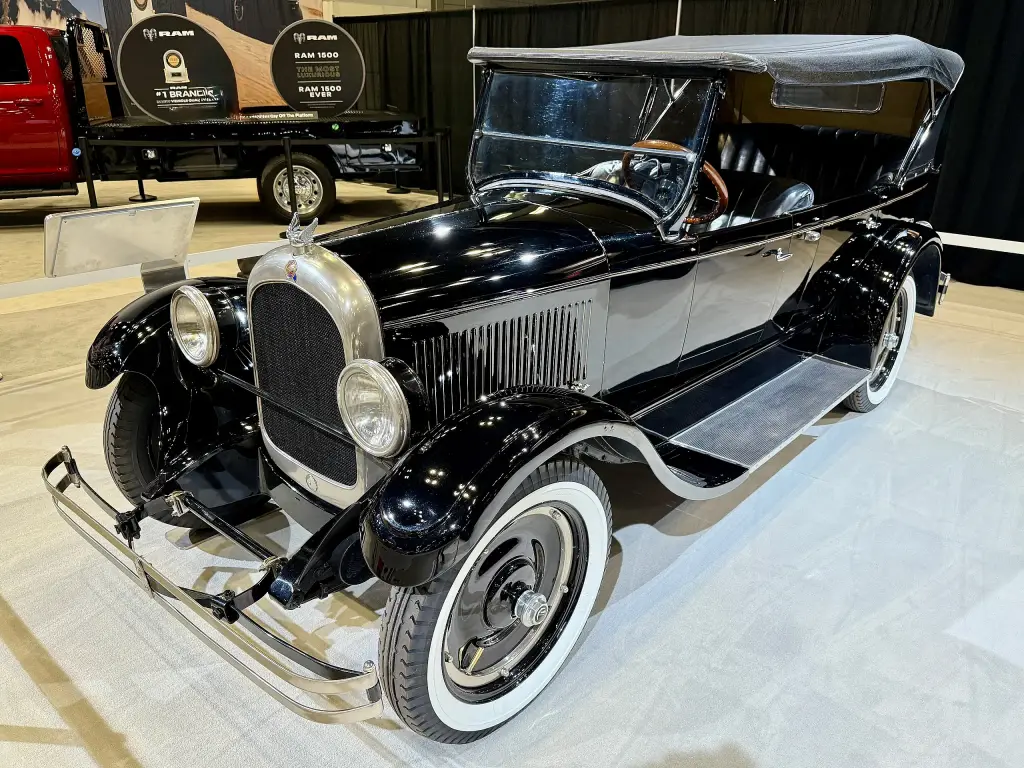
The Chrysler Six was the first car sold under the Chrysler name. Launched in January 1924 as the Model B-70, it used a technically advanced six-cylinder engine, four-wheel hydraulic brakes and a top speed of about 70 mph, and its success — 32,000 cars by the end of 1924 — turned a struggling company into a major manufacturer.
Chrysler Six at a glance
| First model | B-70, launched January 1924 |
|---|---|
| Designers | Fred Zeder, Owen Skelton and Carl Breer |
| Originally intended as | the Willys Six |
| Bodies in first year | nine, from Fisher Body |
| Brakes | four-wheel hydraulic drum |
| Top speed | 70–75 mph (113–121 km/h) |
| Prices | US$1,595 roadster to US$3,725 town car |
| 1924 sales | 32,000 cars |
| G-70 (1926) | 72,039 of 108,600 Chryslers built |
| G-70 engine | 218.6 cu in (3.6 L) six |
| Racing | Le Mans 1925, 1928 and 1929 |
History of the Chrysler Six
The Three Musketeers
Development of the B-70 began as early as 1919 for the Willys Corporation, a holding company owned by John Willys, and the car was originally intended to be launched as the Willys Six. Three former Studebaker engineers — Fred Zeder, Owen Skelton and Carl Breer, known as “The Three Musketeers” — were responsible for the design. When Willys went bankrupt in 1919, William C. Durant outbid Walter Chrysler for its modern factory in Elizabeth, New Jersey, which had built Duesenbergs and held prototypes of the Willys Six; Chrysler had wanted only the car. Durant’s purchase led to the Flint Six, while Zeder, Skelton and Breer, unhappy with the new plan, moved to Chalmers, where Chrysler brought them and where development resumed in mid-1923. In January 1924 the finished car was presented as the Chrysler Six Model B-70 at the Commodore Hotel during the New York Auto Show.
The B-70
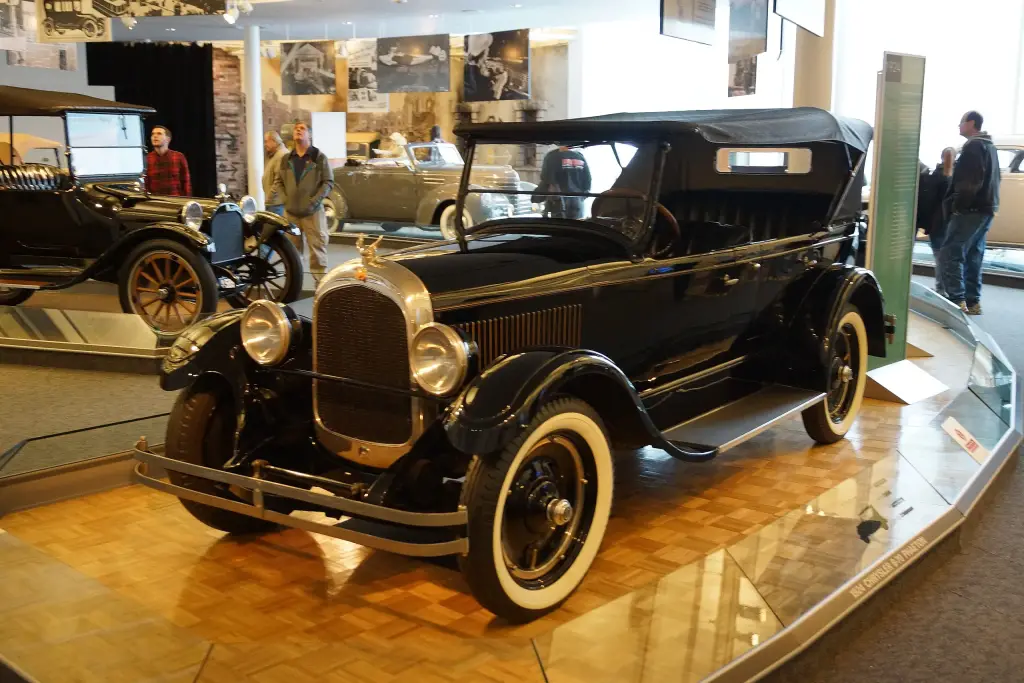
The B-70 was Chrysler’s first model and replaced the cars of Maxwell, whose brand Walter Chrysler had bought in 1921. Nine bodies from Fisher Body were offered in the first year; open cars had horizontally split windscreens inspired by the Brewster design, 30-inch wheels with five lug nuts and hydraulic four-wheel drum brakes. The success was sensational: 32,000 cars had been sold by the end of 1924, a record for the launch of a new model, and production of Chalmers stopped with the arrival of the B-70. The entry-level Roadster with rumble seat cost US$1,595 and the Town Car US$3,725. Chrysler included as standard several items and technologies that rivals charged extra for, while pricing the car in the medium-price field. High-performance versions reached 70 to 75 mph, only about 5 mph short of the Packard Eight; Ralph DePalma won the Mt. Wilson hill climb in a stripped touring car, covering 1,000 miles in 786 minutes on 5 January 1925, a stripped roadster finished the 1925 Le Mans and Sir Malcolm Campbell set a 100 mph lap at Brooklands in a streamlined roadster.
G-70 and the series cars
Maxwell became the Chrysler Corporation the following year. The cars continued almost unchanged apart from a one-piece hinged windscreen on open models, and from mid-1925 Chrysler built its own bodies after buying the Kercheval Body Factory in Detroit, which became the Jefferson Avenue plant. The radiator cap carried a stylised Viking winged helmet. In 1926 the B-70 was replaced by the Model G-70, of which 72,039 were built out of 108,600 Chryslers that year. The G-70 was an appearance upgrade with minor changes to door openings and headlamp design, and offered several two- and four-door bodies including the Touring four-door five-passenger at US$1,395; the only engine was the 218.6 cu in six. A Royal Coupe and Crown Sedan trim package appeared for the first time and later became model names, and the G-70 was joined by the luxury Series E-80, renamed Imperial for 1927. In 1927 the Series 60 became the shorter-wheelbase version of the G-70 while the Series 70 kept the longer chassis, and with sales success Chrysler bought Dodge in 1928, rebranded its entry-level Series 50 as Plymouth and introduced DeSoto in 1929.
Design and features
- Advanced six: a high-compression engine giving 70–75 mph in a medium-priced car.
- Hydraulic four-wheel brakes: standard at a time when many rivals still used mechanical brakes.
- Equipment included: many items that competitors charged extra for came as standard.
- Racing record: Le Mans in 1925, 1928 and 1929, a Brooklands lap record and a hill-climb win.
- Commercial success: 32,000 cars in the first year, a record for a new model.
Chrysler Six versions
- B-70 (1924–1925): the first Chrysler, with nine Fisher bodies.
- G-70 (1926): an appearance upgrade with the 218.6 cu in six.
- Series 60 and 70 (1927): short and long wheelbase versions of the G-70.
- Series 50 (1927–1928): the entry-level Chrysler that was rebranded Plymouth in 1928.
The Six was the ancestor of the Chrysler Royal and Imperial, and its streamlined successor is covered by the Chrysler Airflow. More cars are in the Chrysler collection.
Video: 1924 Chrysler B-70 Phaeton
Video by Stellantis North America on YouTube.
Sources
- Chrysler Six, English Wikipedia: origins, B-70, G-70, series cars
- Chrysler Six, Wikimedia Commons: photographs