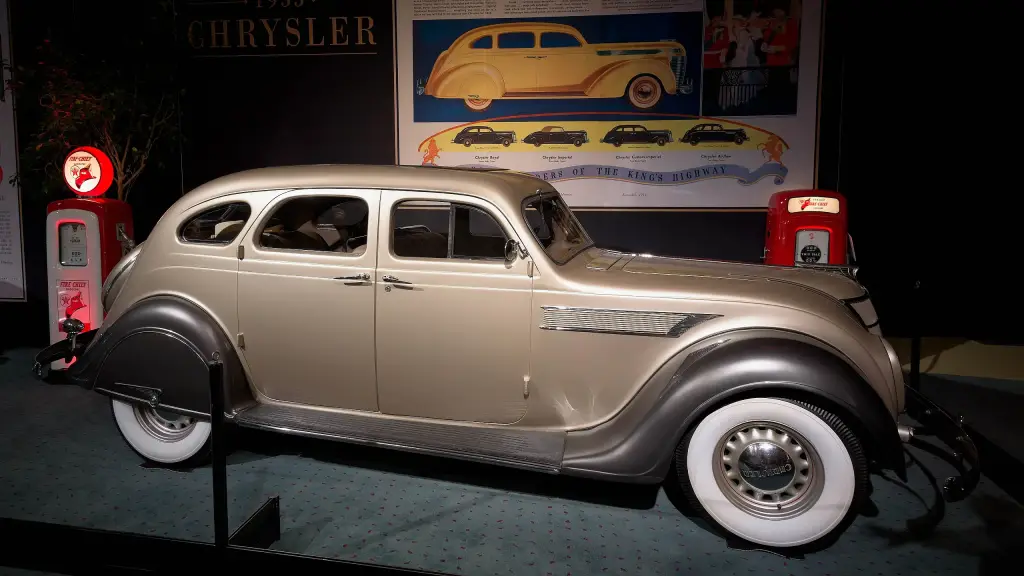
The Chrysler Airflow, built from 1934 to 1937, was the first full-size American production car to be shaped by aerodynamics rather than fashion. Chrysler moved the engine forward, seated passengers inside the wheelbase and welded a steel body to a unitary structure, producing a car far ahead of its rivals — and a commercial failure because buyers did not like the way it looked.
Chrysler Airflow at a glance
| Production | 1934–1937 |
|---|---|
| Body | unitary steel, no separate chassis |
| Design work | wind-tunnel testing from 1930 |
| Weight distribution | about 54% over the front wheels |
| Engine position | moved forward over the front axle |
| Powerplant | flathead straight-eight |
| Bodies | two-door coupe and four-door sedan |
| Price | US$1,345 |
| Peak monthly output | 6,212 cars in May 1934 |
| Sister model | DeSoto Airflow |
| Name revived | 2022, for an electric crossover concept |
History of the Chrysler Airflow
From the wind tunnel
Carl Breer and his fellow Chrysler engineers Fred Zeder and Owen Skelton began a series of wind-tunnel tests, with the cooperation of Orville Wright, to find the shapes nature handles most efficiently. Chrysler built a wind tunnel at Highland Park and had tested at least fifty scale models by April 1930. The engineers found the two-box cars of the day so inefficient that they were more aerodynamic when tested as if driven backwards. They also began looking at unitary construction to gain rigidity with less weight than a separate frame and body, and demonstrated the strength of the body in a publicity film.
Engineering
Traditional cars carried about 65% of their weight over the rear wheels, rising to 75% or more when loaded, which made them unstable on slippery roads and forced stiff rear springs. In the Airflow the engine was moved forward over the front wheels and all passengers were moved forward so that those in the rear sat inside the wheelbase rather than on top of the axle. The result was about 54% of the weight over the front wheels, evening out to nearly 50:50 with passengers, with more equal spring rates, better handling and a far better ride. Chrysler did not build another unitary vehicle until the 1960 Forward Look.
Debut and failure
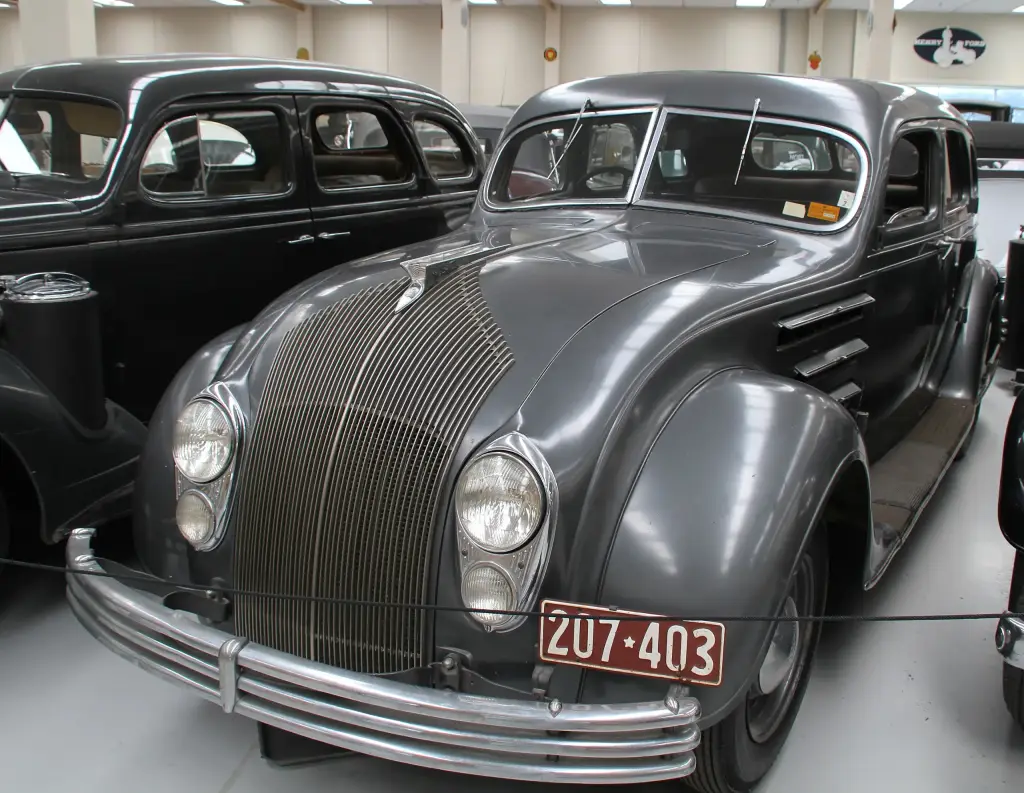
Before the launch Chrysler reversed the chassis of a 1933 Chrysler Six so that the car could be driven “backwards” through Detroit, a stunt intended to draw attention to the aerodynamics of current cars. The Airflow that followed had a grille that cascaded forward and down like a waterfall, semi-flush headlamps, fenders that enclosed the tyre tread and rear wheels hidden by skirts; the windscreen was made of two panes forming a raked vee, and all windows were safety glass. It was introduced in January 1934, months before production began, and output peaked at only 6,212 cars in May 1934 — barely one car per dealer. The factory had underestimated the welding needed, and the first 2,000 to 3,000 cars left with serious defects, including engines breaking loose from their mountings at 80 mph.
Design and features
- Streamlined body: the first full-size American production car designed around air resistance rather than appearance.
- Unitary construction: a welded all-steel body that was stronger and lighter than a separate frame and body.
- Forward engine and seating: passengers moved inside the wheelbase for close to 50:50 weight distribution.
- Waterfall grille: a front end that flowed forward and down, with semi-flush headlamps and covered rear wheels.
- Safety glass throughout: every window was made of safety glass at a time when wooden body framing was still common.
Chrysler Airflow versions
- 1934 range: Coupe, Brougham, Sedan and Town Sedan, two- and four-door, all at US$1,345.
- DeSoto Airflow: the companion model, which DeSoto sold exclusively for a time.
- Chrysler Imperial Airflow: the same styling offered on Chrysler’s largest model.
- Canadian Airflow Six (CY): built by Chrysler of Canada on DeSoto mechanicals.
The Airflow’s bodywork was also offered on the Chrysler Imperial, and the same period of Chrysler history is covered by the Chrysler Six and Chrysler Royal. More cars are in the Chrysler collection.
Video: Fashioned by Function – Chrysler Airflow
Video by King Rose Archives on YouTube.
Sources
- Chrysler Airflow, English Wikipedia: development, engineering, launch, production
- Chrysler Airflow, Wikimedia Commons: photographs