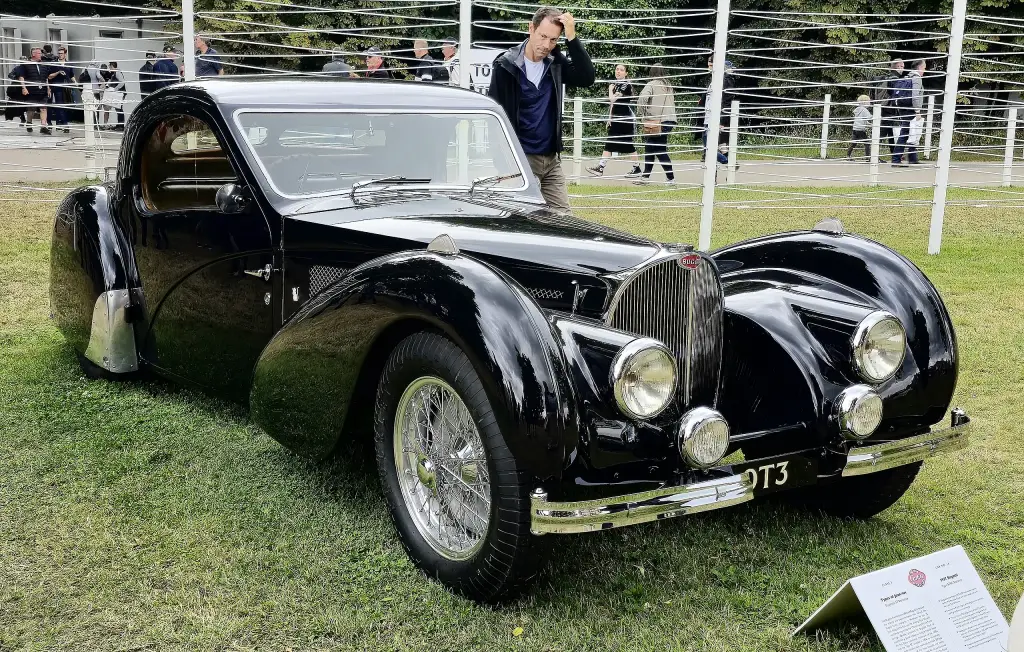
The Bugatti Type 57 was a grand tourer built from 1934 through 1940 and an entirely new design by Jean Bugatti, son of the founder Ettore. It was the most refined Bugatti of the pre-war years and the basis of the famous Atlantic and Atalante coupes.
Bugatti Type 57 at a glance
| Maker | Bugatti, Molsheim |
|---|---|
| Designer | Jean Bugatti |
| Production | 1934–1940 |
| Class | grand tourer |
| Engine | 3,257 cc twin-cam straight-eight |
| Bore × stroke | 72 mm × 100 mm |
| Power | 135 hp in the Type 57 |
| Wheelbase | 3,302 mm (130 in) |
| Track | 1,349 mm (53 in) |
| Weight | about 950 kg |
| Top speed | 153 km/h |
| Built | 710 Type 57s of all versions |
Based on one source, the English Wikipedia article.
History of the Bugatti Type 57
A new design by Jean Bugatti
The Type 57 was an entirely new car rather than a development of the Type 49, whose bore and stroke of 72 by 100 mm it kept. The 3.3-litre straight-eight had twin camshafts and was heavily modified by Jean Bugatti; while the Type 50 and Type 51 used bevel gears at the front of the engine to drive the camshafts, the Type 57 used a train of spur gears at the rear, with fibre gear wheels on the camshafts to make it quieter. In all, 710 Type 57s were produced.
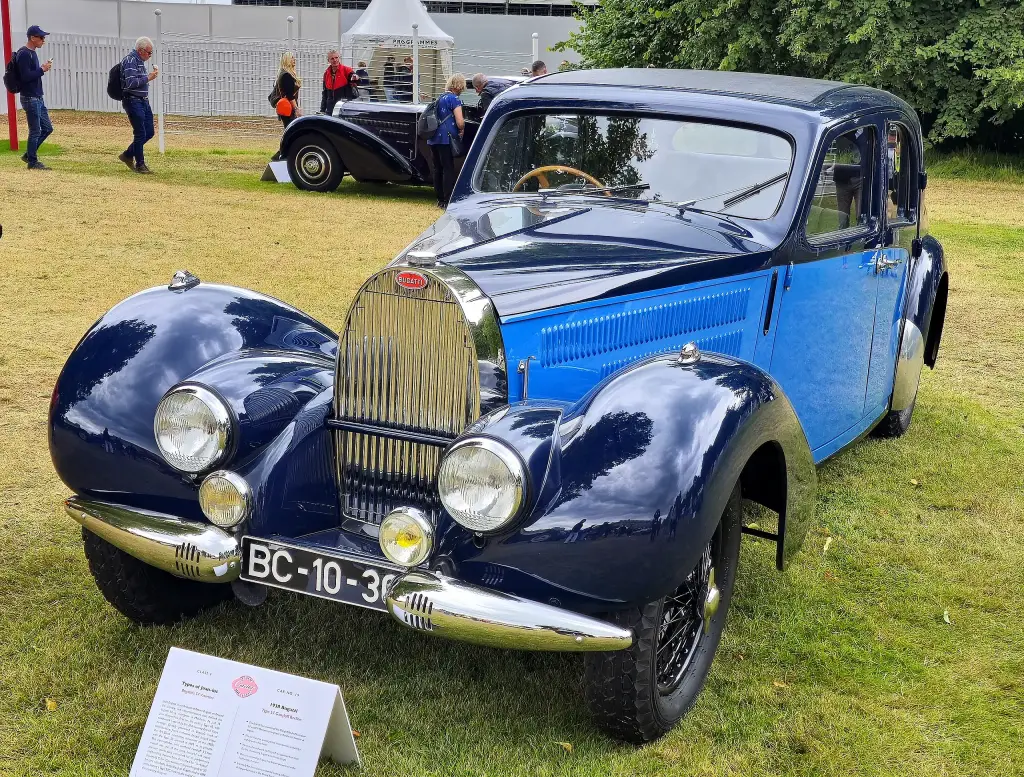
The original Type 57
The standard touring car was built from 1934 to 1940 with the 3,257 cc engine from the Type 59 Grand Prix cars, producing 135 hp and a top speed of 153 km/h. It rode on a 3,302 mm wheelbase with a 1,349 mm track and weighed about 950 kg. The body had a smaller version of the Royale’s square-bottom horseshoe grille, and the sides of the engine compartment were covered with thermostatically controlled shutters. Hydraulic brakes replaced the cable-operated units in 1938, a change Ettore Bugatti opposed. 630 examples of the original car were built.
57T and 57C
The tuned Type 57T reached 185 km/h. The Type 57C racing car of 1937–1940 kept the 3.3-litre engine but added a Roots-type supercharger for 160 hp; about 96 were built.
57S and 57SC
The Type 57S and 57SC are among the most famous Bugattis. ‘S’ stood for Surbaissé, lowered, and ‘C’ for Compresseur, supercharged. Lowering the car was a major task: the rear axle passed through the frame instead of under it, a dry-sump system was needed to fit the engine under the lower bonnet, and the front suspension became nearly independent, something Ettore disliked. The 57S had a V-shaped dip at the bottom of the radiator and mesh grilles beside the engine. Just 43 Surbaissé cars and two supercharged 57SCs were made at first, but most 57S owners had their cars converted at Molsheim, raising output from 170 to 200 hp and top speed from 201 to 217 km/h.
Atlantic and Le Mans
The Atlantic body, with its pronounced dorsal seam, came from the 1935 Aérolithe concept. The Aérolithe used Elektron, a magnesium alloy that could not be welded, so its panels were riveted externally, which created the seam; the four production Atlantics used plain aluminium but kept the seam for style. Three of the four survive. The 57G Tank, based on the 57C, won Le Mans in 1939; shortly afterwards Jean Bugatti crashed the winning car on the Molsheim–Strasbourg road on 11 August while avoiding a cyclist, and died at the age of 30. The chassis and engine were revived in 1951 as the Type 101.
Design and features
- Jean Bugatti’s design: an all-new twin-cam grand tourer, quieter than earlier Bugatti eights.
- 57S and 57SC: the lowered, later supercharged versions, with 170 to 200 hp.
- Atlantic: the riveted dorsal seam of the Aérolithe carried over to four production coupes.
- Racing: the 57G Tank won Le Mans in 1939.
Bugatti Type 57 versions
- Type 57 (1934–1940): the standard tourer, 135 hp, 630 built.
- Type 57T: the tuned version, 185 km/h.
- Type 57C (1937–1940): supercharged, 160 hp, about 96 built.
- Type 57S / 57SC: the lowered cars, 43 plus two original supercharged examples.
- Atlantic: four coupes with the dorsal seam.
- Type 57G Tank: the Le Mans winner of 1939.
The Type 57 followed the Type 50 and used ideas from the Type 35 racing programme, and its name lives on in the 16C Galibier. More cars are in the Bugatti collection.
Sources
- Bugatti Type 57, English Wikipedia: design, versions, dimensions, Atlantic, racing