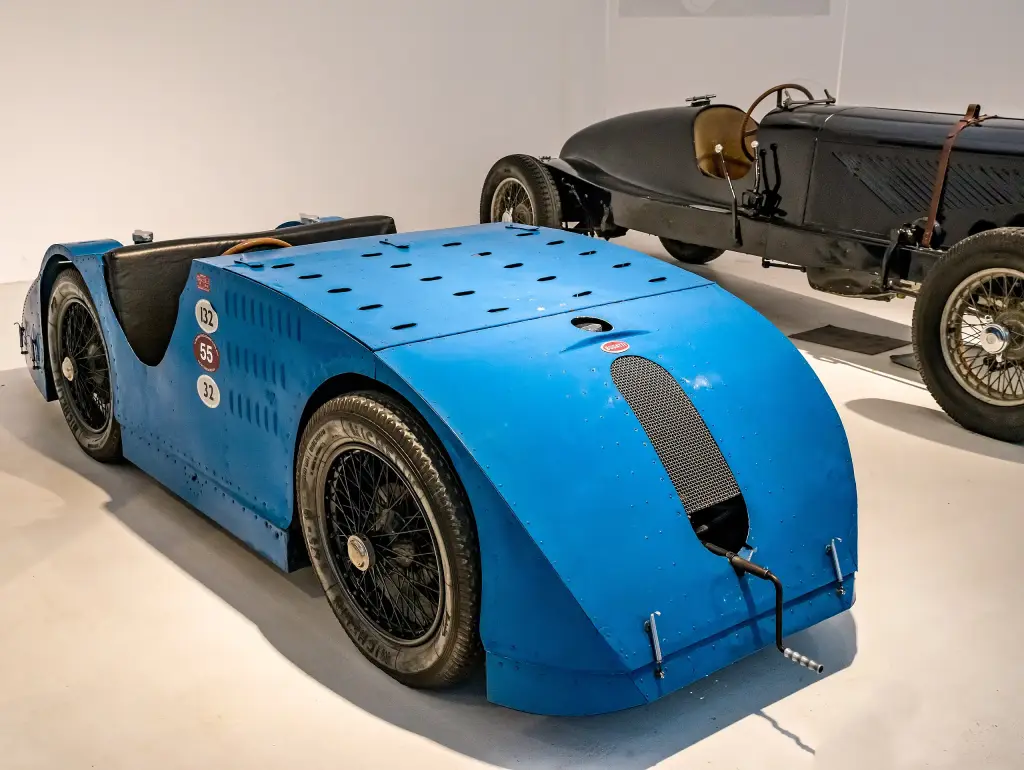
The Bugatti Type 32, commonly called the Tank de Tours, was a streamlined racing car built in 1923 for the French Grand Prix. Ettore Bugatti designed it to be simple and quick to assemble, and its shape gave the car its nickname.
Bugatti Type 32 at a glance
| Maker | Bugatti, Molsheim |
|---|---|
| Built | 1923 |
| Class | streamlined racing car |
| Nickname | Tank de Tours |
| Engine | 1,991 cc straight-eight, three valves per cylinder |
| Power | 90 hp |
| Weight | about 650 kg |
| Wheelbase | 1,994 mm |
| Track | 1,052 mm |
| Built | five cars, including the prototype |
| Top speed | about 180 km/h at Tours |
Based on one source, the English Wikipedia article.
History of the Bugatti Type 32
A car for one race
The Type 32 was designed especially for the 1923 French Grand Prix, held at Tours on 2 July. The first prototype with an aerodynamic aluminium body was built in six months around the 1,991 cc straight-eight engine used in the earlier Type 30, tuned to 90 hp for the race and weighing about 650 kg. The nickname came from the body, which resembled the battle tanks of the period, and from the name of the town.
Design
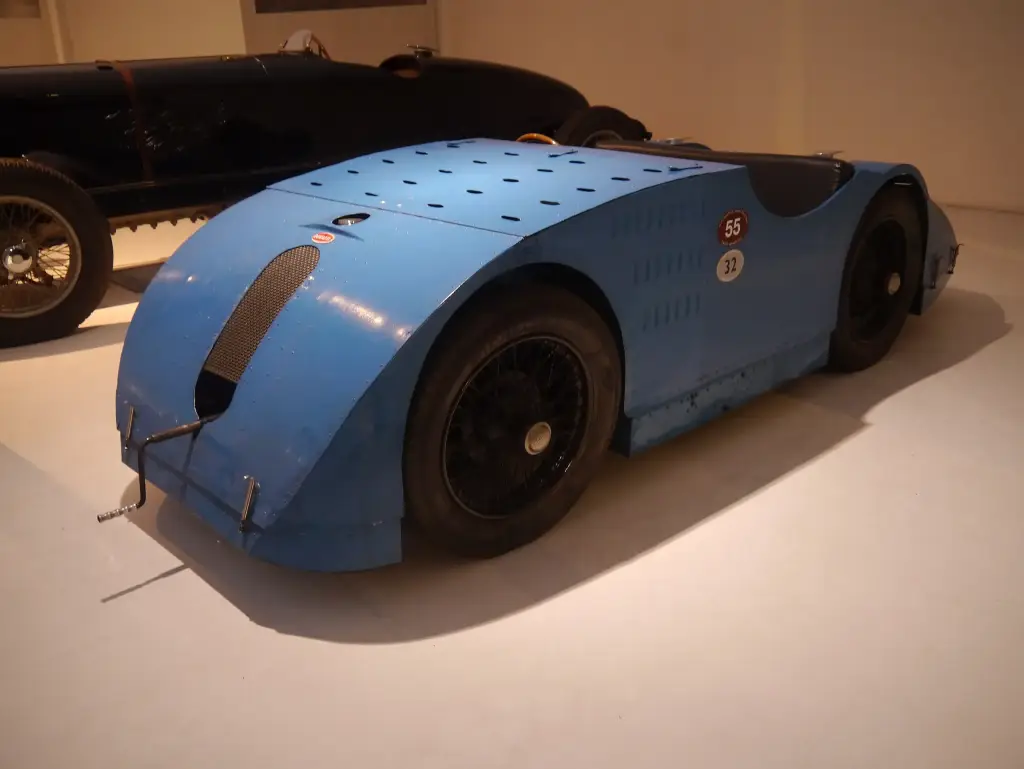
Compared with the previous competition model, the Type 29, the Type 32 shared only its engine layout. The car was small, with a 1,994 mm wheelbase like the Bugatti Type 13, and five were produced: the prototype and four racing cars. The engine was a longitudinal straight-eight with five main bearings, three valves per cylinder (two inlet and one exhaust) and a single camshaft. Brakes were hydraulic at the front and mechanical, by cable, at the rear. The Type 32 was the first Bugatti with roller-bearing big ends, and it used a three-speed and reverse transaxle because the very short wheelbase and long engine left no room for a conventional gearbox.
The handling problem
Despite its low centre of gravity the Type 32 had poor grip. Its aerodynamics worked like a wing profile, so the car tended to rise at high speed, and the short wheelbase made matters worse. That weakness, rather than a lack of power, decided its racing life.
Racing
Four cars were entered at Tours. Number 6, driven by Ernest Friderich, finished third; number 18 of the Prince of Cystria retired on lap 12, number 11 of Pierre de Vizcaya retired at the start after an accident, and number 16 of Pierre Marco retired on the third lap. On the main straight the Type 32 reached about 180 km/h. The French Grand Prix was its only Grand Prix, but chassis 4059 was bought by Mr Junek of Czechoslovakia, who raced it for the rest of 1923 and won the third Schöberbergrennen hill climb. The Type 32 was replaced by the far more successful Type 35; a second tank-bodied Bugatti, the 1936 Type 57G, did much better.
Design and features
- Tank body: an aluminium streamlined shell that gave the car its nickname.
- Straight-eight: the 1,991 cc engine of the Type 30, tuned to 90 hp.
- Short wheelbase: 1,994 mm, with a transaxle gearbox to fit the long engine.
- New ideas: the first Bugatti with roller-bearing big ends and hydraulic front brakes.
Bugatti Type 32 versions
- Prototype (1923): the first car with the aerodynamic aluminium body.
- Racing cars (1923): four cars built for the French Grand Prix.
- Chassis 4059: sold to Junek in Czechoslovakia and raced through 1923.
The Type 32 was replaced by the Type 35, which became Bugatti’s most successful racer, and it stands next to the unrelated Type 36 prototype. More cars are in the Bugatti collection.
Sources
- Bugatti Type 32, English Wikipedia: design, engine, race results, legacy