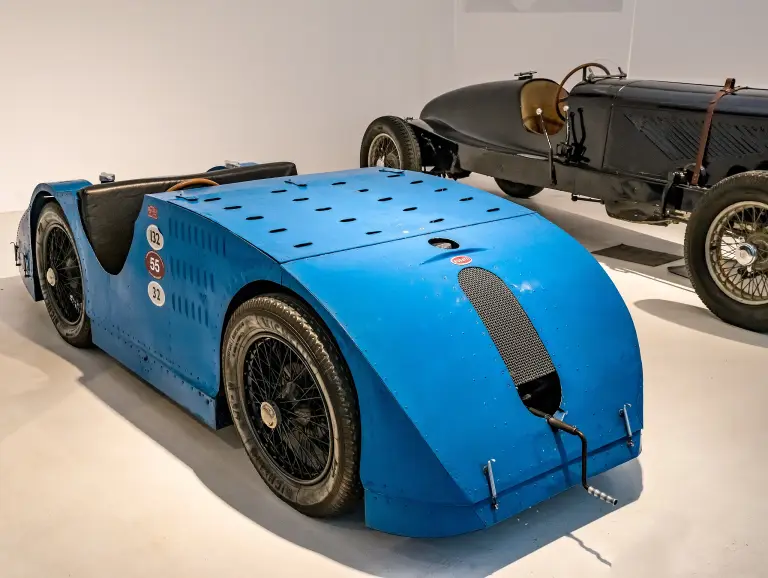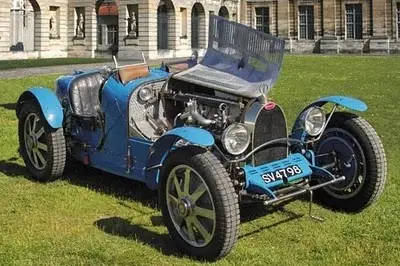
The Bugatti Type 36 was a racing car produced in 1925. It was built for the banked oval at Montlhéry, south of Paris, but it never raced: after practice the cars were withdrawn because of their poor handling. Its later development became the experimental basis of the supercharged Type 35C.
Bugatti Type 36 at a glance
| Maker | Bugatti, Molsheim |
|---|---|
| Built | 1925 |
| Class | racing car, prototype |
| Purpose | racing on the banked oval at Montlhéry |
| Engine | 1.5-litre straight-eight |
| Bore × stroke | 60 mm × 66 mm |
| Later engine use | Type 39A |
| Rear suspension | none at first, axle bolted to the frame |
| Raced | no, withdrawn after practice |
| Development | became the experimental basis for the Type 35C |
Based on one source, a section of the English Wikipedia list of Bugatti prototypes.
History of the Bugatti Type 36
Built for Montlhéry
The Type 36 racer was produced in 1925 and used a 1.5-litre straight-eight engine adapted from earlier Bugatti designs. With a 60 mm bore and 66 mm stroke, that engine later saw use in the Type 39A. The car was built to compete at the banked oval race track at Montlhéry, just south of Paris.
No springs at the back
The Type 36 initially had no rear suspension at all and only very limited front suspension travel: the rear axle was bolted directly to the frame without springs. That layout, and the handling that came with it, ended its racing career before it began. Ettore Bugatti himself drove one of the cars from Molsheim to Montlhéry to compete, but the cars were withdrawn after practice and did not race.
The experimental base for the Type 35C
In 1926 Bugatti added rear springs, increased the front suspension travel and fitted a supercharger to the Type 36. In that form the car became the experimental base for the supercharged Type 35C, one of the most successful racing Bugattis. The Type 36 therefore matters less as a racer than as a test bed: an unsuccessful experiment that pointed the way to the cars that followed.
Design and features
- 1.5-litre straight-eight: a 60 mm × 66 mm engine later used in the Type 39A.
- No rear suspension: the rear axle was bolted straight to the frame.
- Montlhéry project: designed for the banked oval south of Paris.
- Type 35C ancestor: with springs and a supercharger it became the basis of the 35C.
Bugatti Type 36 versions
- Type 36 (1925): the original unsupercharged car with no rear suspension.
- 1926 development car: rear springs, more front travel and a supercharger.
The Type 36 led to the supercharged Type 35 family, and it shared the racing field of the period with the Type 32. More cars are in the Bugatti collection.
Sources
- List of Bugatti prototypes, English Wikipedia: Type 36 design, engine and development