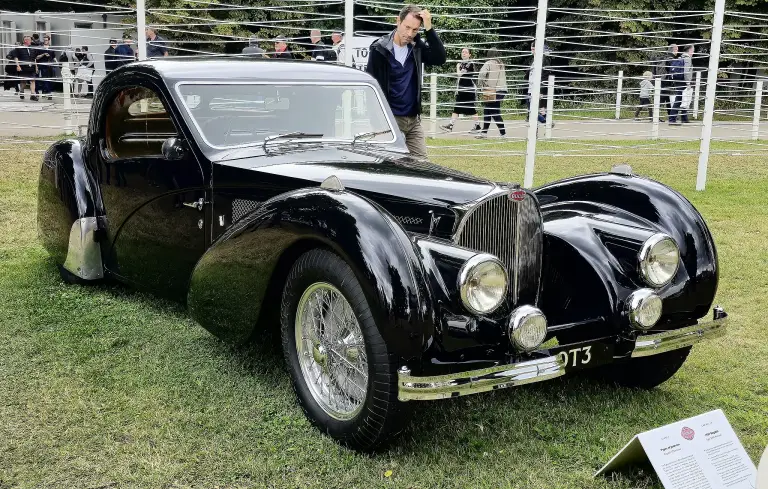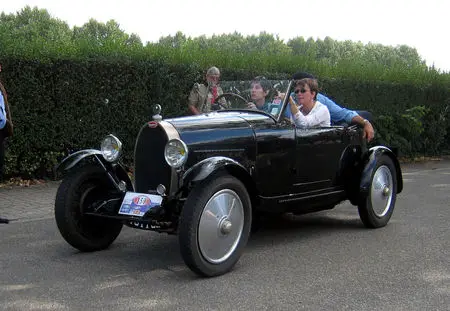
The Bugatti Type 40 was the small car of Bugatti’s early eight-cylinder range. Introduced in 1926 and built until 1930, it used the 1.5-litre three-valve engine first seen in some Type 37s, and it was offered as an enclosed tourer or, in Type 40A form, as a small roadster.
Bugatti Type 40 at a glance
| Maker | Bugatti, Molsheim |
|---|---|
| Production | 1926–1930 |
| Class | small touring car |
| Engine | 1,496 cc three-valve straight-eight |
| Bodies | enclosed tourer; Type 40A small roadster |
| Built | about 830 |
| Type 40A engine | 1,627 cc, sharing the Type 40 block |
| Type 40A production | all 40 cars built in 1930 |
| Engine origin | the 1.5-litre unit first used in some Type 37s |
| Place in the range | the smallest model of the eight-cylinder line |
Based on one source, a section of the English Wikipedia article on the Bugatti 8-cylinder line.
History of the Bugatti Type 40
The small eight
The Type 40 was part of the early Bugatti eight-cylinder line, which began with the Type 30 of 1922 and grew through the Type 38, Type 40, Type 43, Type 44 and Type 49. Where the larger cars used 2.0, 2.3 or 3.0-litre engines, the Type 40 was the small one: it took the 3-valve 1.5-litre engine first used in some Type 37s and put it into a touring chassis.
Touring and roadster
Introduced in 1926 and produced through 1930, the Type 40 was sold as an enclosed tourer. A second version, the Type 40A, was a small roadster; it shared its block with the Type 40 but was bored out to 1.6 litres, or 1,627 cc. All forty Type 40As were built in 1930.
Numbers
About 830 Type 40s were built over five years. In the context of the range that was a large production figure: the Type 38 of 1926–1927 accounted for 385 cars and the Type 43 ‘Grand Sport’ for 160, while only the Type 44 and Type 49 outsold the small Type 40. That made it one of the most common Bugattis of its period and the natural introduction to the marque for a buyer who wanted a quiet tourer rather than a racing car.
Its place
The Type 40 sat below the faster Type 43, which borrowed the supercharged 2.3-litre engine of the Type 35B and became famous as the world’s first 100 mph production car. The Type 40 kept the simpler, unsupercharged approach, with the three-valve head and single camshaft that characterised the early eight-cylinder Bugattis, and it stayed in production until 1930, the year the Type 40A appeared.
Design and features
- 1.5-litre three-valve engine: the unit first used in some Type 37s, simple and easy to maintain.
- Enclosed tourer: a comfortable body, with a small roadster offered as the Type 40A.
- Common by Bugatti standards: about 830 cars built in five years.
- Type 40A: a 1,627 cc version sharing the block, all forty built in 1930.
Bugatti Type 40 versions
- Type 40 (1926–1930): the standard enclosed tourer with the 1,496 cc engine.
- Type 40A (1930): small roadster with a 1,627 cc engine, 40 built.
The Type 40 used the engine of the Type 35 family’s Type 37, and it was followed in the range by the larger Type 50. More cars are in the Bugatti collection.
Sources
- Bugatti 8-cylinder line, English Wikipedia: Type 40 engine, bodies, production numbers