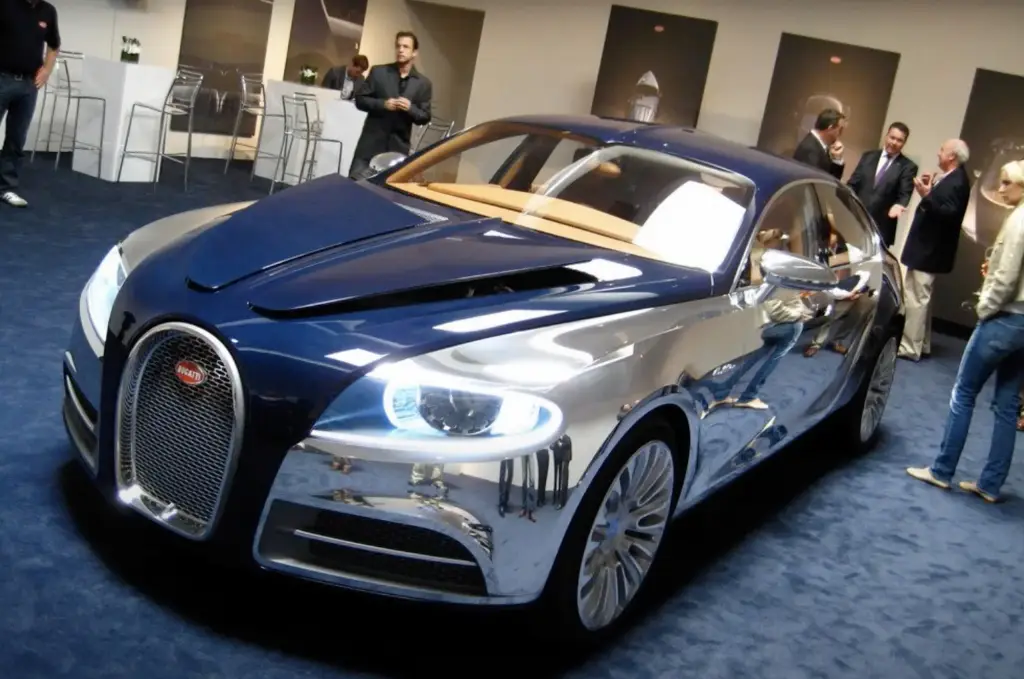
The Bugatti 16C Galibier was a luxury five-door fastback concept built by Bugatti Automobiles S.A.S. Shown first to invited guests at the company’s Molsheim assembly salon on 12 September 2009, it was meant to become a four-door Bugatti for everyday use, but in the end it stayed a concept.
Bugatti 16C Galibier at a glance
| Maker | Bugatti Automobiles S.A.S., Molsheim, France |
|---|---|
| Class | five-door fastback concept car |
| First shown | Molsheim, 12 September 2009 |
| Public debut | Frankfurt Motor Show, 2009 |
| Engine | 8.0 L twin-supercharged W16, front-mounted |
| Drive | permanent all-wheel drive |
| Power | hinted at more than 1,000 PS |
| Top speed | hinted at over 378 km/h |
| Planned output | about 3,000 cars |
| Project cancelled | May 2012 |
| Replaced in plan by | Bugatti Chiron |
Based on one source, the English Wikipedia article.
History of the Bugatti 16C Galibier
A Bugatti for four
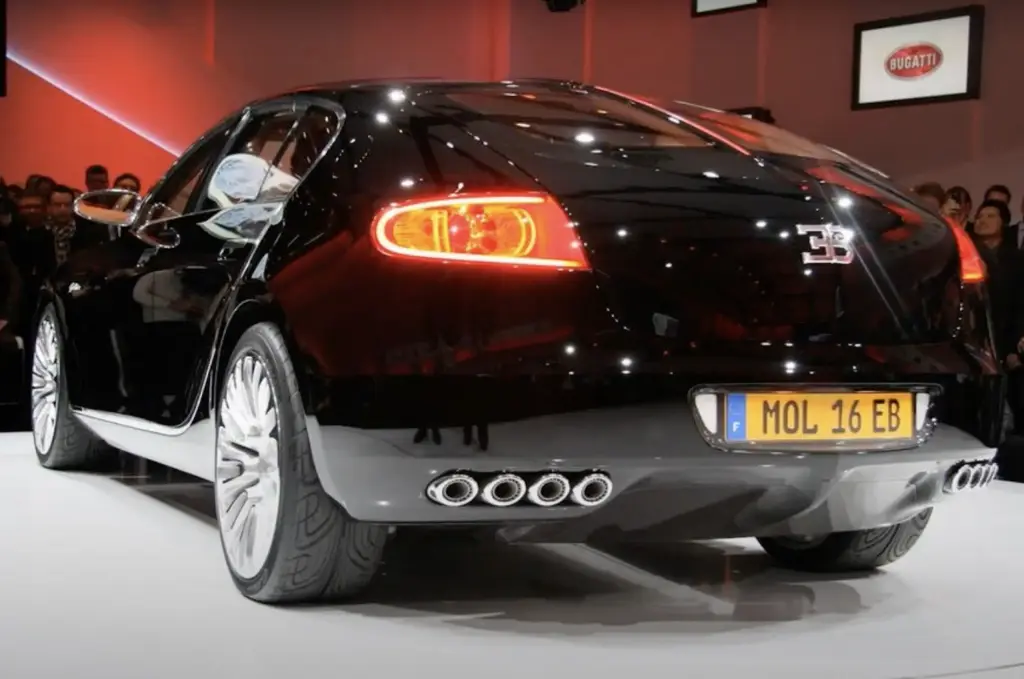
The 16C Galibier was the first attempt by Bugatti under Volkswagen Group ownership to move away from the two-seat hypercar formula of the Veyron. It was a five-door fastback with a long bonnet, intended as the most luxurious car in the world: the interior had an analogue timepiece that could be mounted in the dashboard as a clock or worn on a wristband as a watch. The car was shown in two colour schemes, a two-tone of dark blue and polished aluminium, and black. After the private showing at Molsheim it appeared in public at the 2009 Frankfurt Motor Show.
Name and design
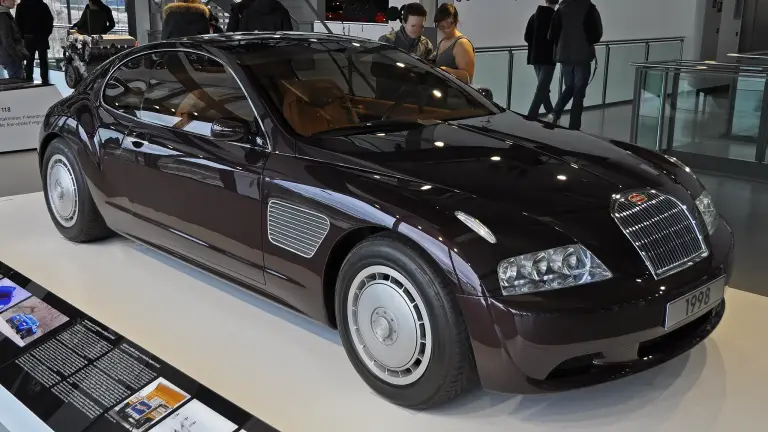
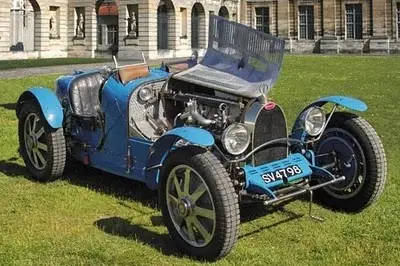
The name refers to the Bugatti Type 57 Galibier; Bugatti traditionally gave Type 57 variants the names of mountain passes, and the Galibier is a pass in the French Alps. The ‘16C’ stands for the sixteen cylinders of the engine. The body carried a longitudinal rib down the centre, the same motif used on the earlier EB 118 and EB 218 concepts and a reference to the body seam of the Type 57SC Atlantic. The bonnet opened in two parts along a central hinge.
Powertrain
The engine was a front-mounted 8.0-litre W16 with twin superchargers, derived from the quad-turbocharged unit of the Veyron, driving all four wheels permanently. Bugatti did not publish performance figures, but hinted at more than 1,000 PS and a top speed beyond 235 mph (378 km/h). A hybrid version was considered as an option, mainly to cut pollution in cities.
The end of the project
A production version, expected to be called the Royale, was originally scheduled for 2013; in 2011 it was postponed to 2015 or later while the design was refined. Bugatti expected to build about 3,000 Galibiers, against 300 Veyrons, at more than £1 million each. The project was cancelled in May 2012, and Bugatti concentrated on the Chiron, which had been under development since the previous summer as a precaution. In 2014 Bugatti president Wolfgang Schreiber said the company would never build the Galibier, and in 2016 his successor Wolfgang Dürheimer confirmed that a four-door was still only one of several possible ideas for the future.
Design and features
- Four doors: a fastback body with room for four, a deliberate break from the two-seat Veyron.
- Front-mounted W16: an 8.0-litre twin-supercharged engine driving all four wheels.
- Type 57 references: a central longitudinal rib echoing the Atlantic’s body seam.
- Watch and clock: an analogue timepiece that could sit in the dashboard or on the wrist.
Bugatti 16C Galibier versions
- Galibier concept (2009): the only car built, shown in dark blue and polished aluminium.
- Black show car: the second colour scheme displayed at Frankfurt.
- Planned Royale: the projected production version, cancelled in 2012.
The Galibier was meant to sit above the Veyron, and its cancellation cleared the way for the Chiron. Its name comes from the Type 57. More cars are in the Bugatti collection.
Sources
- Bugatti 16C Galibier, English Wikipedia: debut, design, powertrain, production plans