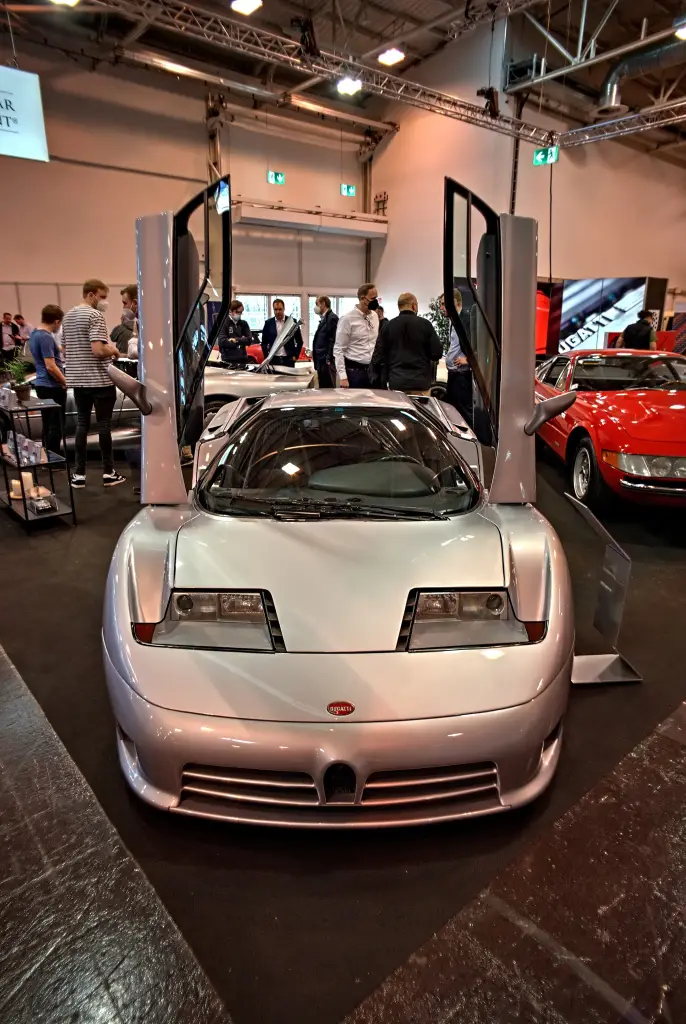
The Bugatti EB 110 was the model that restarted the marque’s presence in the car industry after a gap of almost forty years. Conceived by Paolo Stanzani in the mid-1980s and built by Bugatti Automobili S.p.A. from 1991 until 1995, it was the only production car of Romano Artioli’s Italian Bugatti.
Bugatti EB 110 at a glance
| Maker | Bugatti Automobili S.p.A., Campogalliano, Italy |
|---|---|
| Project code | FL12 |
| Production | 1991–1995 |
| Class | mid-engine two-seat supercar |
| Engine | 3,500 cc V12 with four turbochargers |
| Chassis | aluminium skins over aluminium honeycomb, bonded with epoxy |
| Styling | Marcello Gandini |
| Built | 139, plus a few completed after the bankruptcy |
| Last cars | one by Dauer in 2002, one finished in 2019 |
| Rivals | Lamborghini Diablo, Jaguar XJ220, Ferrari F40 and F50, McLaren F1 |
Based on one source, the English Wikipedia article.
History of the Bugatti EB 110
From Lamborghini talk to a new Bugatti
Discussions about a new supercar began at the end of 1984 between Ferruccio Lamborghini and Paolo Stanzani. Stanzani warned that the engine was possible but the bodywork would be expensive, and suggested Nuccio Bertone for the design; Bertone took part in early talks and then declined. On 11 May 1987 Autoexpo, the company of Romano Artioli, paid 7,500,000 French francs for the Bugatti brand, and on 14 October 1987 Bugatti Automobili S.p.A. was founded.
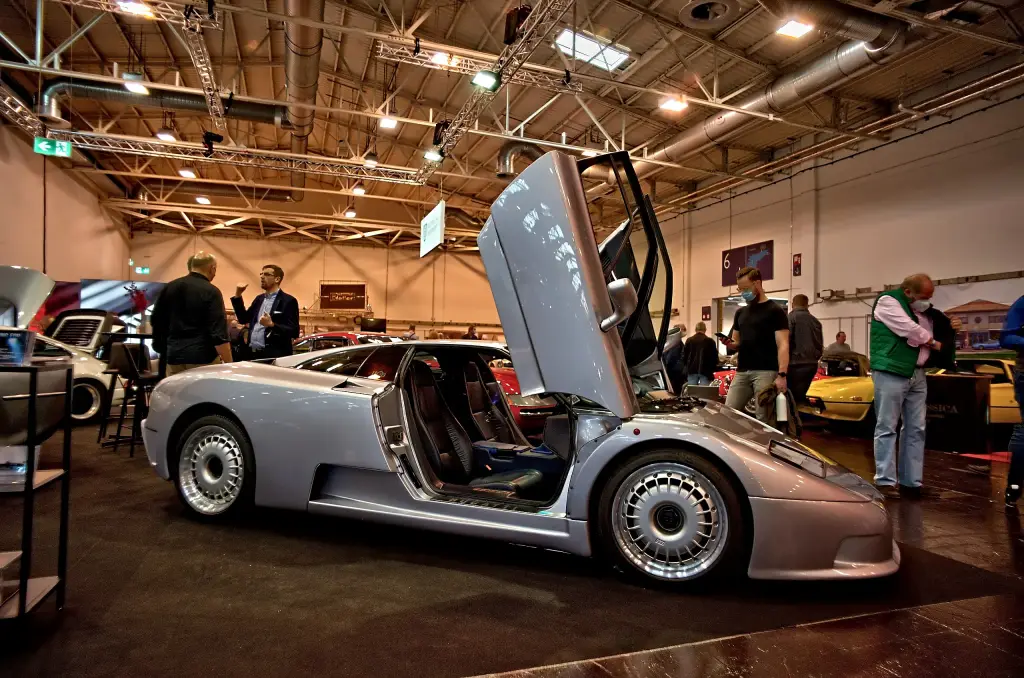
FL12
The project was coded FL12, for ‘Ferruccio Lamborghini 12-cylinder’, and development started in 1986 on the engine and chassis. Work was led by Stanzani, with design by Oliviero Pedrazzi and the engineers of Tecnostile in Modena; the team had worked on the Lamborghini Miura, Urraco and Countach. Loris Bicocchi, formerly Lamborghini’s test driver, was employee number seven in Campogalliano and waited a year before testing the first prototype.
Engine and chassis
The engine was a ‘small’ 3,500 cc V12, a size that mirrored the Formula 1 rules of 1987. Naturally aspirated, it did not give enough torque for a supercar, so Stanzani chose turbocharging; four turbos were used instead of two larger ones because of the expected lag. The chassis was made of two aluminium skins, 0.9 to 1.5 mm thick, separated by 8 to 12 mm aluminium honeycomb and bonded with epoxy glue. Stanzani rejected carbon skins over aluminium or Nomex honeycomb because Italy lacked experience in making and repairing them, and because the aluminium material cost less.
Styling and life
Several designers were invited to propose bodies: Paolo Martin, Giorgetto Giugiaro, Bertone and Marcello Gandini; Gandini’s proposal was accepted. The EB 110 went on sale in 1991 and was produced until 1995, when the company was liquidated. It competed with the Lamborghini Diablo, Jaguar XJ220, Ferrari F40 and F50 and McLaren F1. In all 139 examples were built, plus a small number completed after the bankruptcy: the last was finished by Dauer Sportwagen in 2002 and one unfinished car was completed in 2019. The EB 110 remains the only production model of Artioli’s Bugatti.
Design and features
- Quad-turbo V12: a 3,500 cc engine with four turbochargers to keep lag low.
- Aluminium honeycomb chassis: glued and riveted aluminium skins, chosen over carbon for cost and repairability.
- Gandini body: styling by Marcello Gandini, the designer of the Miura and Countach.
- Rare: 139 cars plus a handful finished after the company closed.
Bugatti EB 110 versions
- EB 110 (1991–1995): the standard production car.
- Post-bankruptcy cars: a few examples completed after 1995.
- Dauer car (2002): the last example, finished by Dauer Sportwagen.
- 2019 completion: one further unfinished car finished decades later.
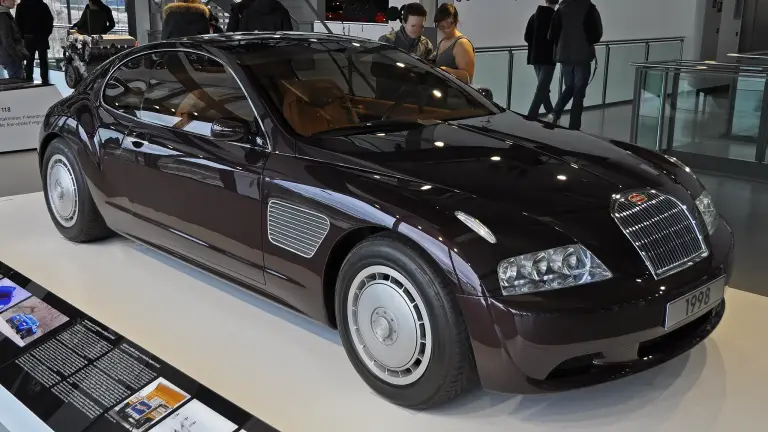
The EB 110 was followed, under Volkswagen ownership, by the EB 118 concept and eventually by the Veyron. More cars are in the Bugatti collection.
Sources
- Bugatti EB 110, English Wikipedia: history, engine, chassis, styling, production