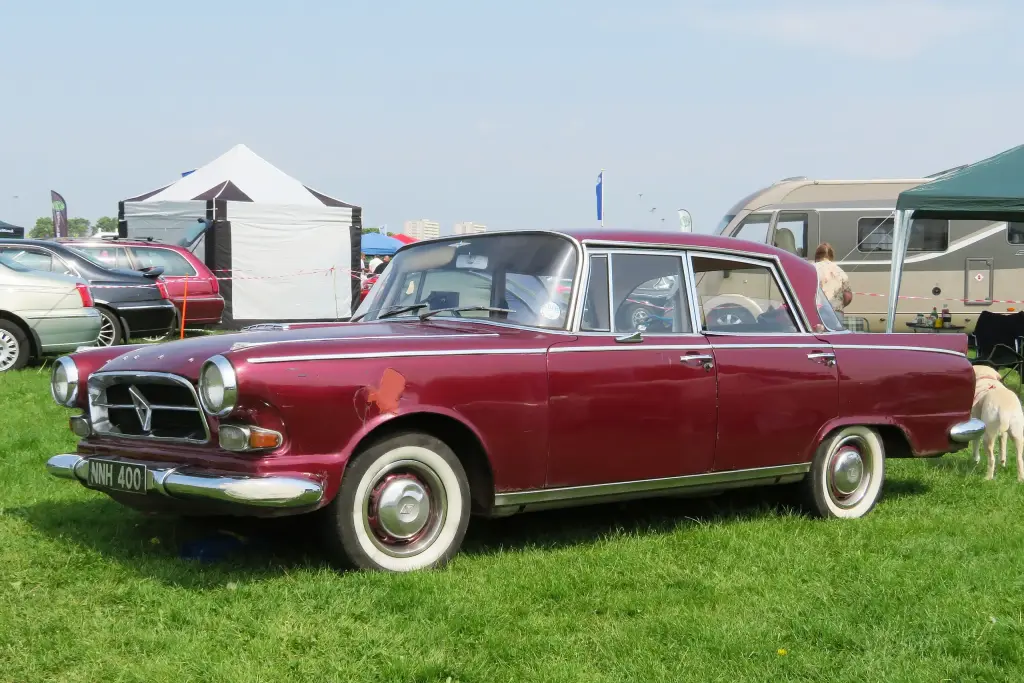
The Borgward P100 was the last large saloon designed in Bremen before the company collapsed. Shown at the Frankfurt Motor Show in September 1959 and built from January 1960 to July 1961, it combined a modern angular body with a 2.2-litre six and a self-levelling air suspension. Fewer than 2,600 cars were made before the bankruptcy, but the production line went to Mexico and the P100 outlived Borgward there as the Borgward 230.
Borgward P100 at a glance
| Maker | Carl F. W. Borgward GmbH, Bremen |
|---|---|
| First shown | Frankfurt Motor Show, September 1959 |
| Production | January 1960–July 1961 |
| Body | four-door saloon |
| Construction | integral chassis, as on the Isabella |
| Engine | 2,240 cc straight-six |
| Power | 100 bhp (75 kW) |
| Top speed | about 100 mph (161 km/h) |
| Suspension | self-levelling air suspension |
| Style | ponton with angular corners and small tailfins |
| Built in Bremen | over 2,500 |
| Mexican production | more than 2,000 cars, 1967–1970 |
based on one source: the English Wikipedia article on the P100 also covers the Mexican Borgward 230.
History of the Borgward P100
A modern shape for the six-cylinder class
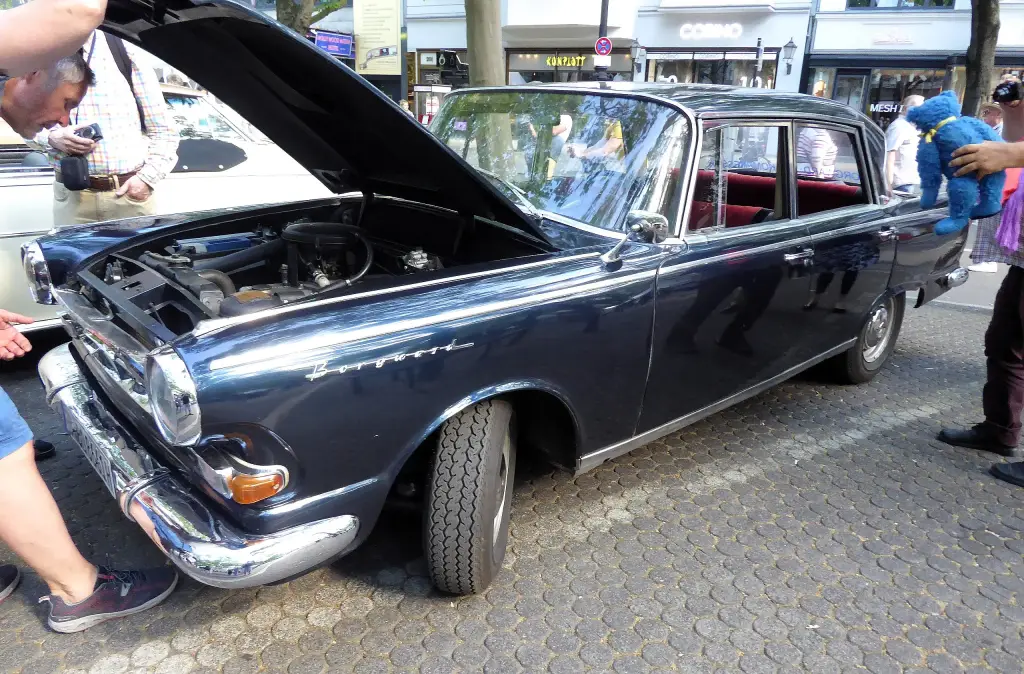
The P100 kept the ponton, three-box layout that Borgward had pioneered with the Hansa 1500 in 1949, but filled it out with relatively angular corners in the manner of the Pininfarina designs of the period, such as the Fiat 1800, the Peugeot 404 and the Austin Westminster. Like those cars it wore small angular tailfins, and like the existing Isabella it was built with an integral chassis rather than a separate frame. Under the bonnet sat a 2,240 cc straight-six derived from the engines of the earlier Borgward six-cylinder saloons, the most recent of which had been the Hansa 2400 Pullman. Borgward advertised 100 bhp and a top speed of around 100 mph, and its publicity made much of the car’s revolutionary self-levelling air suspension.
Competing with Stuttgart
The P100 entered the six-cylinder saloon market that Mercedes-Benz had come to dominate through the 1950s; the 220SE gained a similarly chiselled body for 1960. Borgward’s earlier sixes had sold only in limited numbers, and early reports that the P100 was confirming the firm’s reputation for launching new models full of teething troubles suggested that even its adventurous suspension and modern style might not be enough against Stuttgart’s reputation for dependable saloons. In the event the car did rather better than its predecessors. During nineteen months of production it notched up more than 2,500 cars, putting it on course to outperform the earlier Borgward sixes in the market place.
The end of the line, and Mexico
The bankruptcy of the business in August 1961 brought P100 production to an end, although the plant completed another 47 cars in the days that followed. The model then had a brief afterlife: the production line was sold and shipped to Mexico by Grupo Industrial Ramirez in Monterrey, Nuevo León, where more than 2,000 additional P100s were built between 1967 and 1970. In Mexican hands the car was sold as the Borgward 230, the name under which many of these late cars are known today, and the same route had already taken the Isabella line out of Bremen.
Design and features
- Straight-six engine: 2,240 cc, 100 bhp, developed from the earlier Borgward sixes including the Hansa 2400.
- Air suspension: self-levelling, a rare and technically ambitious system for 1960.
- Integral chassis: the structural approach of the Isabella carried over to the large saloon.
- Pininfarina-influenced body: angular corners with small tailfins, in the fashion of the Fiat 1800 and Peugeot 404.
- Mexican afterlife: more than 2,000 cars assembled in Monterrey between 1967 and 1970 as the Borgward 230.
Borgward P100 versions
- P100 saloon (1960–1961): the only version built in Bremen, four doors and six cylinders.
- Cars completed after the bankruptcy: another 47 assembled in the days after August 1961.
- Borgward 230: Mexican-built cars from the shipped production line, 1967–1970.
The P100 followed the Isabella, whose integral chassis it shared, and it was the last model of the old Borgward company. The Arabella was the small car that kept the name alive after 1961.
Video: Borgward 230 GL-Jilotepec, Méx.-Grupo Fuerte
Video on YouTube.
Sources
- Borgward P100, English Wikipedia: design, engine, commercial history, Mexico