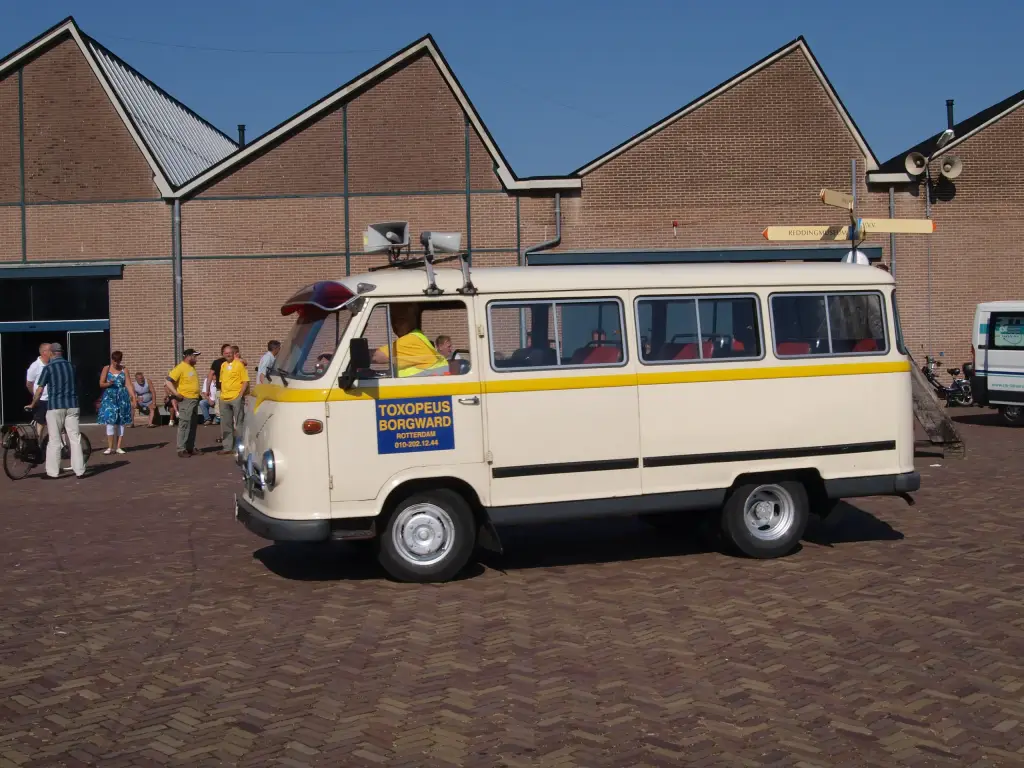
The Borgward B 611 was the Bremen firm’s forward-control light commercial vehicle, sold as a van, a minibus or a platform truck. It appeared in 1957 as the Borgward B 1500 F and took the name B 611 in 1959. With a wide cabin for three and the engine between the driver and the passenger, it was a direct answer to the Mercedes-Benz L 319, and 14,748 were built before the bankruptcy of 1961.
Borgward B 611 at a glance
| Maker | Borgward, Bremen |
|---|---|
| Production | 1957–1961 (some sources 1962) |
| Launched as | Borgward B 1500 F, renamed B 611 in 1959 |
| Payload | 1.5 tonnes |
| Bodies | van, minibus (BO 611), platform truck |
| Petrol engine | 1,493 cc four-cylinder, 60 hp (45 kW) |
| Diesel engine | 1,758 cc four-cylinder, 42 hp (31 kW) |
| Top speed | 92 km/h petrol, 75 km/h diesel |
| Gearbox | four-speed, fully synchronised, column change |
| Wheelbase | 2,600 mm |
| Width | 2,100 mm |
| Length | 5,100 mm van and bus, 5,200 mm platform truck |
| Turning circle | 10.8 m |
| Built in Bremen | 14,748 |
History of the Borgward B 611
Forward control, the Borgward way
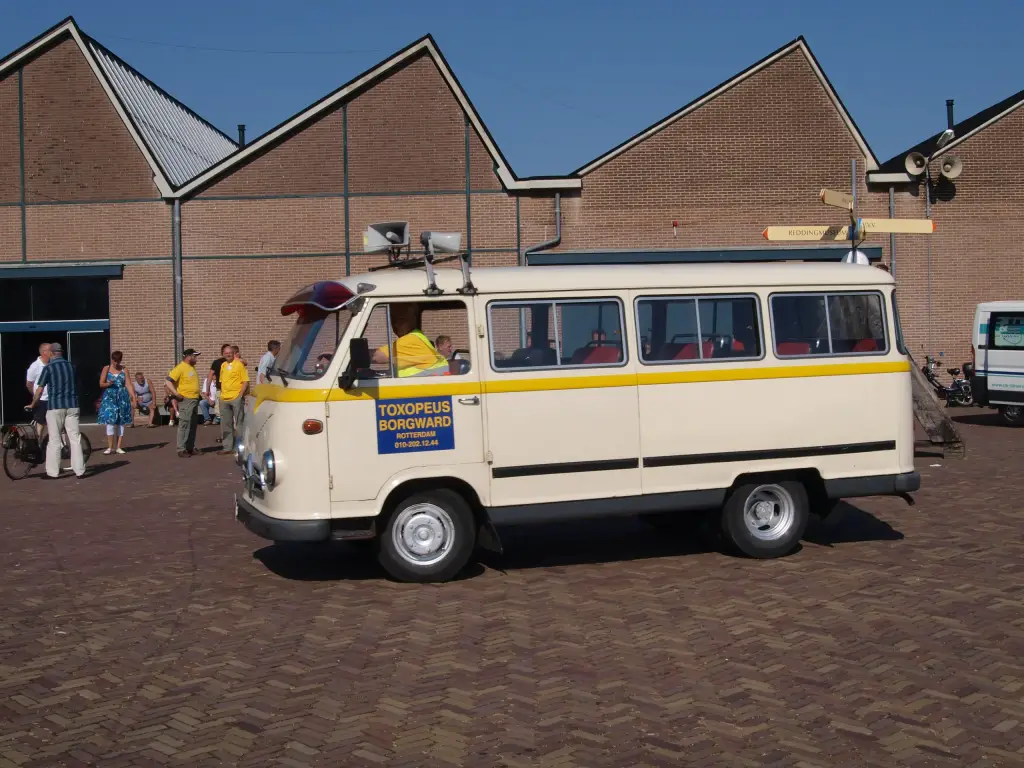
The van was launched in 1957 as the Borgward B 1500 F. The F stood for Frontlenker-Transporter, the forward-control layout in which the driver sits at the very front of the vehicle instead of behind a bonnet with the engine underneath it; it was a first for Borgward. The engine was installed in a large pod between the driver and the passenger, and where three seats were fitted in the cab the middle passenger sat on top of that pod. According to most sources it was only in 1959 that the vehicle received the name by which it is remembered, the Borgward B 611. It was meant to complement the bonneted B 1500, renamed B 511 in 1959.
Engine, gearbox and chassis
Buyers could choose between a water-cooled 1,493 cc petrol four of up to 60 hp, shared with the Borgward Isabella, and a 1,758 cc diesel of 42 hp with much better fuel economy. Both came with the fully synchronised four-speed gearbox and column-mounted lever of the B 1500. The claimed top speed was 92 km/h with petrol power and 75 km/h with the diesel. The B 611 sat on a ladder frame of closed rectangular steel sections with cross-members, and there were two frame versions with load floors at 845 mm or 640 mm above the road; the floor of the van and bus was lower than the platform of the pick-up. At the front the suspension used wishbones with coil springs, at the rear a rigid axle on leaf springs, and the engine, clutch, gearbox, radiator and front suspension were all carried on a subframe. The wheelbase was 2,600 mm, the same as the Isabella’s, and the turning circle of 10.8 m was considered tight enough for city work.
Why the layout looked like Mercedes
Putting the driver and the engine together at the front of a flat-faced cab had been pioneered in France by Citroën in 1939, but with front-wheel drive, which needed constant-velocity joints that were hard to mass-produce cheaply and strongly. Volkswagen’s answer was a rear-engined van, which made loading over the engine awkward. In 1955 Mercedes-Benz combined a forward driving position with rear-wheel drive in the L 319, running the propshaft beneath the load floor, which meant a higher floor but a roomier cab. Borgward followed the Mercedes-Benz layout: engine at the front, driving wheels at the back, and a load floor high enough to clear the shaft. At 2,100 mm wide the Borgward was even slightly wider than the 2,080 mm Mercedes, which allowed the third seat on the engine pod, and much wider than the Volkswagen at 1,750 mm. It was fractionally longer than the L 319 as well, with long overhangs at each end, though its wheelbase was 250 mm shorter.
Cabin, bodies and sales
The platform truck’s cab was generously glazed all round with slim pillars and gave a good view; its rear panel and that of the minibus were identical for economical production, and the same part went into the van with only small changes. With a wide, comfortable cabin for three people and uncomplicated technology, the B 611 won friends in the press and in the market. By the time of Borgward’s controversial bankruptcy in 1961 the firm had built 14,748 of them, and German sources put the end of production in 1961 or 1962. Between 1960 and 1962 Dinborg, an Argentinian joint venture with the state company DINFIA, assembled another 1,296 B 611 light transporters.
Design and features
- Forward-control cab: the driver sat at the very front, with the engine in a pod beside and between the seats.
- Two engines: the Isabella’s 1.5-litre petrol unit or the 1.8-litre diesel of the Hansa 1800.
- Three bodies: panel van, minibus and platform truck with folding sides.
- Wide cabin: 2,100 mm overall width allowed a third seat on top of the engine pod.
- Tight turning circle: 10.8 m on a 2,600 mm wheelbase, with long overhangs at both ends.
Borgward B 611 versions
- B 1500 F (1957–1959): the original name, sold as a 1.5-tonne forward-control transporter.
- B 611 van: the panel van, 5,100 mm long with the lower load floor.
- BO 611 minibus: seats in the back and more windows, same 5,100 mm body.
- B 611 platform truck: pick-up with folding side boards, 5,200 mm long.
- Argentinian assembly: 1,296 vehicles built by Dinborg between 1960 and 1962.
The B 611 used the engine of the Borgward Isabella and the diesel of the Hansa 1800. More commercial vehicles and cars are in the Borgward collection.
Sources
- Borgward B 611, English Wikipedia: layout, engines, chassis, comparison with Mercedes, production
- Borgward B 611, German Wikipedia: frame versions, dimensions, turning circle, Argentinian assembly