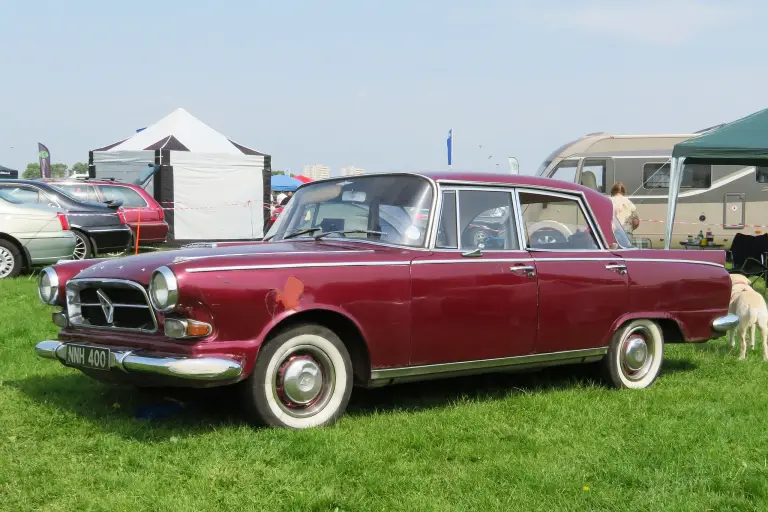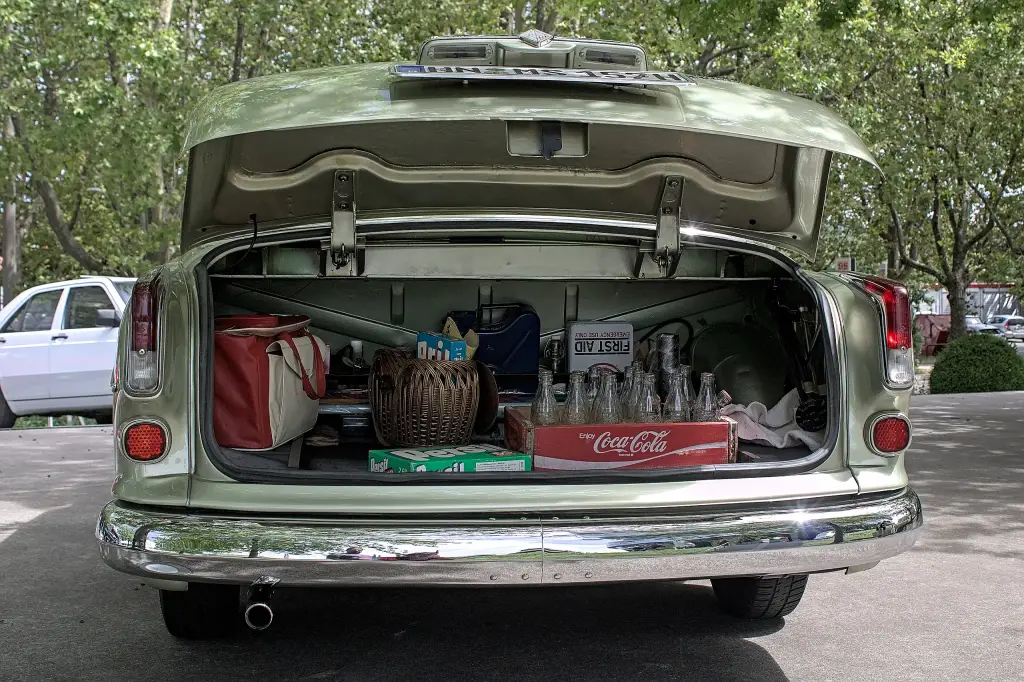
The Borgward Isabella was the car that made the Bremen group’s reputation. Introduced in 1954 as a modern monocoque saloon with a 1.5-litre engine, it stayed in production until 1962 and reached 202,862 examples, far more than any other Borgward. Its coupé, added in 1957, is still regarded as one of the best-looking German cars of its era.
Borgward Isabella at a glance
| Maker | Carl F. W. Borgward GmbH, Bremen |
|---|---|
| Production | 1954–1962 |
| Launch price | DM 7,265 |
| First-year output | 11,150 cars |
| Body | two-door saloon, three-door estate, two-door cabriolet, coupé |
| Engine | 1,493 cc four-cylinder, 60 bhp (75 bhp in TS form) |
| Construction | monocoque, no separate chassis |
| Gearbox | four-speed, fully synchronised, column change |
| Clutch | hydraulic, unusual at the time |
| Suspension | coil springs all round, swing axle at the rear |
| Top speed | 130 km/h at launch |
| Total built | 202,862 |
History of the Borgward Isabella
From Hansa 1500 to Isabella
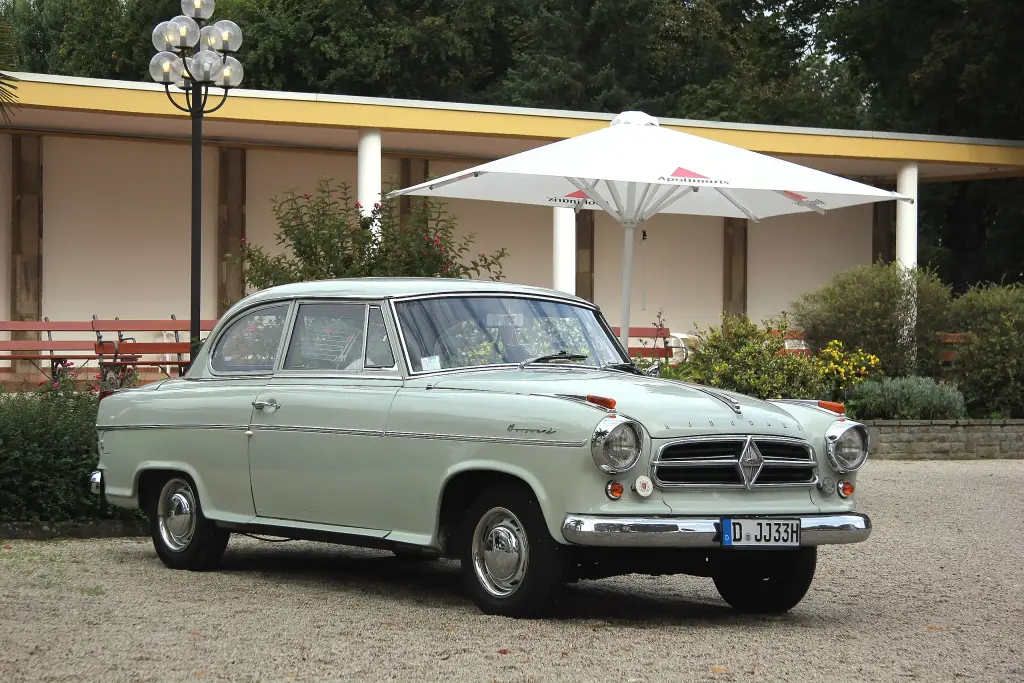
The new car was meant to be sold as the Borgward Hansa 1500, but the name Isabella was written on the pre-production cars used for testing in public and proved so popular with the engineers and the press that it was kept. Only the first few hundred cars left Bremen without Isabella badging, and Hansa lettering was still used until 1957. Production began on 10 June 1954. According to the German accounts the name was a spontaneous idea of Carl F. W. Borgward himself, who is said to have answered a question about what to paint on the secret prototypes with: write Isabella on them, for all I care. Borgward’s own rhombus carried the name from 1957, and in early 1958 the American firm BorgWarner complained that the pointed top of the badge split the word into Borg and ward; from the middle of 1958 the rhombus on the Isabella was made smaller.
A modern car at a competitive price
The Isabella had nothing in common with the Hansa it replaced apart from its general layout. It was a monocoque with no separate chassis, with a more curvaceous body than the flat-sided Hansa, pronounced wheel arches and a chrome strip along the flanks; Carl Borgward himself drew the shape and made 1:5 clay models. The front wheels were on double wishbones with coil springs and an anti-roll bar, the rear axle was a swing axle with trailing arms and coil springs, and the engine and front suspension sat on a subframe. The 1,493 cc four had a three-bearing crankshaft and a side camshaft driven by a gear made of phenol-resin fabric, while the carburettor was bolted to the valve cover. A hydraulic clutch and a fully synchronised four-speed gearbox with a column lever were advanced for the class. At DM 7,265 the car was dearer than an Opel Rekord or a Ford Taunus but cheaper than a Mercedes-Benz 180, and the first year brought 11,150 cars. A road test recorded 130 km/h and 8.4 litres per 100 km.
Estate, cabriolet and coupé
In the autumn of 1955 the two-door saloon was joined by a three-door estate and a cabriolet, and by the Isabella TS with 75 PS instead of 60 PS, recognisable by its boot badge and by the parking lamps on the front wings. The cabriolet was designed by Johannes Beeskow and built by Karl Deutsch in Cologne; without a roof the monocoque was so flexible that the conversion was extensive, and the car cost DM 9,950 against DM 7,565 for the estate. Sales fell by almost a third in 1955 and 1956, and Borgward decided to build a prettier car with a shortened roof. Four hand-built prototypes of the Isabella Coupé were shown in 1956 and were well received; Borgward gave one to his wife Elisabeth, who drove it into the 1980s. Series production with the TS engine began in January 1957 and about 9,500 to 10,000 were built; although 12 cm lower, the coupé was no longer than the saloon at 4.40 m. From 1958 the TS engine was also offered in the saloon and estate.
Model years, exports and the end
The Isabella was facelifted almost every year. For 1957 the cooling slots under the grille disappeared and the Hansa 1500 lettering in the rhombus gave way to Isabella; for 1958 came a dashboard with a ribbon speedometer; for 1959 the smaller rhombus, a straight side strip and the narrower angled rear lights of the Hansa 2400; the last changes in January 1961 brought a new dashboard with round instruments again and a decorative grille behind the radiator opening. Cars were exported to Australia, New Zealand and Malaysia, and the Isabella was also assembled from CKD kits in Surabaya, Indonesia, from 1955 to about 1970. In Argentina the local subsidiary Dinborg built 999 cars between 1960 and 1963. Borgward still had many unsold Isabellas when it went bankrupt in 1961, yet production in Bremen continued until 1962. The production line was then sold and shipped to Mexico, where the P100 was later assembled. A four-door electric Isabella concept was shown at the Frankfurt show in 2017.
Design and features
- Monocoque body: no separate chassis, with a shape drawn by Carl Borgward himself.
- Hydraulic clutch: a novelty in a family saloon of 1954.
- Coil springs all round: double wishbones at the front, a swing axle with trailing arms at the rear.
- TS engine: 75 bhp instead of 60 bhp, offered from 1955 and standard in the coupé.
- Yearly updates: ribbon speedometer in 1958, smaller rhombus in 1959, new dashboard in 1961.
Borgward Isabella versions
- Saloon (1954–1962): two-door only, the bread-and-butter model.
- Estate (1955–1962): three-door combi at DM 7,565, later with a top-hinged tailgate.
- Cabriolet (1955–1962): two-door by Karl Deutsch, DM 9,950.
- TS (1955–1962): 75 bhp version of the saloon, estate and cabriolet.
- Coupé (1957–1962): shortened roof, about 9,500–10,000 built.
- Argentinian cars: 999 Isabellas assembled by Dinborg in Buenos Aires, 1960–1963.
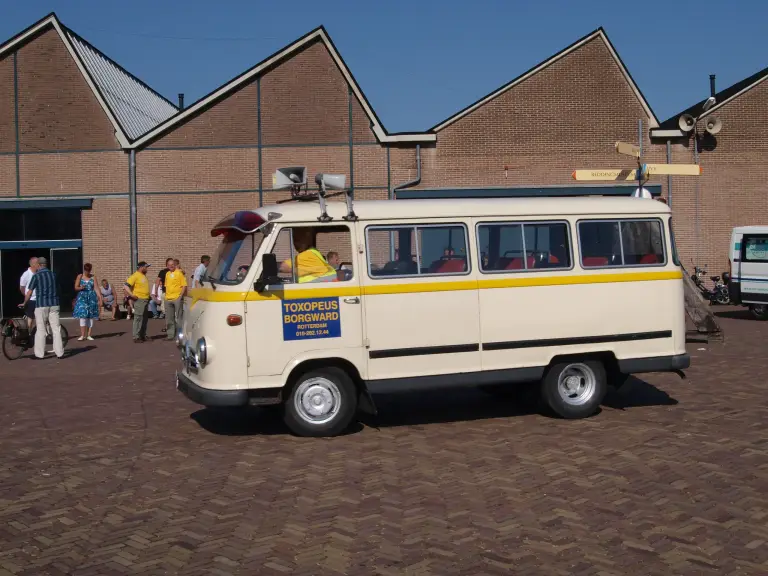
The Isabella replaced the Hansa 1500, and its 1.5-litre engine was later used in the Borgward B 611 van. More cars are in the Borgward collection.
Sources
- Borgward Isabella, English Wikipedia: launch, price, variants, exports and end of production
- Borgward Isabella, German Wikipedia: design, engine, model-year changes, prices