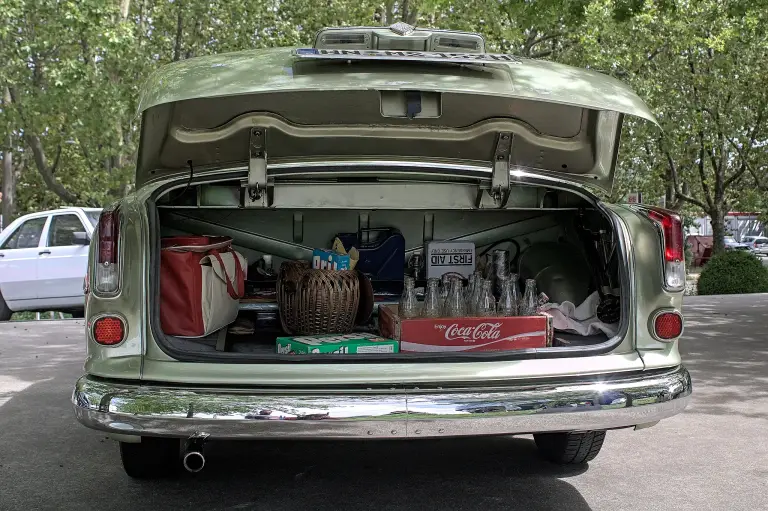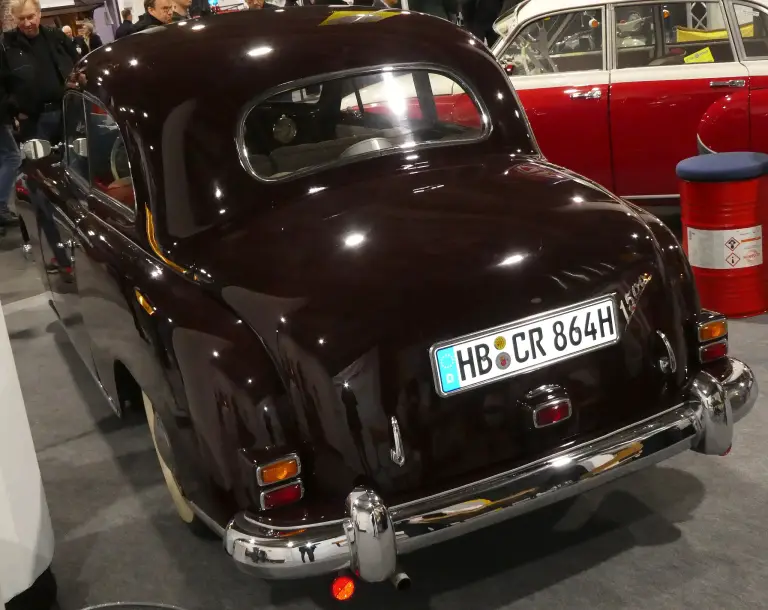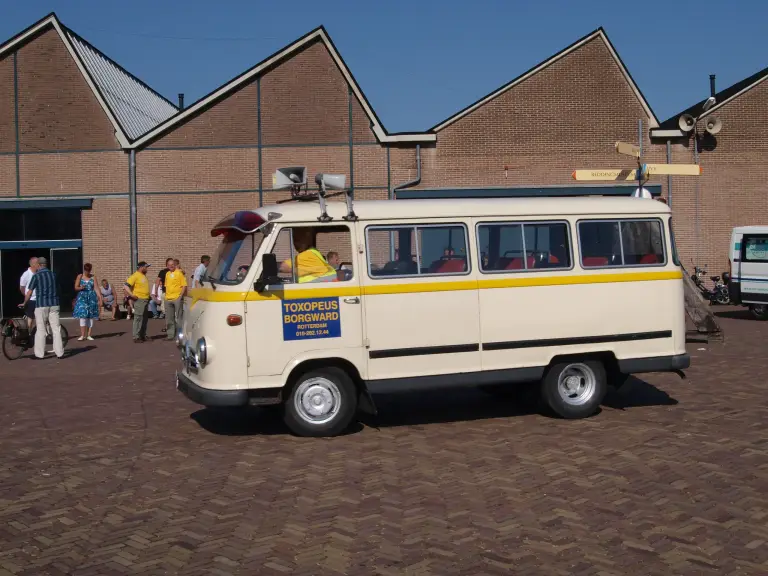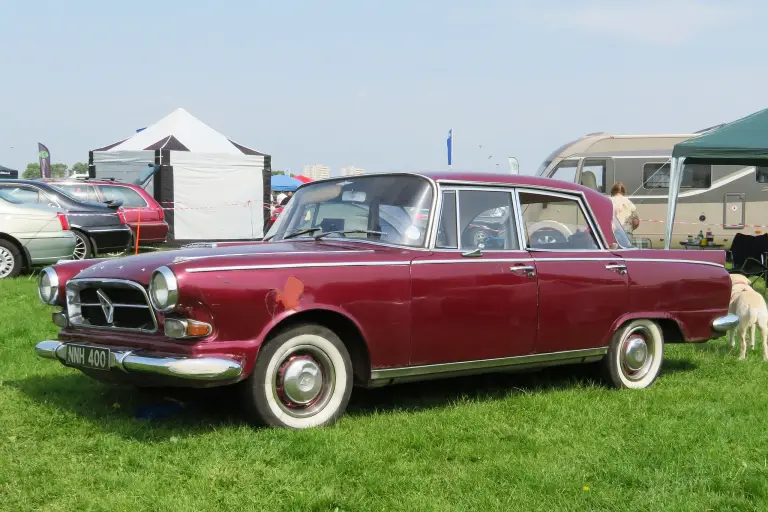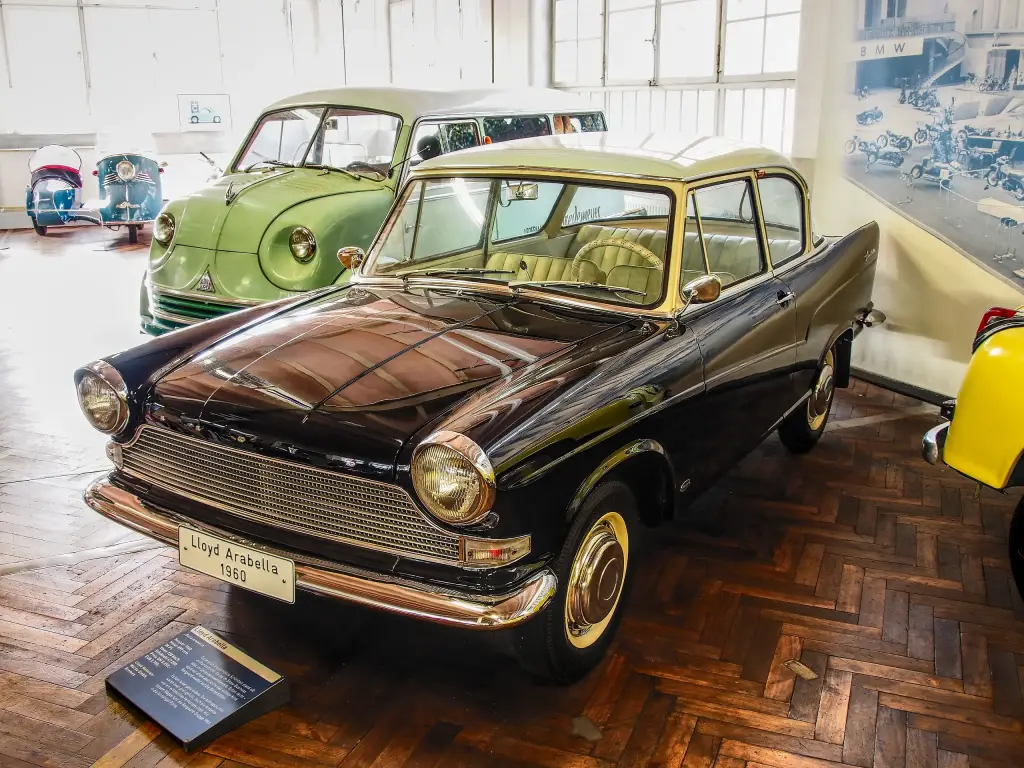
The Borgward Arabella began life in August 1959 as the Lloyd Arabella, the first and only car from Borgward’s Lloyd division with a four-cylinder engine. After the group’s controversial bankruptcy it was kept alive in reduced numbers under the Borgward name until 1963. Small, well equipped and unusually safety-minded for its class, it was the last passenger car to carry the Borgward badge from Bremen.
Borgward Arabella at a glance
| Maker | Lloyd Motorenwerke GmbH, Bremen (Borgward group) |
|---|---|
| Production | 1959–1961 as Lloyd, 1961–1963 as Borgward |
| Development time | 23 months |
| Body | two-door saloon, all-steel |
| Engine | 897 cc water-cooled flat-four |
| Power | 38 PS; 34 PS in the economy version; 45 PS in the de Luxe |
| Top speed | 120 km/h; 133 km/h in the de Luxe |
| 0–100 km/h | 28 seconds; 23 seconds in the de Luxe |
| Brakes | four light-alloy drums, 200 mm |
| Tyres | tubeless, on 13-inch wheels |
| Turning circle | about 10 m |
| Total built | 47,042 |
History of the Borgward Arabella
A new Lloyd in 23 months
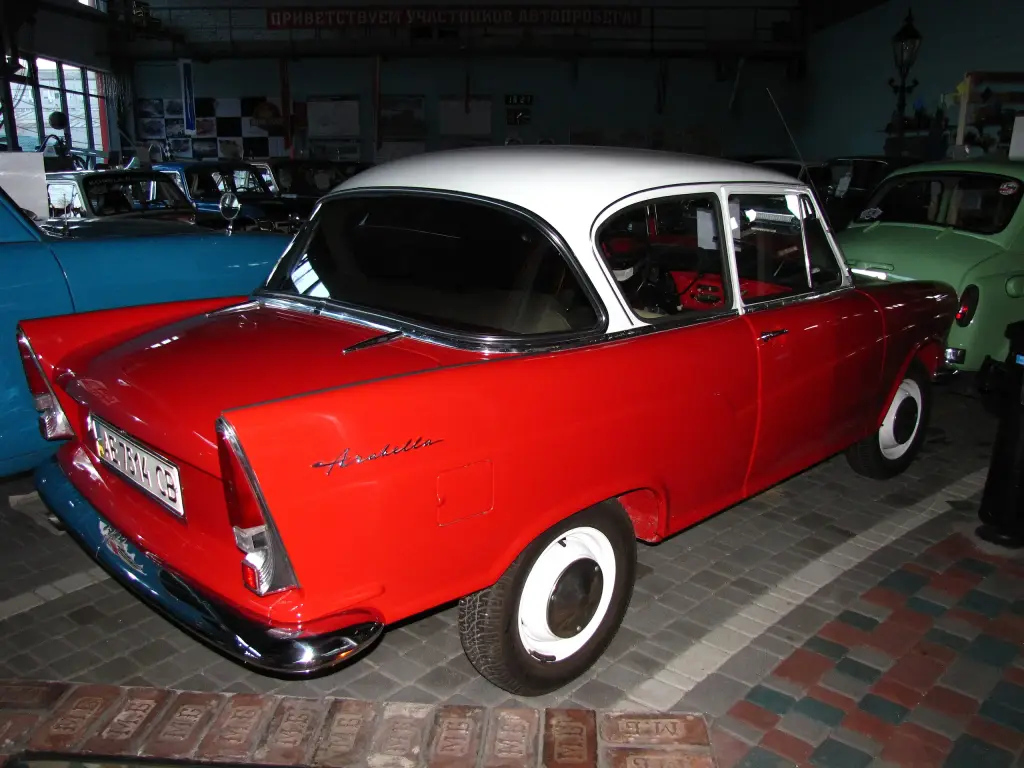
The Arabella was a completely new design that owed little to the Lloyd Alexander it first complemented and then replaced. Its development took just 23 months, which later commentators judged far too short a time to find and cure the teething troubles before the launch. The car used a frame of steel tubes with cross-members. The front wheels were on double wishbones with coil springs and telescopic dampers, the rear wheels on trailing arms with coil springs and an anti-roll bar. The brakes were hydraulic, with four light-alloy drums of 200 mm, and the specification of tubeless tyres on 13-inch wheels was almost as novel. Rack-and-pinion steering needed 3.36 turns between the locks and the turning circle was 10.7 m. The all-steel body followed the fashion of the day with a panoramic wrap-around rear window and tail fins, and there was room for four people, although headroom in the back was limited.
Safety as a selling point
Borgward’s sales material made much of the car’s passive safety, unusual in this class at the time: a two-spoke steering wheel with a recessed central hub, rounded door handles, a lock that stopped the front seat backs from tilting forward unexpectedly, and a padded dashboard and window frames. There were still no head restraints or seat belts, not even as an option. The spare wheel was carried underneath the luggage compartment and could be reached from outside without emptying the boot.
The flat-four under a low bonnet
The original plan was to use an uprated version of the two-cylinder engine and gearbox of the Lloyd Alexander, but tests showed that the combination would not fit under the bonnet of a body that had already been signed off. A four-cylinder water-cooled boxer was therefore developed in a hurry: its flat layout suited the low bonnet line, but space was so tight that the cooling fan had to be squeezed in above the cylinders on the left-hand bank. Unlike the smaller Lloyds, the Arabella used water cooling. The gearbox sat ahead of the front axle and ahead of the engine, as on the firm’s small cars, and had to be redesigned for the longer installation; the engine itself was mounted longitudinally. A Saxomat automatic clutch was available on request.
Three versions in two years
At its launch in August 1959 the Arabella had an 897 cc engine of 38 PS at 4,800 rpm. A major price increase during 1960 was softened by a cut-price version launched in July 1960, with the same engine detuned to 34 PS and a price of DM 4,985. In October 1960 a de Luxe model followed with 45 PS at 5,300 rpm, obtained by raising the compression ratio from 7.5:1 to 9:1 and fitting a larger Solex carburettor. Top speed rose from 120 to 133 km/h and the 0–100 km/h time fell from 28 to 23 seconds, which made the small Borgward brisker than larger and heavier cars such as the Ford Taunus, and well ahead of the Volkswagen of 1960 with its 112 km/h and 38 seconds. The de Luxe was recognised by a revised grille with the Borgward rhombus at its centre and the word Borgward on the nose instead of Lloyd, although the car was only formally renamed in 1961.
“Aquabella” and the end
By July 1961 Lloyd had built 45,549 Arabellas, and after the collapse of the Borgward group another 1,493 were made until 1963, for a total of 47,042. The car never became the sales success its makers hoped for. Early gearbox failures and water leaking into the interior in heavy rain led to expensive recalls and damaged its reputation, and in popular speech it became known as the Aquabella. A coupé shown at the Frankfurt show in 1959 never reached production: only the two exhibition cars were built.
Design and features
- Water-cooled flat-four: developed at short notice to fit under a bonnet already designed, with the fan squeezed above the left cylinder bank.
- Passive safety: recessed steering-wheel hub, rounded handles, padded dashboard and window frames, locked front seat backs.
- De Luxe engine: 45 PS and 133 km/h from 897 cc, against 120 km/h for the standard car.
- Externally stowed spare wheel: reachable without unloading the boot.
- Tubeless tyres: on 13-inch wheels, advanced for a small car of 1959.
Borgward Arabella versions
- Arabella (1959–1963): the standard 38 PS car, later sold with Borgward badging.
- Economy version (1960–1963): detuned to 34 PS and priced at DM 4,985.
- Arabella de Luxe (1960–1963): 45 PS, higher compression, larger Solex carburettor, Borgward grille.
- Arabella Coupé: shown in 1959, never put into production.
- Borgward Arabella (1961–1963): the same car built after the bankruptcy under the parent name.
The Arabella came from the same Bremen group as the Borgward Isabella and was the last car to carry the name after the P100. More cars are in the Borgward collection.
Sources
- Lloyd Arabella, English Wikipedia: design, engine, versions, performance
- Lloyd Arabella, German Wikipedia: chassis, prices, production figures, reputation