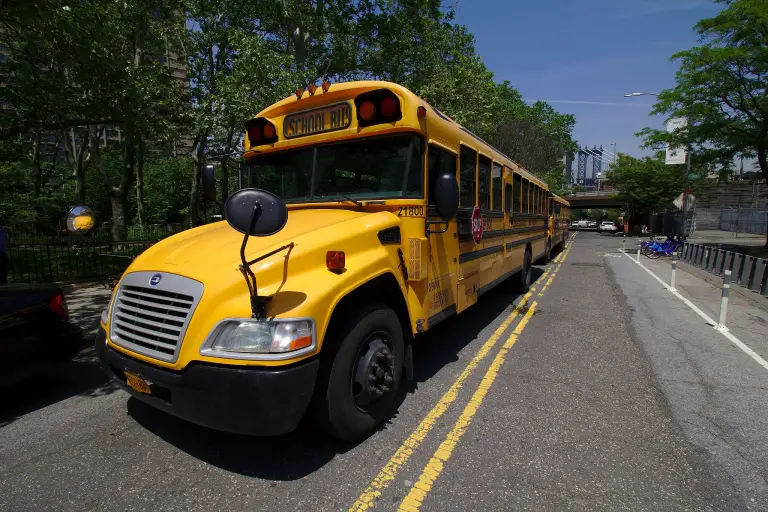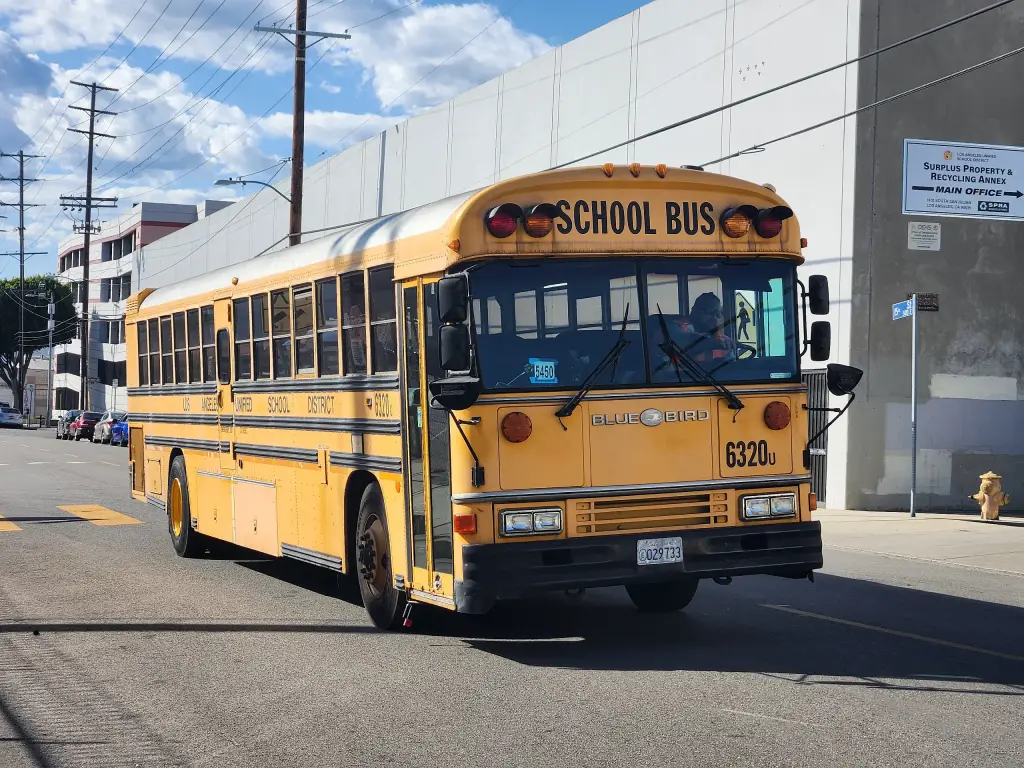
The Blue Bird All American is the oldest model line of the American school bus maker Blue Bird Corporation, in production without a break since 1949. Its flat-front, transit-style body became the standard for large school buses in North America, and the line is now in its sixth generation, introduced for 2014.
Blue Bird All American at a glance
| Maker | Blue Bird Corporation (originally Blue Bird Body Company), Fort Valley, Georgia |
|---|---|
| Production | since 1949, sixth generation from 2014 |
| Type | transit-style (flat-front) school bus |
| Layout | front engine; rear engine option from 1961 |
| Chassis | Blue Bird proprietary design since 1952 |
| Body | steel; front axle behind the entry door |
| Capacity | up to 72 passengers in the early range |
| Headlights | quad units from 1958 to 2013 |
| Assembly | Fort Valley, Georgia; also South America from the 1960s to the 1980s |
| Distinction | longest-assembled commercial vehicle line in the world |
Based on the English Wikipedia article; one source.
History of the Blue Bird All American
In the 1930s American builders began moving the engine next to the driver and the front axle behind the entry door, creating the forward-control school bus with more seats in the same length and a shorter, more manoeuvrable wheelbase. After the Second World War Blue Bird founder A.L. Luce wanted such a bus of his own. During a 1948 trip to Europe he and his son George visited the Paris Auto Salon, where a front-engine motorcoach on a General Motors chassis built in an Opel factory in Belgium caught their eye.
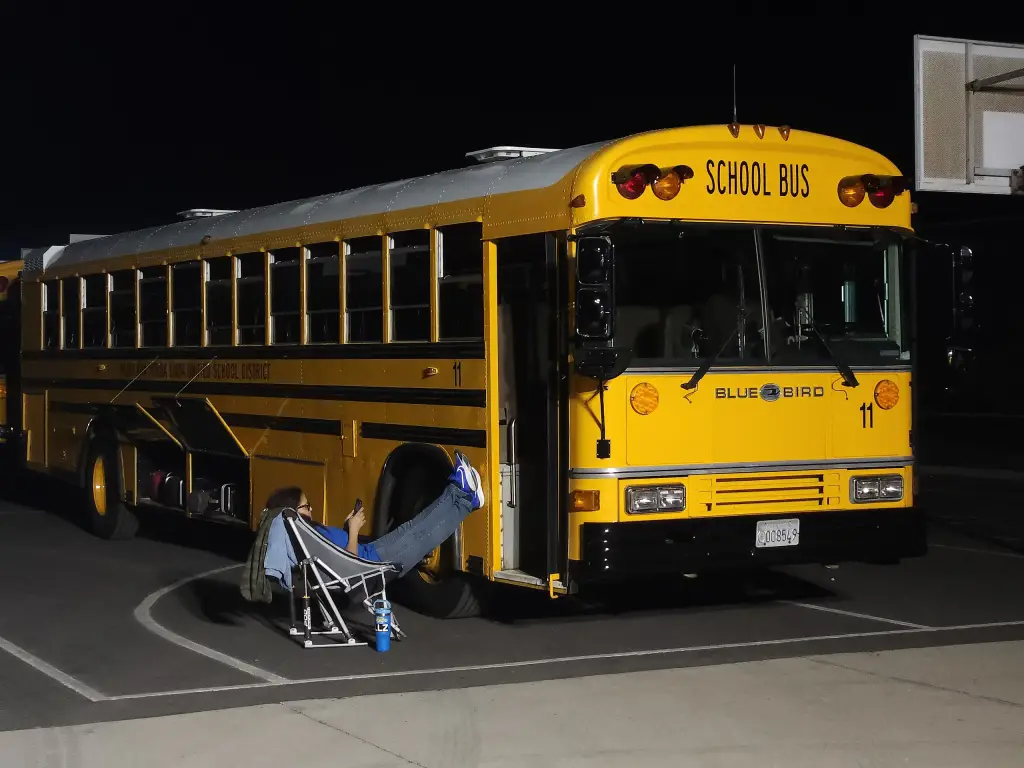
The Luces bought the coach and shipped it to Fort Valley to be reverse-engineered. Blue Bird engineers found the Opel chassis close to a Chevrolet medium-duty truck converted to forward control, with a widened front axle, modified steering and, unusually, a remote-control gearshift. Chevrolet was chosen for the first prototype, completed in 1949 and named the All American; engineering problems kept it out of full production until 1950.
The first generation (1950–1956) used Chevrolet and GMC chassis stripped and converted to forward control before the body went on, a slow and costly process. In 1952 Blue Bird dropped second-party chassis and built its own, as it has done for every front-engine All American since. The body gained a larger entry and front door, a nearly vertical windshield, a less rounded rear and side windows almost the full length of the bus, and the largest versions seated 72.
The second generation arrived for 1957 with a taller roof and flatter sides so that older students could stand upright, a redesigned driver’s compartment, enlarged entry-door glass and a panoramic windshield. Quad headlights, permitted by federal legislation in 1958, stayed in various forms until 2013. In 1961 Blue Bird added a rear-engine “pusher” version, and since 1988 every rear-engine All American has used a Blue Bird chassis. The line has been built almost entirely at Fort Valley, with production in South America from the 1960s to the 1980s, and its chassis engineering was later carried over to the TC/2000 and Vision.
Design and features
- Transit-style body: a flat front with the front axle behind the entry door, which the All American made the North American norm.
- Own chassis: a Blue Bird design since 1952, with rear-engine versions on a Blue Bird chassis since 1988.
- Long production run: uninterrupted since 1949, the longest of any commercial vehicle line.
- Wide range of uses: school bus first, but also law enforcement vehicles and the basis of the Wanderlodge motorhome.
Blue Bird All American versions
- All American FE: front-engine layout, the original configuration.
- All American RE: rear-engine pusher introduced in 1961 and built on a Blue Bird chassis from 1988.
- First generation (1950–1956): converted Chevrolet and GMC chassis, up to 72 seats.
- Second generation (1957–1989): taller body, panoramic windshield and quad headlights.
- Sixth generation (2014–): the current line.
The All American was the donor vehicle for the Blue Bird Wanderlodge motorhome, and its chassis thinking led to the TC/2000. More buses are in the Blue Bird collection.
Video: 1986 Blue Bird All American
Video by the uploader on YouTube.
Sources
- Blue Bird All American, English Wikipedia: history, generations, chassis, capacity