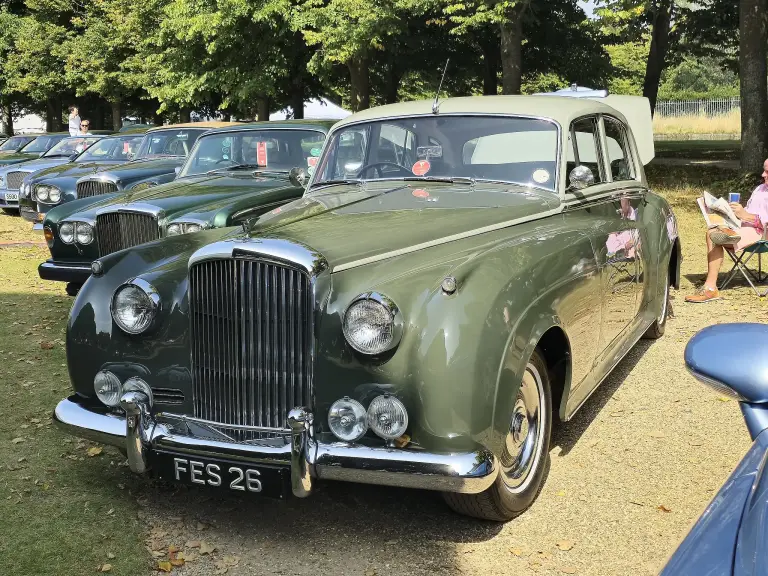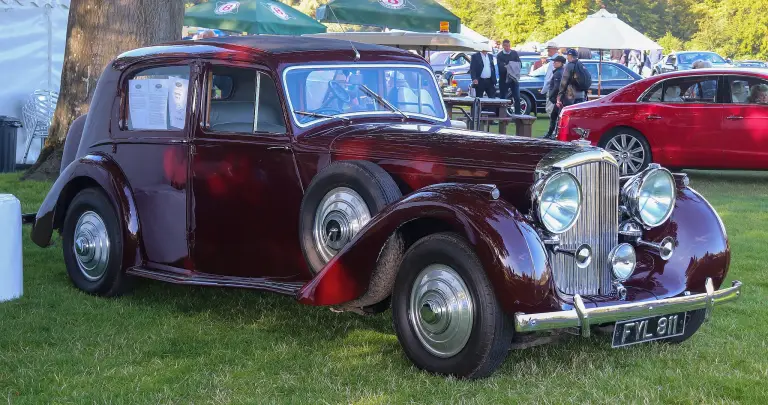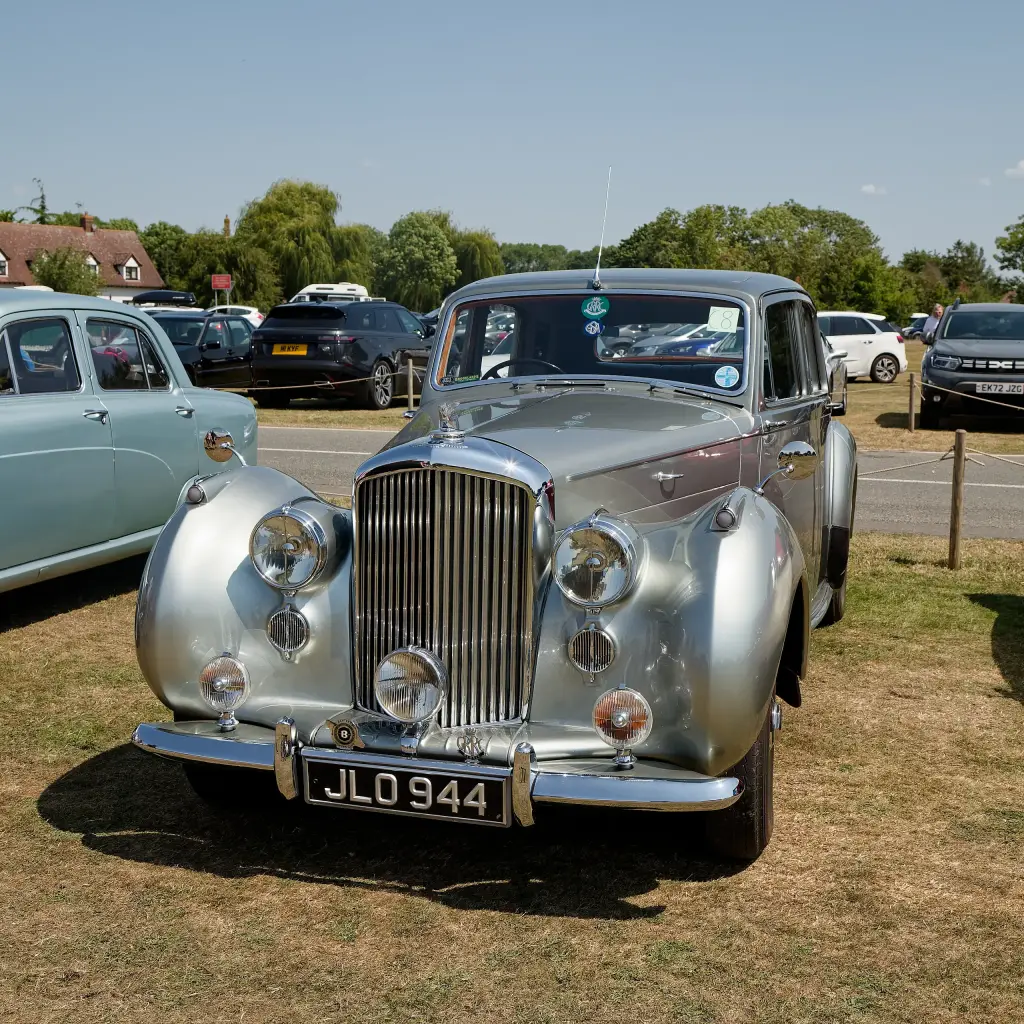
The Bentley Mark VI was Bentley’s first post-war luxury car, produced from 1946 to 1952. Its four-door standard steel sports saloon was both the first car from Rolls-Royce with all-steel coachwork and the first complete car assembled and finished at the factory.
Bentley Mark VI at a glance
| Maker | Bentley Motors, Crewe |
|---|---|
| Production | 1946–1952 |
| Announced | May 1946 |
| Engine | 4,257 cc straight-six, later 4,566 cc |
| Valve gear | F-head: inlet valves in the head, exhaust valves at the side |
| Transmission | four-speed manual, later a GM automatic option |
| Front suspension | independent, coil springs |
| Rear suspension | leaf springs with hydraulic damper adjustment |
| Brakes | 311 mm drums with Rolls-Royce mechanical servo |
| Top speed | 160 km/h (4.6-litre, tested 1951) |
| Built | 4,000 of 4,257 cc and 1,202 of 4,566 cc |
History of the Bentley Mark VI
In 1944 the Rolls-Royce executive W. A. Robotham saw that post-war demand for a bare chassis with a body from a specialist coachbuilder would be limited. He negotiated with the Pressed Steel Company a contract for a general-purpose body to carry four people in comfort on the post-war chassis behind a Rolls-Royce or Bentley radiator. Pressed Steel were taken aback by the modest demand, even after Robotham stretched it to 2,000 a year. The result was the Mark VI standard steel sports saloon, announced in May 1946: the first Bentley factory-finished car.
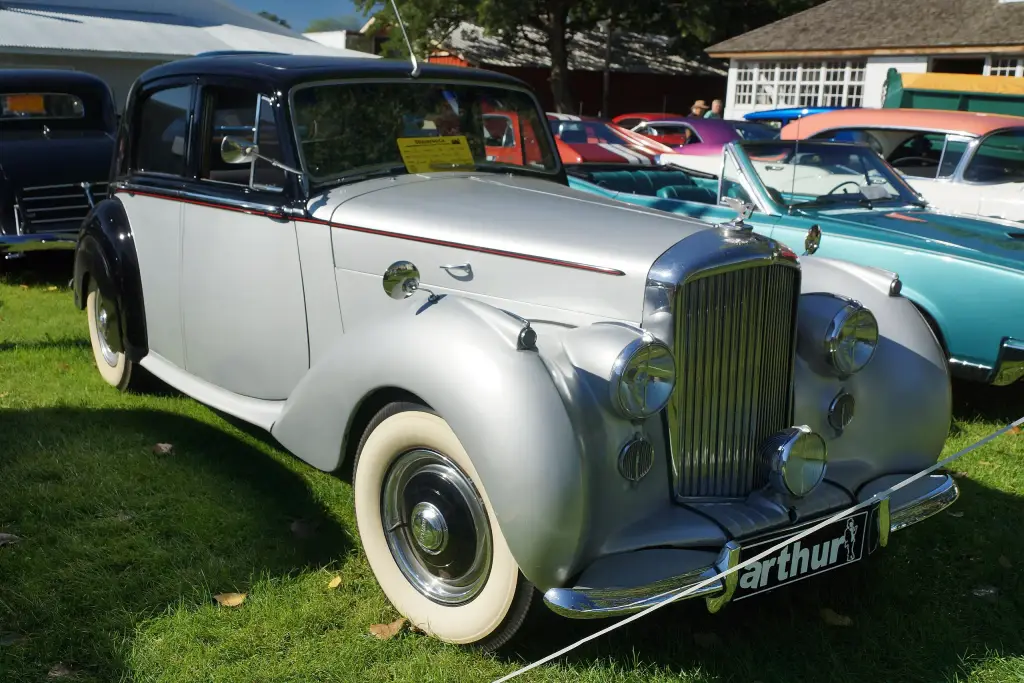
Chassis continued to be supplied to independent coachbuilders, who produced four-door saloons, two-door saloons and drophead coupés; the most sought after of the coachbuilt cars are the 241 built by H. J. Mulliner. The Mark VI’s shorter chassis and engine were a variant of the Rolls-Royce Silver Wraith of 1946, and with the same standard steel body they became the cautiously introduced Rolls-Royce Silver Dawn of 1949. In 1952 the bodies gained a boot about twice the size and the Bentley became the R Type. The Mark VI was a genuine success, though its weakness lay in the inferior steels forced on the company by post-war government controls.
Engine
The Mark VI used an F-head straight-six of 4,257 cc, with inlet valves in the head and exhaust valves at the side. Rolls-Royce refused to disclose a power output beyond the tax horsepower of 29.4 hp by the old RAC formula, but a 1950 Autocar road test found flexibility down to 6 mph in top gear and the ability to climb a 1-in-9 gradient with bends. In 1951 a 4,566 cc version arrived, the bore growing from 3½ to 3⅝ inches; it is often called the big-bore engine and the earlier unit the small-bore. Right-hand-drive cars had two horizontal SU carburettors, left-hand-drive cars a single Stromberg. A four-speed synchromesh manual was fitted, with the lever on the right for right-hand drive and on the column for left-hand drive, and an automatic transmission later became available.
Chassis and running gear
The chassis used leaf springs at the rear and independent coil springing at the front. A control at the centre of the steering wheel adjusted the hardness of the rear springing by hydraulic adjustment of the dampers, using transmission oil. A pedal-operated central lubrication system fed oil to the moving parts of the suspension from a central reservoir, and the 311 mm drum brakes were assisted by the traditional Rolls-Royce mechanical servo at the transmission. Italian sources give 4,000 cars with the 4,257 cc engine, 832 of them coachbuilt, and 1,202 with the 4,566 cc engine, 180 of them coachbuilt; a 1951 road test of the larger car recorded 160 km/h, 0–97 km/h in 15 seconds and a price of £4,473 including taxes.
Design and features
- All-steel factory body: the first Rolls-Royce product with standard steel coachwork finished in the factory.
- F-head six: inlet valves in the head, exhaust valves at the side, in 4,257 cc and 4,566 cc forms.
- Adjustable rear damping: a control on the steering wheel centre altered the rear springing.
- Central lubrication: a pedal-operated system fed the suspension from one reservoir.
Bentley Mark VI versions
- Standard steel saloon (1946–1952): the factory-bodied four-door.
- 4½ Litre big-bore (1951–1952): 4,566 cc, twin exhaust on right-hand-drive cars, 1,202 built.
- Coachbuilt cars: four-door and two-door saloons and drophead coupés, including 241 by H. J. Mulliner.
- R Type (1952): the Mark VI with a larger boot, renamed from the chassis series.
The Mark VI followed the Mark V and was replaced by the R Type. More cars are in the Bentley collection.
Video: Bentley Mk VI Chassis after restoration
Video by Andrew Baldwin on YouTube.
Sources
- Bentley Mark VI, English Wikipedia: body, engine, chassis, coachbuilders
- Bentley Mark VI, Italian Wikipedia: engine, transmission, production, road test
- Bentley Mark VI, French Wikipedia: successor, Continental