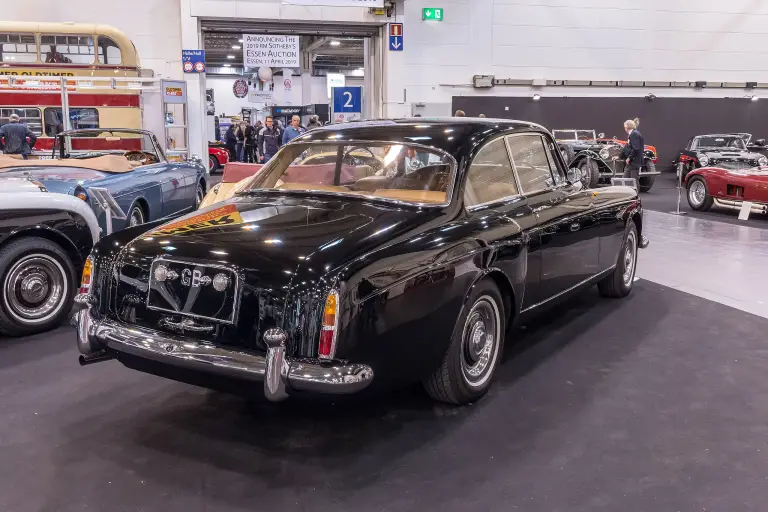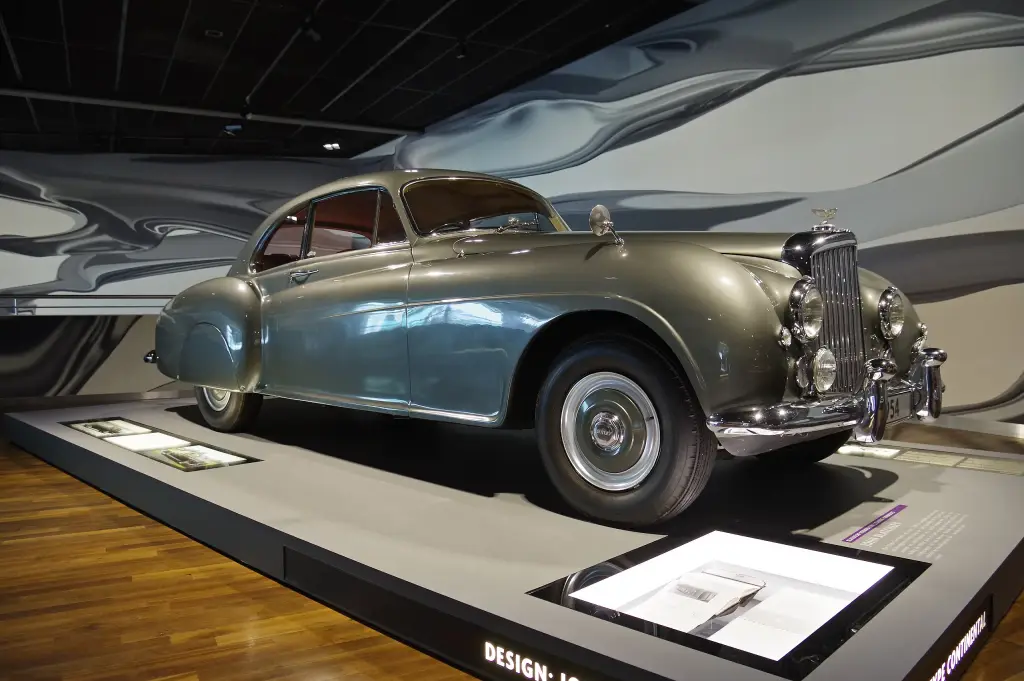
The Bentley R Type Continental was the high-performance version of the R Type and, at its introduction, the fastest four-seat car in production. Built from 1952 to 1955, it was developed with aerodynamic testing and coachwork by H. J. Mulliner, and 207 were made.
Bentley R Type Continental at a glance
| Maker | Bentley Motors, chassis built at Crewe |
|---|---|
| Production | 1952–1955 |
| Body | two-door fastback coupé, aluminium |
| Engine | 4,566 cc straight-six, iron block and aluminium head |
| Bore and stroke | 92 mm × 114.3 mm; 94.62 mm bore from July 1954 |
| Compression | 7.25:1, raised from the standard 6.75:1 |
| Carburation | twin SU Type H6 |
| Transmission | four-speed manual |
| Maximum weight | 1,700 kg, to keep the tyres safe at 120 mph |
| Built | 207 |
This page covers the Continental version of the R Type and is based on English Wikipedia only, so the facts were not cross-checked against a second source.
History of the Bentley R Type Continental
The R Type was the second series of post-war Bentley, produced from 1952 to 1955 as the successor to the Mark VI. It was essentially a Mark VI with a boot almost twice as large, and some regard it as a stop-gap before the S series of 1955. During development it was called the Bentley Mark VII, and the R Type name comes from the RT chassis series. The engine was the 4,566 cc iron-block, aluminium-head straight-six with twin SU Type H6 carburettors, a 92 mm bore and a 114.3 mm stroke, and a four-speed manual was standard, with a four-speed automatic becoming standard on later cars. The brakes were 311 mm drums, hydraulic at the front and mechanical at the rear through a gearbox-driven servo. A four-door saloon with automatic transmission tested by The Motor in 1953 reached 101.7 mph and 0–60 mph in 13.25 seconds, and cost £4,481 including taxes.
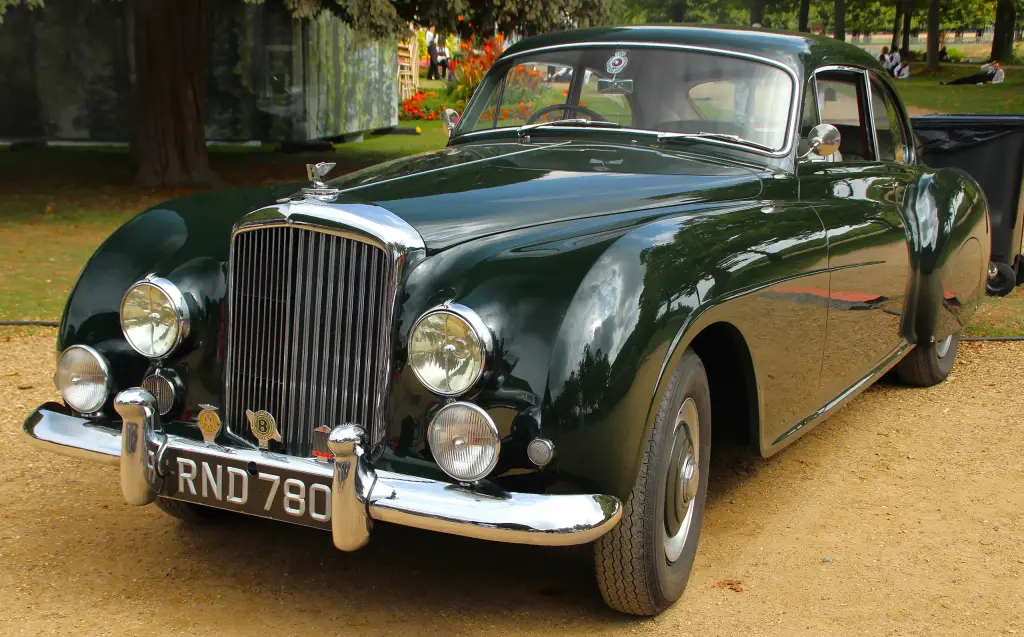
Development with H. J. Mulliner
The Continental was developed by a team of Rolls-Royce designers and engineers working with H. J. Mulliner & Co., led by Rolls-Royce’s chief project engineer Ivan Evernden. Rolls-Royce chose Mulliner rather than its own Park Ward subsidiary because Mulliner had developed a lightweight body construction using metal throughout instead of the traditional ash frame. The styling, finalised by Stanley Watts of H. J. Mulliner, was influenced by aerodynamic testing in Rolls-Royce’s wind tunnel by Evernden’s assistant Milford Read, and the rear fins stabilised the car at speed and made it resistant to crosswinds. A maximum kerb weight of 1,700 kg was specified to keep the tyres within a safe load limit at a top speed of 120 mph.
The prototype, chassis 9-B-VI and registered OLG-490, was nicknamed “Olga” and was on the road by August 1951. Olga and the first production Continentals were based on the Mark VI chassis and used a manual mixture control on the steering wheel boss because they had no automatic choke. The early R Type Continental had essentially the same engine as the standard R Type, but with modified carburation, induction and exhaust manifolds and higher gear ratios: compression rose to 7.25:1 and the final drive was raised from 3.41 to 3.07.
Bodies and production
Despite its name, the two-door Continental was produced principally for the home market: most of the 207 cars were right-hand drive, with 43 left-hand drive examples for abroad. The chassis was built at Crewe and delivered as a rolling chassis to the coachbuilder of choice. Most bodies were completed by H. J. Mulliner in fastback coupé form; Park Ward of London built six, later including a drophead coupé, Franay of Paris five, Graber of Wichtrach three, Pininfarina one and James Young a Sports Saloon for the company owner James Barclay in 1954. After July 1954 the engine was given a larger 94.62 mm bore and a displacement of 4,887 cc. The model’s rarity has made it valuable: in 2015 an unrestored 1952 R Type Continental sold for over $1 million.
Design and features
- Aerodynamic body: styled with wind-tunnel testing by Rolls-Royce and built in aluminium by H. J. Mulliner.
- Rear fins: fitted to stabilise the car at speed and in crosswinds.
- Higher gearing: a 7.25:1 compression ratio and a 3.07 final drive for the fast coupé.
- Lightweight construction: a metal body instead of the traditional ash frame.
Bentley R Type Continental versions
- H. J. Mulliner fastback coupé: the standard Continental body, the majority of the 207 cars.
- Park Ward bodies: six cars, later including a drophead coupé.
- Continental coachwork from the continent: five by Franay, three by Graber and one by Pininfarina.
- 4.9-litre cars (from July 1954): a 94.62 mm bore and 4,887 cc.
The R Type Continental was followed by the S1 Continental, and the saloon it was based on is described on the Mark VI page. More cars are in the Bentley collection.
Video: Classic British Cars – Bentley R Type Continental
Video by TR4man on YouTube.
Sources
- Bentley R Type, English Wikipedia: R Type, R-Type Continental, development, production