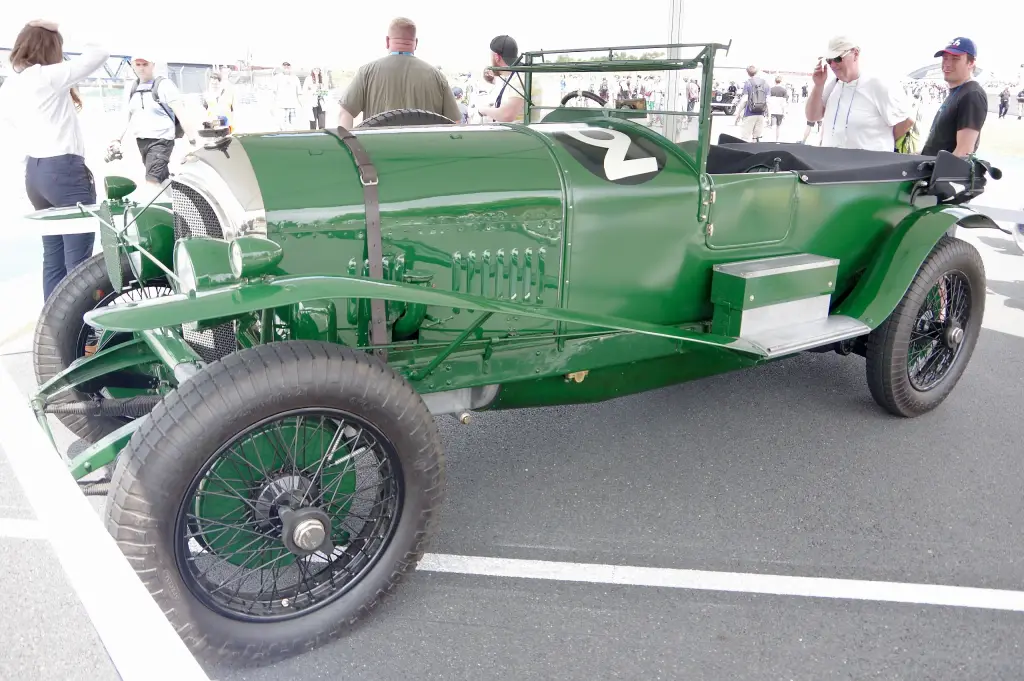
The Bentley 3 Litre was the first car made by W. O. Bentley’s company. Developed from 1919, the chassis was offered to customers’ coachbuilders from 1921 to 1929, and it won the 24 Hours of Le Mans in 1924 and again in 1927 in Super Sports form.
Bentley 3 Litre at a glance
| Maker | Bentley Motors, Cricklewood, London |
|---|---|
| Production | 1921–1929 |
| Engine | 2,996 cc straight-four, single overhead camshaft, four valves per cylinder |
| Bore and stroke | 80 mm × 149 mm |
| Power | about 70 hp, more in Speed and Super Sports form |
| Top speed | 80 mph; 90 mph Speed Model; over 100 mph Super Sports |
| Gearbox | four-speed manual |
| Wheelbase | 2,743 mm, 2,984 mm or 3,302 mm |
| Brakes | rear wheels only until 1924, then four-wheel |
| Le Mans wins | 1924 and 1927 |
| Built | 1,622: 1,088 3 Litre, 513 Speed Model, 18 Super Sports, 3 experimental |
History of the Bentley 3 Litre
The 3 Litre was developed from 1919 and shown as a chassis at the 1919 London Motor Show, but the engine was not yet finished. It took two more years to get it right, and the first customer car was delivered in September 1921. Production ran to 1929, by which time Bentley’s own 4½ Litre had surpassed it. The car was much larger than the 1,368 cc Bugattis that dominated racing at the time, but double the engine size and great strength compensated for the extra weight.
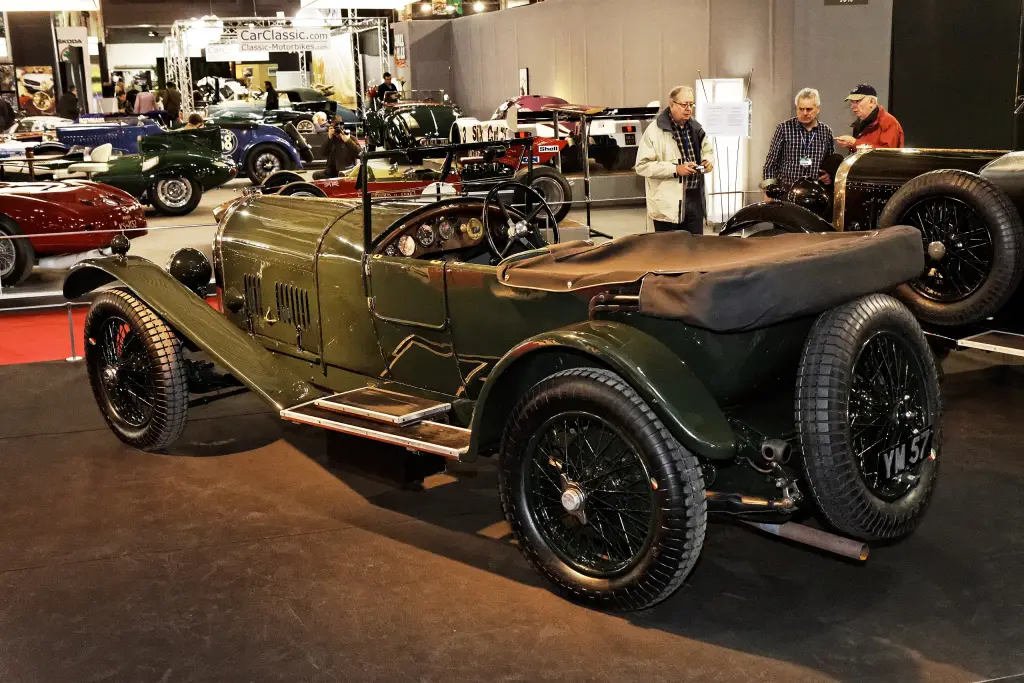
In 1924 a 3 Litre driven by John Duff and Frank Clement won the 24 Hours of Le Mans, and in 1927 the model won again in Super Sports form with S. C. H. “Sammy” Davis and Dudley Benjafield. Its weight, size and speed led Ettore Bugatti to call it “the fastest lorry in the world”, which Bentley people took as a compliment.
Engine and chassis
The 3.0-litre engine was designed by Clive Gallop, an ex-Royal Flying Corps engineer, and was technically advanced for its time: one of the first production car engines with four valves per cylinder, dry-sump lubrication and an overhead camshaft. The four-valve hemispherical design with bevel-geared camshaft drive was based on a pre-war Mercedes racing engine. The cast-iron monobloc and fully enclosed aluminium camshaft made it durable, and it was also among the first engines with two spark plugs per cylinder and twin carburettors. It was extremely undersquare, with an 80 mm bore and a 149 mm stroke, tuned for low-end torque.
The chassis was designed by Frederick Tasker Burgess, previously chief designer at Humber, who had worked with W. O. Bentley during the war on the BR1 and BR2 aero engines. Bentley did not deliver complete cars: as was customary, the customer received a running chassis and chose a coachbuilder, often the near neighbour Vanden Plas. Only the rear wheels had brakes until 1924, when four-wheel brakes were introduced.
Production is usually given as 1,088 standard 3 Litre cars, 513 Speed Models and 18 Super Sports, plus three experimental chassis. The oldest surviving production Bentley is chassis number 3, delivered in 1921 with bodywork by R. Harrison & Son; in 2011 it sold at auction for $962,500 including buyer’s premium.
Design and features
- Advanced four-cylinder: four valves per cylinder, overhead camshaft, dry-sump lubrication and twin spark plugs.
- Long-stroke torque: 80 mm bore and 149 mm stroke gave strong low-speed pull rather than high revs.
- Rolling chassis: buyers chose their own body, with Vanden Plas a favourite among Bentley’s recommendations.
- Racing pedigree: outright wins at Le Mans in 1924 and 1927.
Bentley 3 Litre versions
- Blue Label: the standard model, 2,984 mm wheelbase from 1921 to 1929, or a long 3,302 mm chassis from 1923.
- Red Label: a 5.3:1 high-compression engine in the 2,984 mm chassis, made from 1924 to 1929.
- Green Label: the high-performance version with 6.3:1 compression and a short 2,743 mm chassis, guaranteed at 100 mph.
- Supercharged experiment: in the winter of 1926/7 the factory fitted a Roots blower to chassis 220 FR5189, two years before the Birkin Blower Bentleys.
The 3 Litre was replaced by the Bentley 4½ Litre, and its six-cylinder brother was the Speed Six. More cars are in the Bentley collection.
Sources
- Bentley 3 Litre, English Wikipedia: development, engine, variants, production
- Bentley 3 Litre, Italian Wikipedia: coachwork, brakes, wheelbases
- Bentley 3 Litre, French Wikipedia: development, labels, production