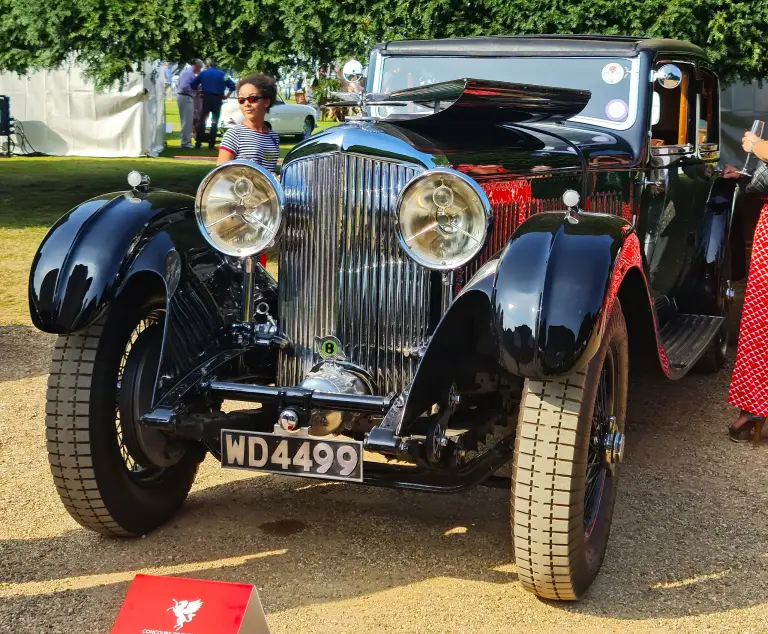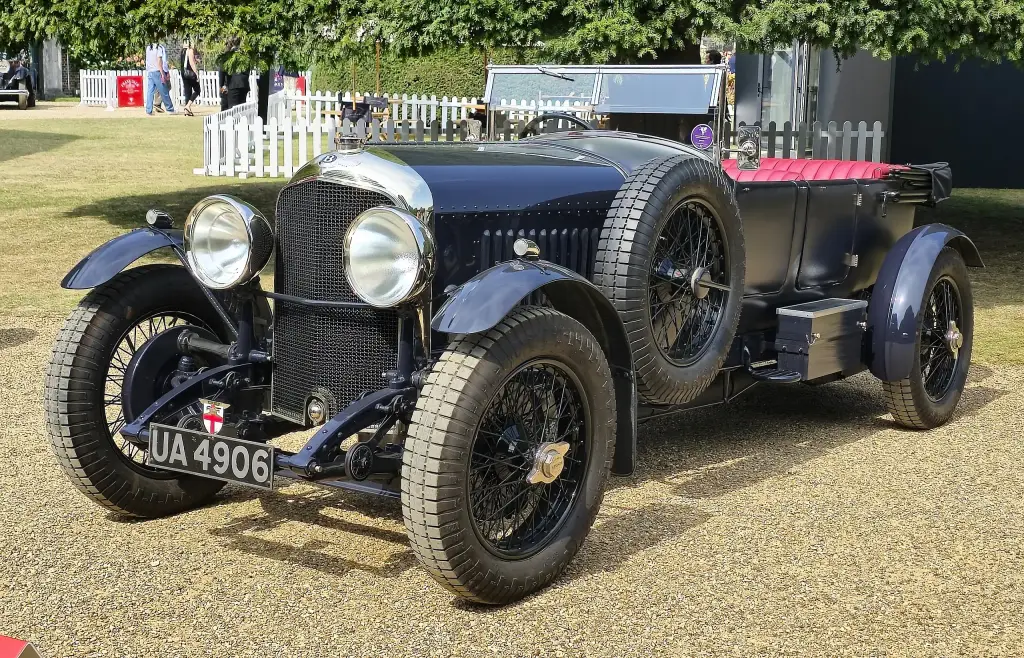
The Bentley 4½ Litre was the model with which W. O. Bentley replaced the 3 Litre, enlarging the engine to 4.4 litres. It was built from 1927 to 1931, and its racing version, the supercharged Blower Bentley, became one of the most famous cars of the inter-war years.
Bentley 4½ Litre at a glance
| Maker | Bentley Motors, Cricklewood, London |
|---|---|
| Production | 1927–1931 |
| Engine | 4,398 cc straight-four, single overhead camshaft, four valves per cylinder |
| Bore and stroke | 100 mm × 140 mm |
| Power | 110 hp touring, 130 hp racing |
| Carburation | two SU carburettors, dual ignition with Bosch magnetos |
| Gearbox | four-speed manual, unsynchronised |
| Wheelbase | 3,302 mm |
| Weight | 1,625 kg |
| Built | 720, including 55 supercharged cars |
| Le Mans win | 1928 |
History of the Bentley 4½ Litre
The 4½ Litre was developed in 1927 by removing two cylinders from the 6½ Litre engine, which gave a capacity of 4.4 litres. At the time the 3 Litre was an outdated, under-powered model and the 6½ Litre’s image had been tarnished by poor tyre performance, so a new car was needed to keep Bentley at the front. Buyers used their cars for personal transport and had their chassis fitted with saloon or tourer bodies, but the publicity from racing was invaluable for marketing.
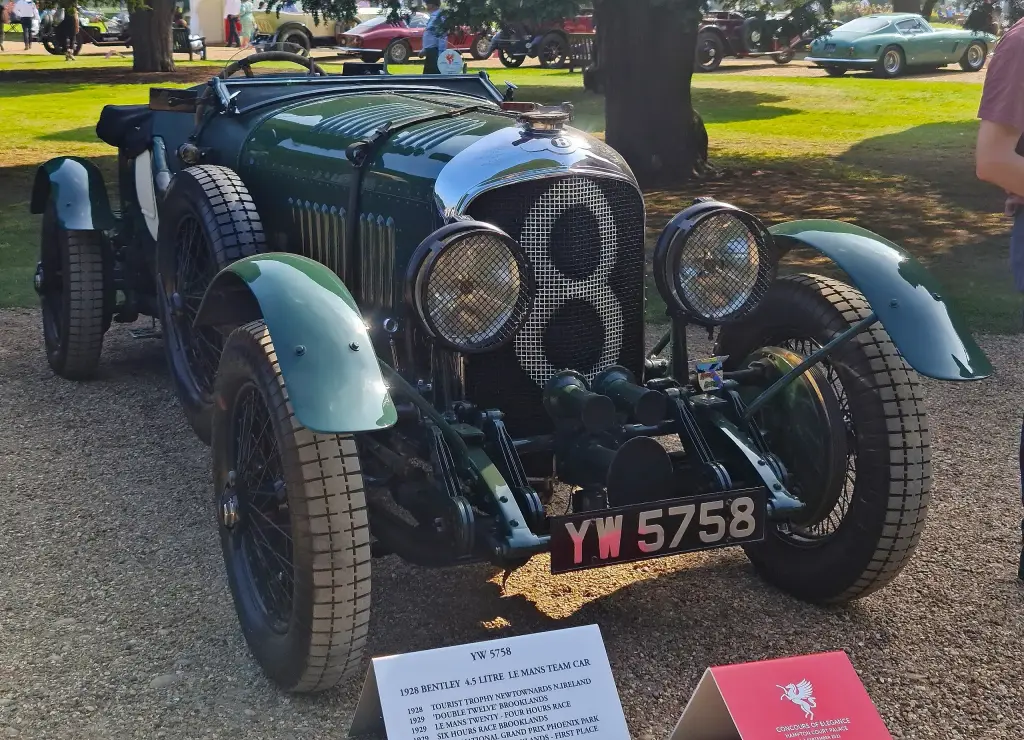
The 4½ Litre was heavy, at 1,625 kg, and large, with a length of 4,380 mm on a 3,302 mm wheelbase, yet it remained well balanced and steered nimbly. The four-speed manual gearbox had no synchromesh and needed skill. The lattice chassis of steel, reinforced with ties, supported the heavy cast-iron four. The engine had two SU carburettors and dual ignition with Bosch magnetos, and it produced 110 hp in touring form and 130 hp for racing, with a rev limit of 4,000 rpm. A single overhead camshaft worked four valves per cylinder, inclined at 30 degrees, an advanced layout when most cars still used two valves in a side-valve head.
Le Mans and the Bentley Boys
The 24 Hours of Le Mans was established in 1923, and a win there quickly raised a maker’s reputation. After two years without success, Bentley gathered a group of wealthy British drivers and mechanics who became known as the Bentley Boys and drove Bentleys to victory in several races between 1927 and 1931, including four consecutive wins at Le Mans. A 4½ Litre won the race in 1928.
Tim Birkin and the Blower
Sir Henry “Tim” Birkin, one of the Bentley Boys, did not accept W. O. Bentley’s belief that a larger engine was always better than forced induction. Aided by a former Bentley mechanic, he arranged five supercharged cars for Le Mans, with the approval of chairman Woolf Barnato and the money of the horse-racing enthusiast Dorothy Paget; the superchargers came from Amherst Villiers and the cars were built in a workshop at Welwyn Garden City. The Blower Bentley was presented in 1929 at the Olympia motor show, and 55 were built to satisfy Le Mans regulations. Bentley himself was hostile to the idea: “to supercharge a Bentley engine was to pervert its design and corrupt its performance”. The Blower’s racing record was not outstanding, but it set speed records, most famously at Brooklands in 1932, when the Blower No.1 Monoposto recorded 222.03 km/h.
The first supercharged Bentley had in fact been a 3-litre, chassis FR5189, converted at Cricklewood in the winter of 1926/7. Production of the 4½ Litre ended in 1931, when Rolls-Royce bought the company.
Design and features
- Big four-cylinder: 4,398 cc with an overhead camshaft and four valves per cylinder.
- Quick pit stops: radiator, oil and petrol tanks had quick-release filler caps that opened with one stroke of a lever.
- Racing brakes: 17-inch finned drum brakes operated by rods, with semi-elliptic leaf springs front and rear.
- Blower option: a crankshaft-driven Roots supercharger mounted in front of the radiator on the 55 supercharged cars.
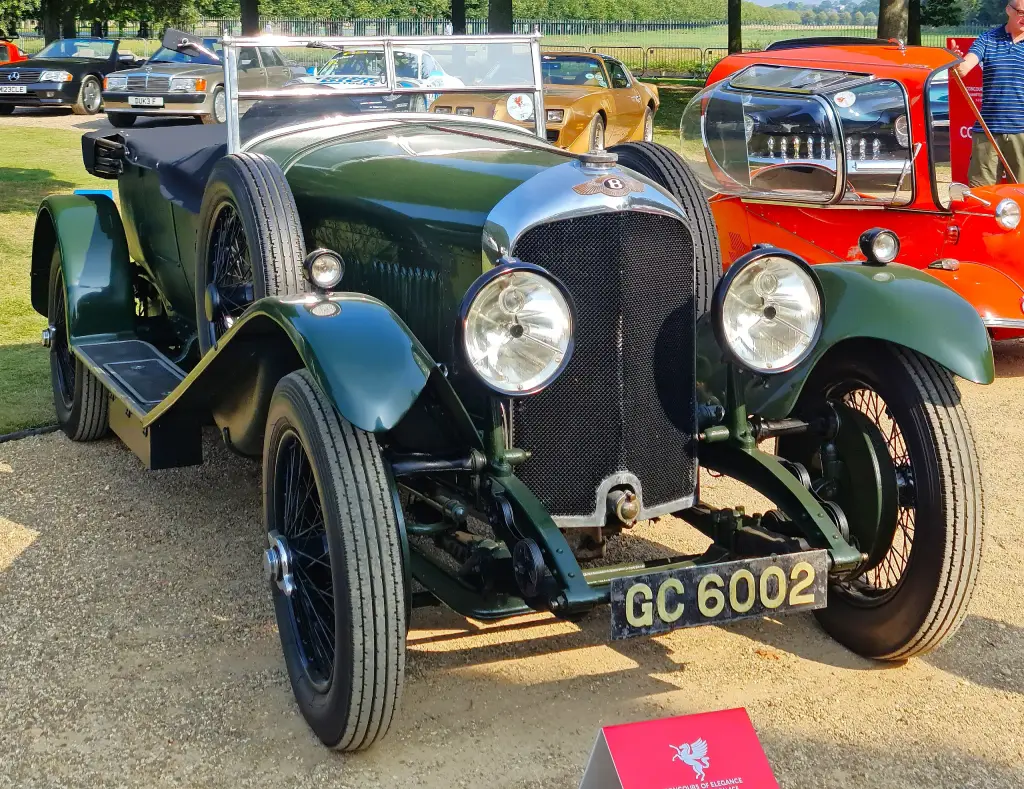
Bentley 4½ Litre versions
- Touring 4½ Litre: 110 hp, the standard road car.
- Racing 4½ Litre: 130 hp with a 4,000 rpm limit.
- Blower Bentley: 55 supercharged cars built by Birkin’s team at Welwyn Garden City.
- Blower No.1 Monoposto: the single-seat record car that reached 222.03 km/h at Brooklands in 1932.
The 4½ Litre replaced the Bentley 3 Litre and shared its six-cylinder technology with the Speed Six. More cars are in the Bentley collection.
Sources
- Bentley 4½ Litre, English Wikipedia: production, engine, chassis, Blower history
- Bentley 4½ Litre, French Wikipedia: Bentley Boys, Birkin, production