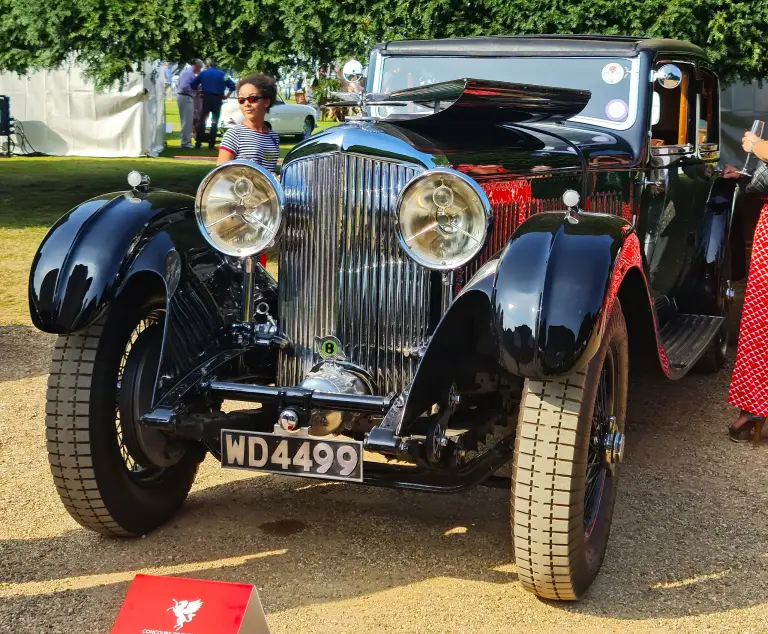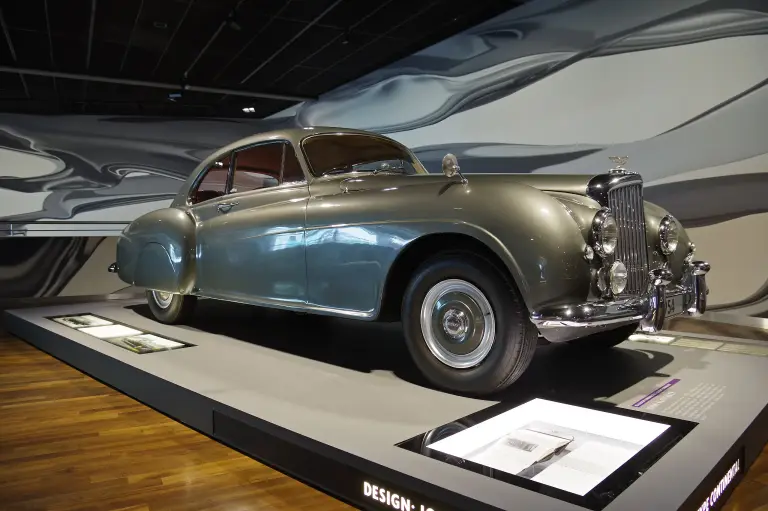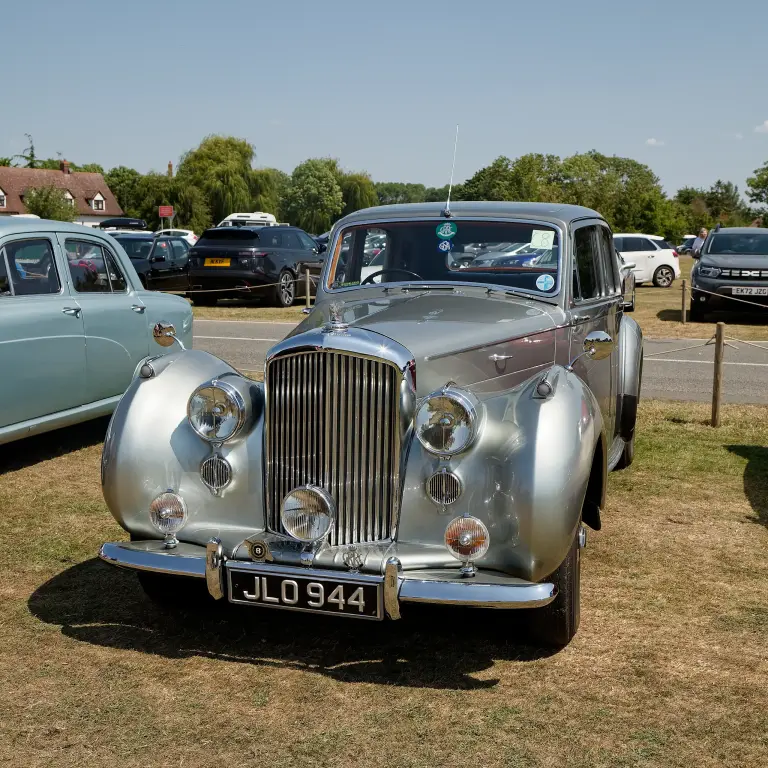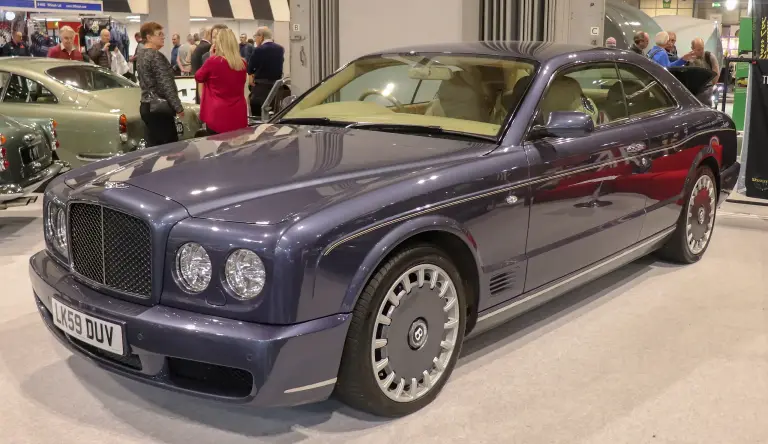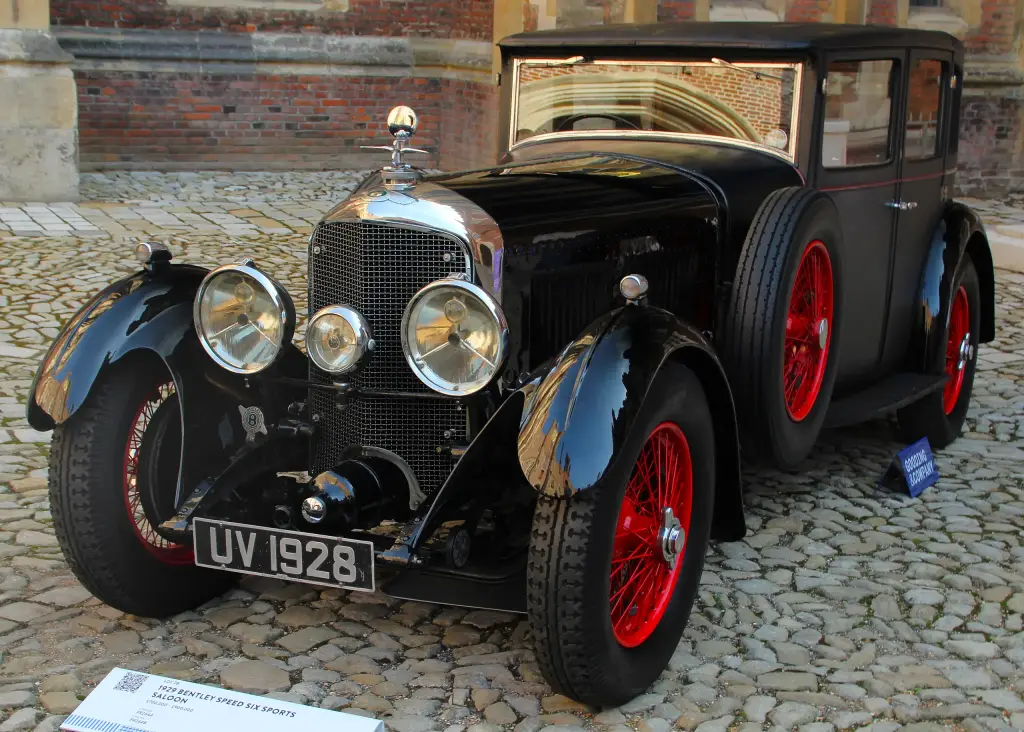
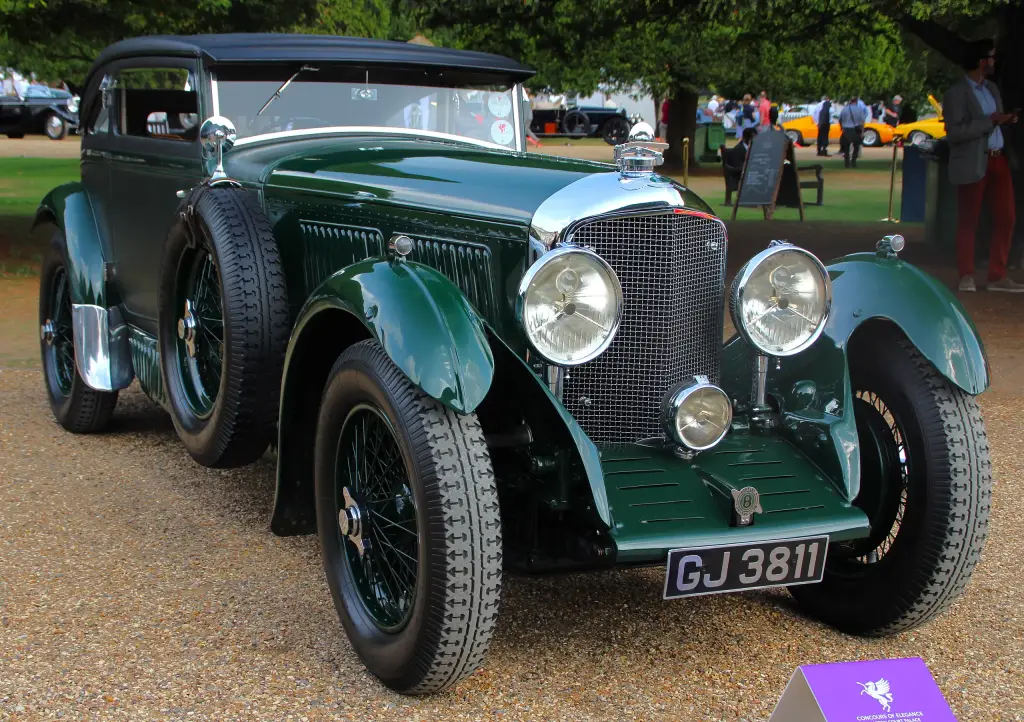
The Bentley Speed Six was the high-performance version of the Bentley 6½ Litre, introduced in 1928 and produced until 1930. It became the most successful racing Bentley, winning the 24 Hours of Le Mans in 1929 and 1930, and it gave its name to the Blue Train episode.
Bentley Speed Six at a glance
| Maker | Bentley Motors, Cricklewood, London |
|---|---|
| Production | 1928–1930 (6½ Litre from 1926) |
| Engine | 6,597 cc straight-six, overhead camshaft, four valves per cylinder |
| Bore and stroke | 100 mm × 140 mm |
| Power | 180 hp at 3,500 rpm |
| Racing engine | 6.1:1 compression, 200 hp at 3,500 rpm |
| Carburation | two SU carburettors |
| Wheelbase | 3,505 mm, 3,569 mm or 3,874 mm |
| Le Mans wins | 1929 and 1930 |
| Built | 182 Speed Six (and 362 6½ Litre) |
History of the Bentley Speed Six
From the 6½ Litre
By 1924 Bentley had been in business for five years and decided to build a larger chassis than the 3 Litre, with a smoother, more powerful engine that would suit the large and heavy limousine bodies customers were putting on his sports car chassis. A development mule was built with a 4¼-litre straight-six derived from the 3 Litre’s four, disguised with a large wedge-shaped radiator and registered as a “Sun”, with a lightweight Weymann-type tourer body by Freestone and Webb. W. O. Bentley combined a road test of the Sun with a trip to the 1924 French Grand Prix, and on the way back raced an equally disguised Rolls-Royce test car along the routes nationales until the Rolls driver’s hat blew off.
Realising that the Sun had no performance advantage over the latest Rolls-Royce, W. O. increased the bore of his six-cylinder engine from 80 mm to 100 mm; with the 140 mm stroke this gave 6,597 cc. Like the four, the six had an overhead camshaft, four valves per cylinder and a single-piece iron block and head, and it used Bentley’s patented three-throw drive for the camshaft, a system carried over to the 8 Litre. In base form, with a single Smiths five-jet carburettor, twin magnetos and a 4.4:1 compression ratio, the 6½ Litre gave 147 hp at 3,500 rpm. It had a dry-plate clutch with a clutch brake for fast gear changes and power-assisted four-wheel brakes with finned drums, four leading shoes per drum at the front, plus a patented compensator that let the driver adjust the brakes for wear while moving. Wheelbases ranged from 3,353 to 3,874 mm, the most popular being 150 inches (3,810 mm).
The Speed Six
The Speed Six chassis was introduced in 1928 as a more sporting version of the 6½ Litre. With a single-port block, two SU carburettors, a high-performance camshaft and a 5.3:1 compression ratio, its engine produced 180 hp at 3,500 rpm. Customers could choose wheelbases of 3,505 mm, 3,569 mm or 3,874 mm, and the shortest was the most popular. The Criminal Investigation Department of the Western Australia Police ran two saloon-bodied Speed Sixes as patrol cars.
Racing and the Blue Train
The racing Speed Six had a wheelbase of 3,353 mm and an engine with 6.1:1 compression producing 200 hp at 3,500 rpm. These cars won the 24 Hours of Le Mans in 1929 and 1930 with the Bentley Boys Tim Birkin, Glen Kidston and Woolf Barnato, the chairman of Bentley Motors. In March 1930 Barnato raced the French Blue Train from Cannes to Calais in a Speed Six and reached his club in London before the train was due at the coast. It had long been believed that the car was the Gurney Nutting Sportsman Coupé, but that car was delivered to Barnato more than a month after the race; the car used was a Speed Six with H. J. Mulliner saloon coachwork. Production came to 362 6½ Litres and 182 Speed Sixes.
Design and features
- Big six: 6,597 cc with an overhead camshaft, four valves per cylinder and the patented three-throw camshaft drive.
- Powerful brakes: servo-assisted four-wheel drums with four leading shoes at the front and a wear compensator.
- Racing success: Le Mans victories in 1929 and 1930.
- Blue Train fame: Barnato’s dash against the French train in March 1930.
Bentley Speed Six versions
- 6½ Litre (1926–1930): the standard car, 147 hp, 362 built.
- Speed Six (1928–1930): 180 hp, 182 built.
- Racing Speed Six: 6.1:1 compression, 200 hp, Le Mans winner.
- Blue Train cars: the Speed Sixes associated with Barnato’s race against the train.
The Speed Six was the six-cylinder brother of the 4½ Litre and was followed by the 8 Litre. More cars are in the Bentley collection.
Sources
- Bentley Speed Six, English Wikipedia: 6½ Litre, Speed Six, racing, Blue Train, production
- Bentley 6½ L, Italian Wikipedia: racing history, Blue Train Special