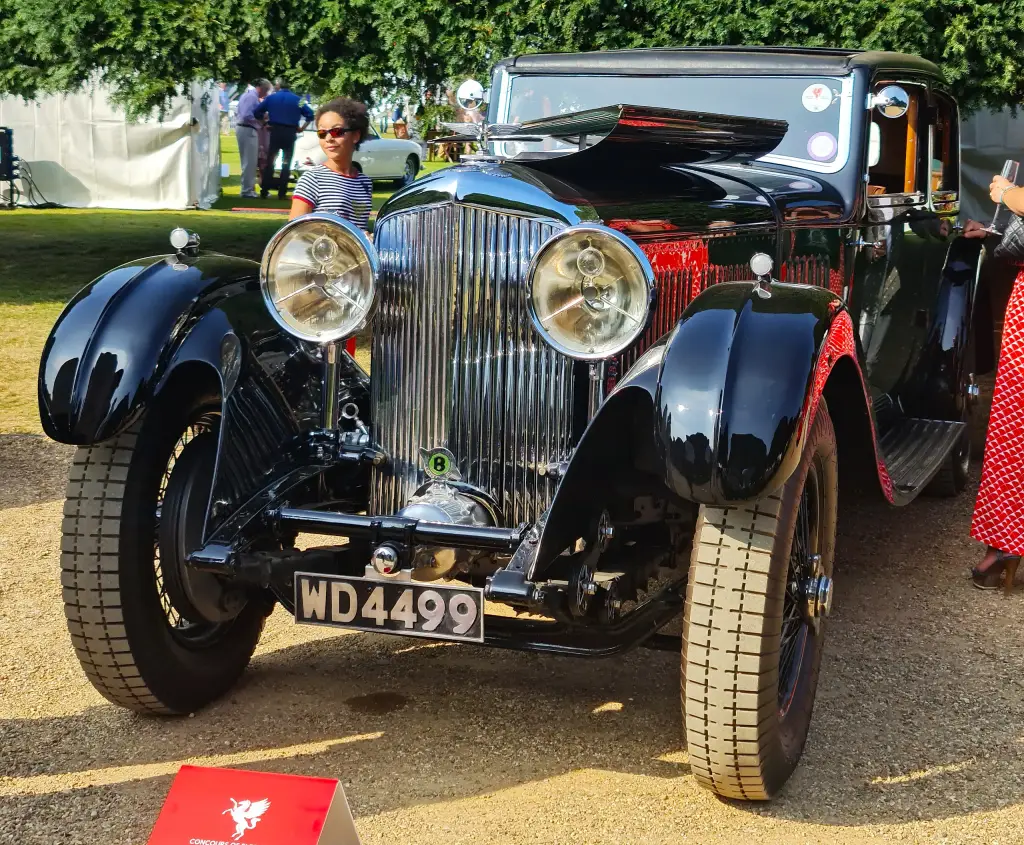
The Bentley 8 Litre was a large luxury car with an inline six-cylinder engine, built at Cricklewood in London. Announced on 15 September 1930, it was the last completely new model made by Bentley before the company’s financial collapse and forced sale to Rolls-Royce.
Bentley 8 Litre at a glance
| Maker | Bentley Motors, Cricklewood, London |
|---|---|
| Announced | 15 September 1930 |
| Production | 1930–1931 |
| Engine | 7,983 cc straight-six, single overhead camshaft, four valves per cylinder |
| Bore and stroke | 110 mm × 140 mm |
| Power | about 200–225 hp depending on compression |
| Top speed | about 125 mph claimed; over 104 mph guaranteed |
| Gearbox | four-speed manual, single-plate dry clutch |
| Wheelbase | 3,500 mm, 3,700 mm or 4,000 mm |
| Chassis price | £1,850 |
| Built | 100 |
| Survivors | 78 known in 2011 |
History of the Bentley 8 Litre
The 8 Litre was developed as Bentley’s answer to the Rolls-Royce Phantom II, and it was the largest and most expensive car the company had yet built. Introduced a year into the Great Depression, it could not turn the company’s finances around: less than nine months after its launch, Bentley Motors was placed into receivership. The chassis was priced at £1,850, roughly £293,000 in 2010 money, and only 100 cars were made, 35 of them on the shorter wheelbase. Fewer than 25 received open bodies. It is suggested that the cost of developing the car was a prime reason for the bankruptcy.
The straight-six used a one-piece cast-iron block with a non-detachable cylinder head and a crankcase of Elektron, a magnesium alloy. Its overhead camshaft was driven by a Bentley-patented “three-throw drive” of triple coupling rods, and, like all earlier Bentleys, the engine had four valves per cylinder and twin-spark ignition with separate coil and magneto systems. With a 110 mm bore and a 140 mm stroke it displaced 7,983 cc. Engine and gearbox were mounted at three points each on rubber to isolate the chassis and body from vibration.
Chassis and running gear
The 8 Litre was built on Bentley’s largest rolling chassis, a ladder frame with large tubular steel crossmembers downswept towards the centre to lower the centre of gravity. It was available with a 144-inch (3,700 mm) or a 156-inch (4,000 mm) wheelbase, and three were built on a 138-inch (3,500 mm) chassis. An entirely new four-speed gearbox had constant mesh on third, a single-plate dry clutch and a hypoid bevel final drive to the rear axle. Suspension was by long semi-elliptic leaf springs with double-acting dampers, friction at the front and hydraulic at the rear, and all four wheels had Dewandre vacuum-servo-assisted 400 mm drum brakes, the front units of Bentley-Perrott design. Steering was worm and sector with adjustable castor.
The manufacturer claimed a maximum speed of about 125 mph and guaranteed more than 104 mph even with the heaviest saloon bodies. The car was noted for its tractability and smoothness: it could be driven from walking pace to highway speed in top gear without effort.
The 4 Litre and the end
Bentley made one more attempt at recovery by fitting modified Ricardo 4-litre engines into a shortened 8 Litre chassis and selling the result as the Bentley 4 Litre. Announced on 15 May 1931, only 50 were made before the company went into receivership. When Rolls-Royce bought Bentley Motors from the receiver in November 1931, it stopped 8 Litre production and disposed of the spare parts. By mid-2011, 78 cars were known to survive, many with replacement tourer bodies, which makes original-bodied cars much sought after.
Design and features
- Huge six: 7,983 cc with a cast-iron monobloc, Elektron crankcase and patented three-throw camshaft drive.
- Rubber-mounted power unit: engine and gearbox each sat on three rubber mountings.
- Servo brakes: Dewandre vacuum assistance on 400 mm drums at all four wheels.
- Long-legged touring: top gear from walking pace, with a claimed 125 mph maximum.
Bentley 8 Litre versions
- Standard 8 Litre: 3,700 mm wheelbase, the usual chassis.
- Long 8 Litre: 4,000 mm wheelbase for the largest limousine bodies.
- Short-chassis 8 Litre: three cars on a 3,500 mm frame.
- Bentley 4 Litre: a shortened 8 Litre chassis with a 4-litre Ricardo engine, 50 built in 1931.
The 8 Litre came after the Bentley 4½ Litre and was replaced in spirit by the 3½ Litre Derby Bentley. More cars are in the Bentley collection.
Video: The Bentley 8-litre
Video by CARMiddleEast on YouTube.
Sources
- Bentley 8 Litre, English Wikipedia: engine, chassis, production, survivors
- Bentley 8 Litre, French Wikipedia: market, power, price
- Bentley 8 Litre, Italian Wikipedia: dimensions, production