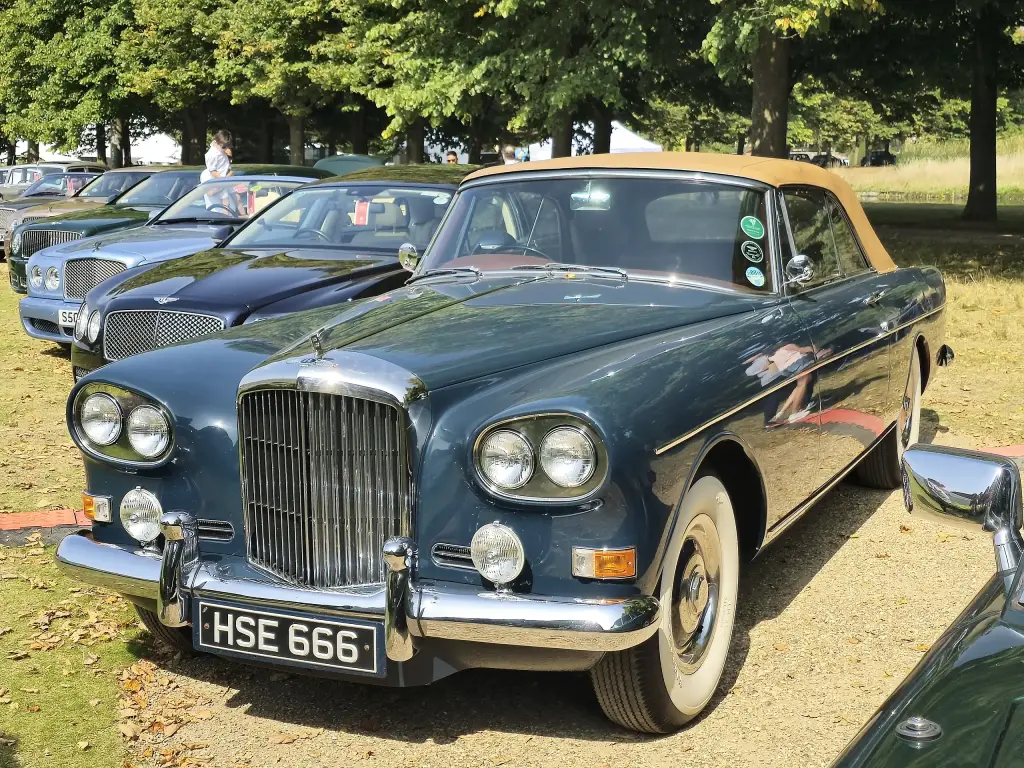
The Bentley S3 Continental was produced from 1962 to 1965 and was strictly a coachbuilt car. It was the last of the coachbuilt Bentleys, with aluminium bodies, four canted headlamps and the 6.2-litre V8 in a higher state of tune.
Bentley S3 Continental at a glance
| Maker | Bentley Motors, Crewe; bodies at Willesden, London |
|---|---|
| Production | 1962–1965 |
| Based on | Bentley S3 |
| Engine | 6,230 cc V8 |
| Compression | 9:1, up from 8:1 |
| Power | 7 per cent more than the S2 |
| Headlamps | four, canted |
| Bodies | fixed-head and drophead coupés, aluminium |
| Coachbuilders | Mulliner Park Ward and James Young |
| Built | 311 (291 by Mulliner Park Ward and 20 by James Young) |
This page covers the Continental version of the S3 and is based on English Wikipedia only, so the facts were not cross-checked against a second source.
History of the Bentley S3 Continental
The S3 was announced at the Paris Motor Show in October 1962. It was very similar to the S2, with the most visible exterior difference being a four-headlamp layout reflecting that introduced on the Rolls-Royce Silver Cloud III the same model year. The radiator was lowered by 1½ inches to allow a lower bonnet line, and the front mudguards were restyled. Inside there were individual front seats and a rear seat moved two inches back for more legroom. The 6,230 cc V8 continued with larger carburettors and compression raised from 8:1 to 9:1, increasing power by 7 per cent and bringing a top speed of 115 mph. An engine “breather” was used for the American market to reduce air pollution.
A strictly coachbuilt car
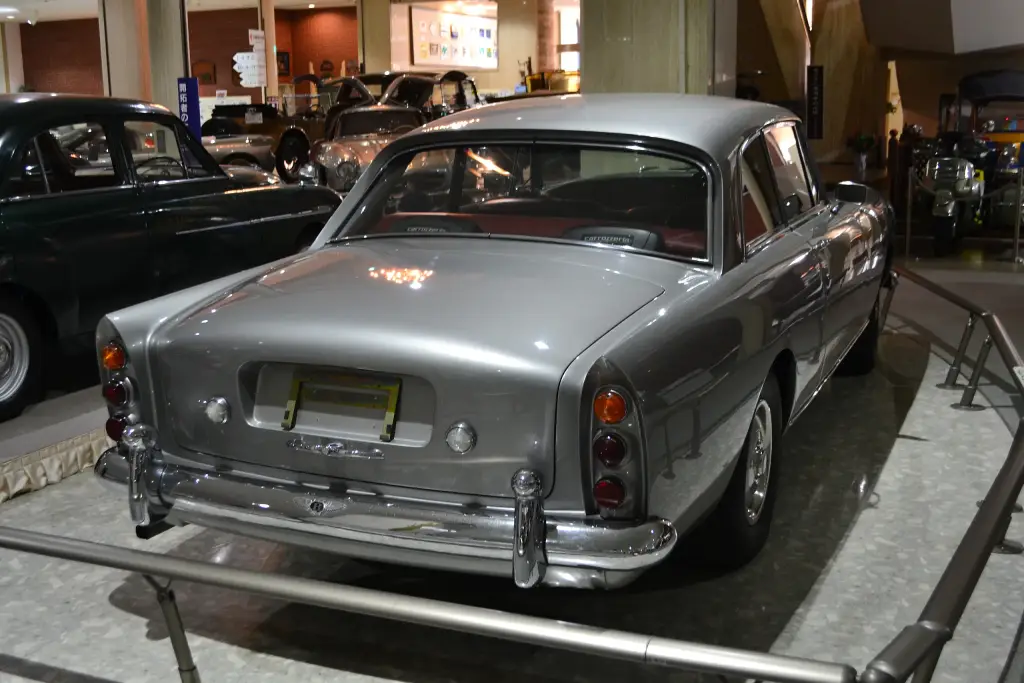
Rolls-Royce had bought H. J. Mulliner & Co. in 1959 and merged it with Park Ward, which it had owned since 1939, to form Mulliner, Park Ward Ltd. in 1961. When S3 Continental production began, the cars were built at the former Park Ward premises in Willesden, north London, and the HJM facilities were abandoned. Most bodies followed the altered HJM style, in fixed-head or drophead coupé form, and the most prominent visual difference from the S2 was the four canted headlights. For the first time the body was offered on the Rolls-Royce Silver Cloud as well as the Bentley S3 chassis.
Like earlier Continentals, the sportier S3 bodywork was made entirely from aluminium, unlike the heavier steel-bodied S3 saloon, and this with higher gearing and better compression ratios made for a markedly faster car. Four-door Continentals bodied by H. J. Mulliner were known as the Flying Spur, though the term is sometimes wrongly applied to four-door Continentals by other coachbuilders; James Young also built an elegant four-door saloon on the S3 Continental chassis.
Prices and production
The S3 saloon cost £6,126, more than three times the top-of-the-range British-built Jaguar Mark X at £2,022 including taxes, while the Park Ward Continental sports saloon was £8,495, a premium of about 40 per cent over an S3. Of the 328 coachbuilt S3 cars, including Continentals, nearly 100 were by Mulliner Park Ward. S3 Continental production came to 311 cars, 291 by Mulliner Park Ward and 20 by James Young, against 1,286 standard S3 saloons and 32 long-wheelbase cars. The final S3 was delivered in 1966, when the Rolls-Royce Silver Shadow and Bentley T-series were already available.
Design and features
- Aluminium coachwork: the Continental body was made entirely of aluminium, unlike the steel saloon.
- Four canted headlamps: the most obvious visual difference from the S2 Continental.
- Higher performance: 9:1 compression, larger carburettors and 7 per cent more power.
- Flying Spur: the four-door Continental by H. J. Mulliner carried this name.
Bentley S3 Continental versions
- Fixed-head coupé: the closed Continental, mainly by Mulliner Park Ward.
- Drophead coupé: the open Continental.
- Flying Spur: the four-door by H. J. Mulliner.
- James Young saloon: a four-door on the S3 Continental chassis, 20 cars.
The S3 Continental followed the S2 Continental and was the last coachbuilt Bentley before the unitary T-series. More cars are in the Bentley collection.
Sources
- Bentley S3, English Wikipedia: S3 Continental, coachbuilders, prices, production