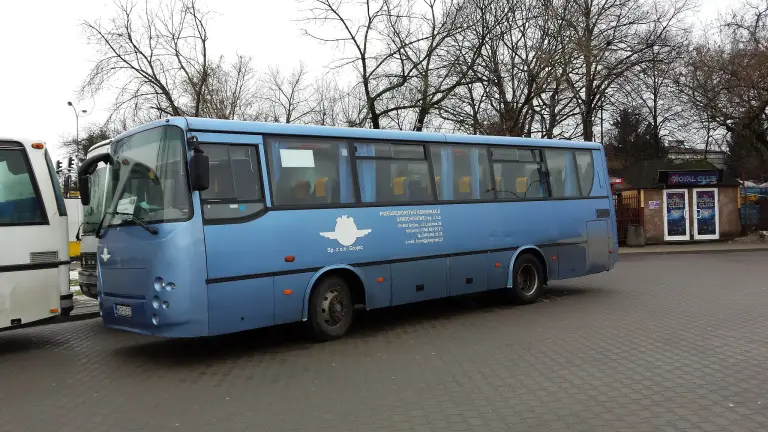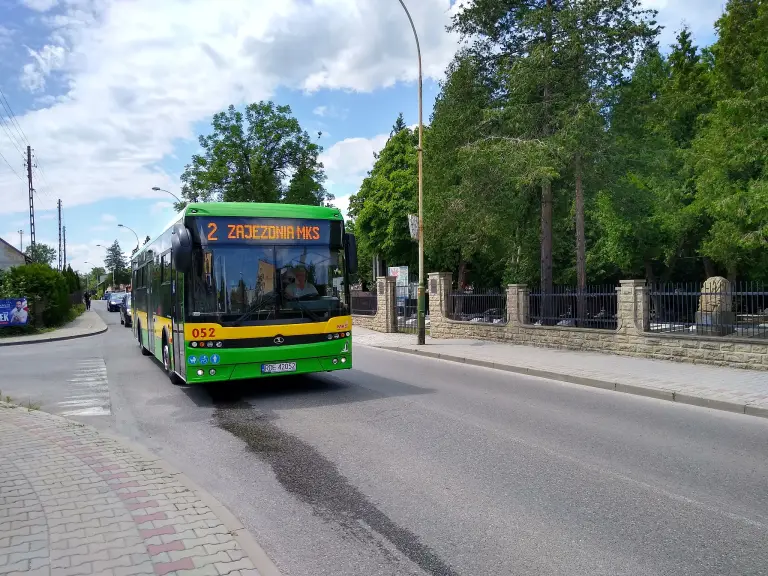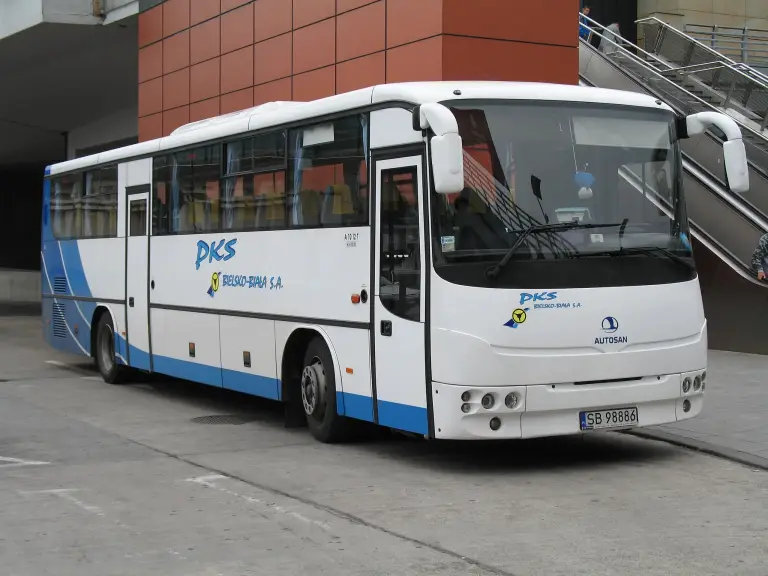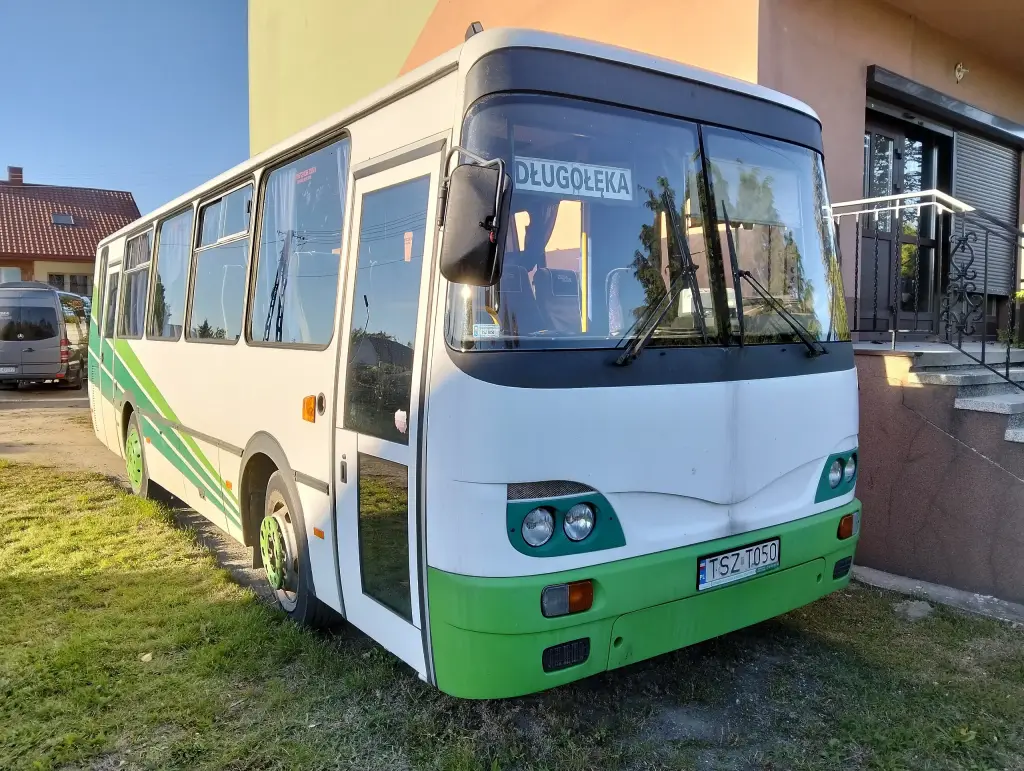
The Autosan H9 is a family of local, intercity and urban midi-class buses produced in Sanok between 1974 and 2002, with a few units still built until 2006. Its simple, durable construction made it the mainstay of Polish state road transport, especially in PKS depots.
Autosan H9 at a glance
| Maker | Sanok Bus Factory, later Autosan, Sanok |
|---|---|
| Production | 1974–2002, a few until 2006 |
| Class | local, intercity and urban midi bus |
| Predecessor | San H100 |
| Prototypes | Sanos A9 and Sanok 09 (1967) |
| Production start | 27 July 1974 |
| Engines | Andoria 6C107, 6,540 cm³, 101.5 kW (138 hp); Star S359, 6,840 cm³, 110 kW (150 hp) |
| Length | 9,310 mm |
| Capacity | 48 passengers, 36+2 seated, 10 standing |
| Gearbox | five-speed S5-45 |
| Main users | PKS state transport, driving schools, private carriers |
| Successors | H10 and the A10 family |
History of the Autosan H9
Origins: Sanos A9 and Sanok 09
Work on a successor to the San H100 began in 1967. The H100 was considered outdated and only a stopgap, and the new bus was to be a medium-capacity design with the engine behind the rear axle. With the Yugoslav company Karoserija – 11 Oktomvri from Skopje, the Sanok factory built 15 prototypes of a 9-metre bus called the Sanos A9 in urban, suburban, intercity and tourist versions. It carried 38 seated passengers and used a 6,540 cm³ SW-400 diesel of 92 kW (125 hp), built under Leyland licence, mounted lengthwise behind the rear axle, which left room for underfloor luggage space.
At the end of 1967 the Sanok Bus Factory began its own design, the Sanok 09, with engineers from the factory, the Kraków University of Technology, the Industrial Automotive Institute and the Military Technical Academy. It had a steel frame with a truss body, a licensed Leyland SW400 engine of 92 kW (125 hp) and a ZF-licensed S5-45 gearbox, and it reached 80 km/h. Four prototypes were built in 1968 in intercity and tourist form, and the first was shown at the Poznań motor show. After testing both designs, the Polish Sanok 09 was chosen for further development.
The 1970 prototype and series launch
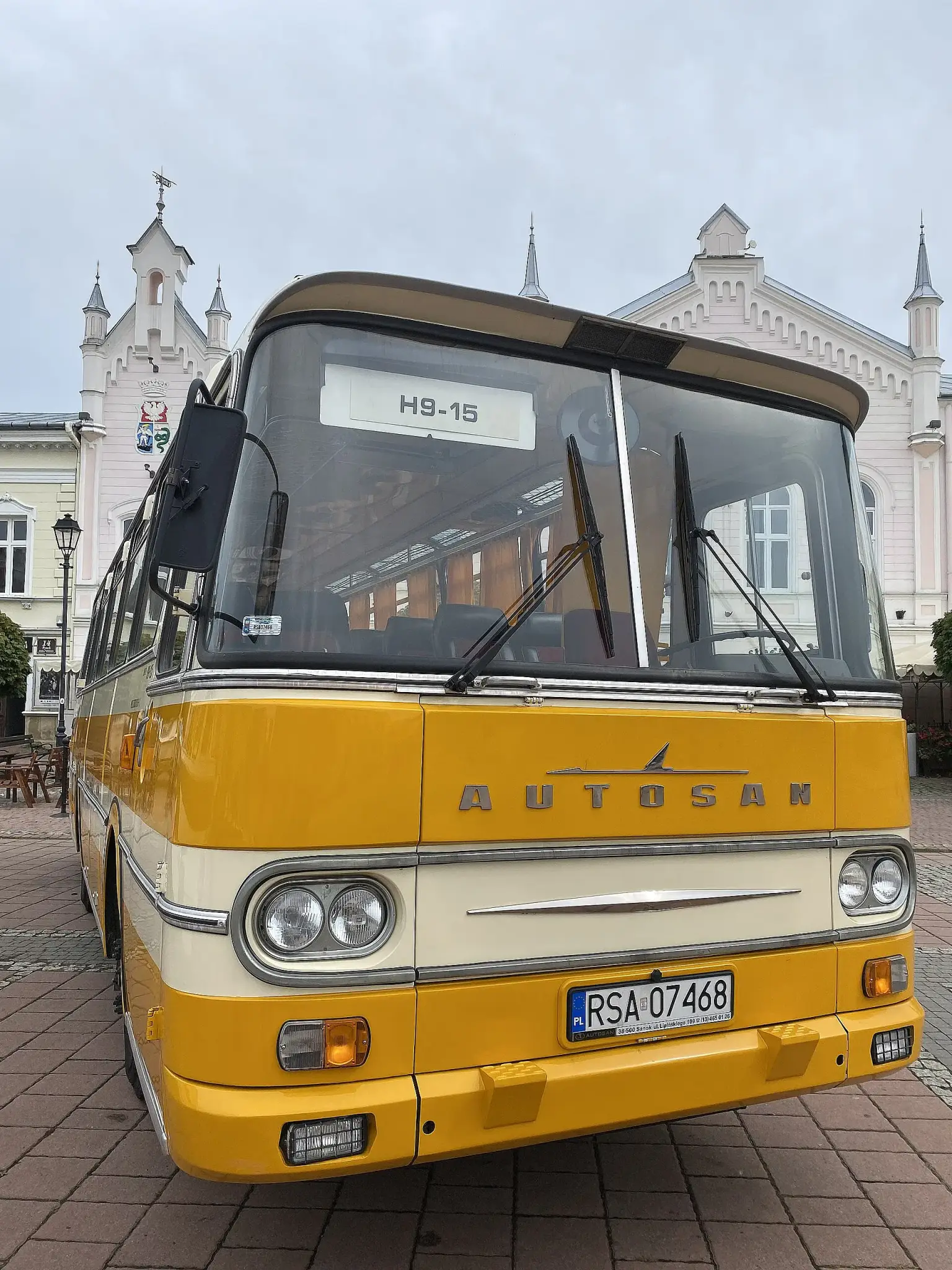
A further improved H9 prototype appeared in 1970 with a body lengthened to 9,310 mm, raising capacity to 48 passengers, 36+2 seated and 10 standing. It used either the Andrychów-built 6C107 engine of 101.5 kW (138 hp) or the Starachowice S359 of 110 kW (150 hp), and gained pneumatic control for the service and auxiliary brakes. The bodywork was revised too, with a characteristic bend in the front of the roof line and extra windows along the window belt; tourist versions had airline-style seats. After a six-unit pre-production batch in 1970, test series followed in 1971, 1972 and 1973, and mass production began on 27 July 1974 with the tourist H9-02 and the intercity H9-03.
Later variants
The H9 was modernised repeatedly over almost three decades. The family grew to include the H9-15, the intercity H9-20 and H9-21, the city H9-33 and H9-35 and the school H9-21 Kleks. Its popularity rested on a simple and durable structure that coped with poor roads, easy repair and service, and a low price. Production ended in 2002, although a few units were still built until 2006, and the type was gradually replaced by the H10 and then the A10 family.
Design and features
- Rear engine: the diesel sat behind the rear axle, leaving underfloor space for luggage.
- Simple structure: steel frame and truss body, easy to repair in a workshop.
- Rough-road durability: rigid axles on leaf springs suited to poor Polish roads.
- Low cost: cheap to buy and to run, which made it popular with PKS depots.
- Many bodies: local, intercity, urban, tourist and school versions shared the same base.
Autosan H9 versions
- H9-02: tourist version at the 1974 launch.
- H9-03: intercity version at the 1974 launch.
- H9-15: later intercity variant.
- H9-20 and H9-21: the most widespread intercity models.
- H9-33 and H9-35: city versions.
- H9-21 Kleks: school bus version.
The H9 was replaced by the H10, and its H9-21 version was modernised into the A0909L Tramp. More Sanok buses are in the Autosan collection.
Video: Autobusy Autosan H09-15 i H09-20
Video on YouTube.
Sources
- Autosan H9, English Wikipedia: origins, prototypes, production, engines
- Autosan H9, Polish Wikipedia: model history and specifications
- Autosan, English Wikipedia: later variants and company context