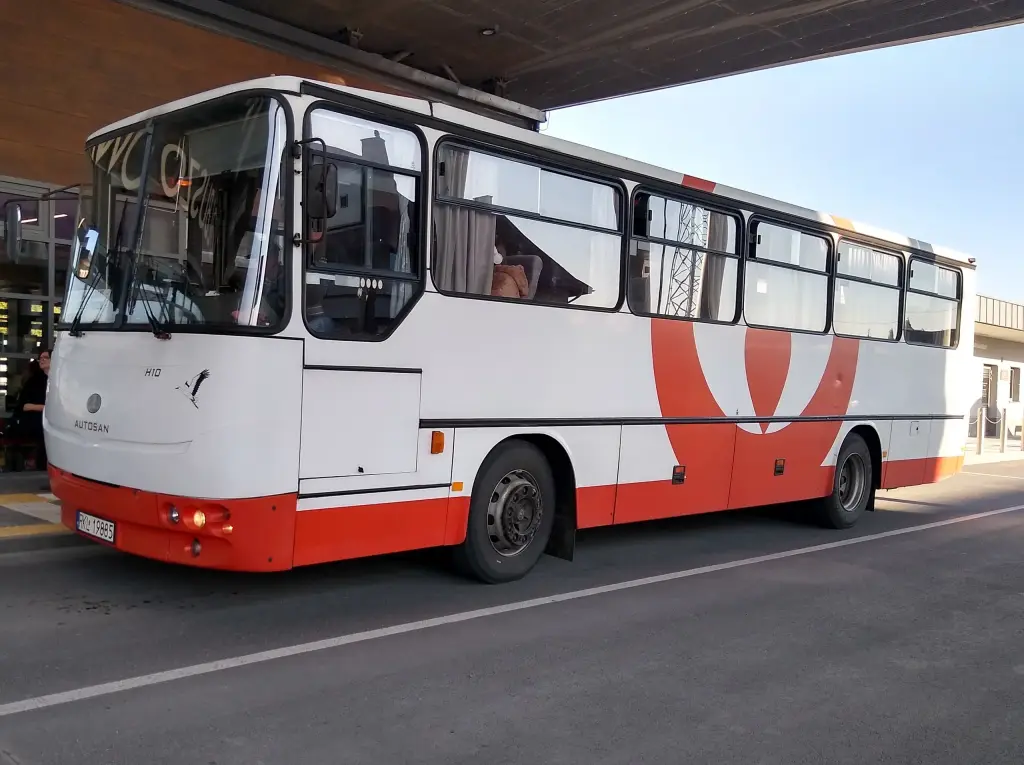
The Autosan H10 is a family of midi and maxi city, local and intercity buses built in Sanok between 1984 and 2003. It was meant to replace the H9, but the first production models supplemented the older range rather than displacing it.
Autosan H10 at a glance
| Maker | Sanok Bus Factory, later Autosan, Sanok |
|---|---|
| Production | 1984–2003 |
| Class | midi and maxi city, local and intercity buses |
| Predecessor | Autosan H9, intended replacement |
| First prototypes | H10-20.01 (1981), H10-20.02 and H10-21 (1982) |
| Maxi prototypes | H10-51 and H10-53 (1983) |
| Engines | Andoria 6CT107, TAM F6L-413FR |
| Power | 125–141 kW (170–192 hp) |
| Gearboxes | five-speed S5-45 or Famos 5MS-6024 |
| Axles | FSC Star and TAM, on leaf springs |
| Midi model | H10-10, introduced in 1992 |
| Successors | Autosan A1010T and A1012T |
History of the Autosan H10
Origins
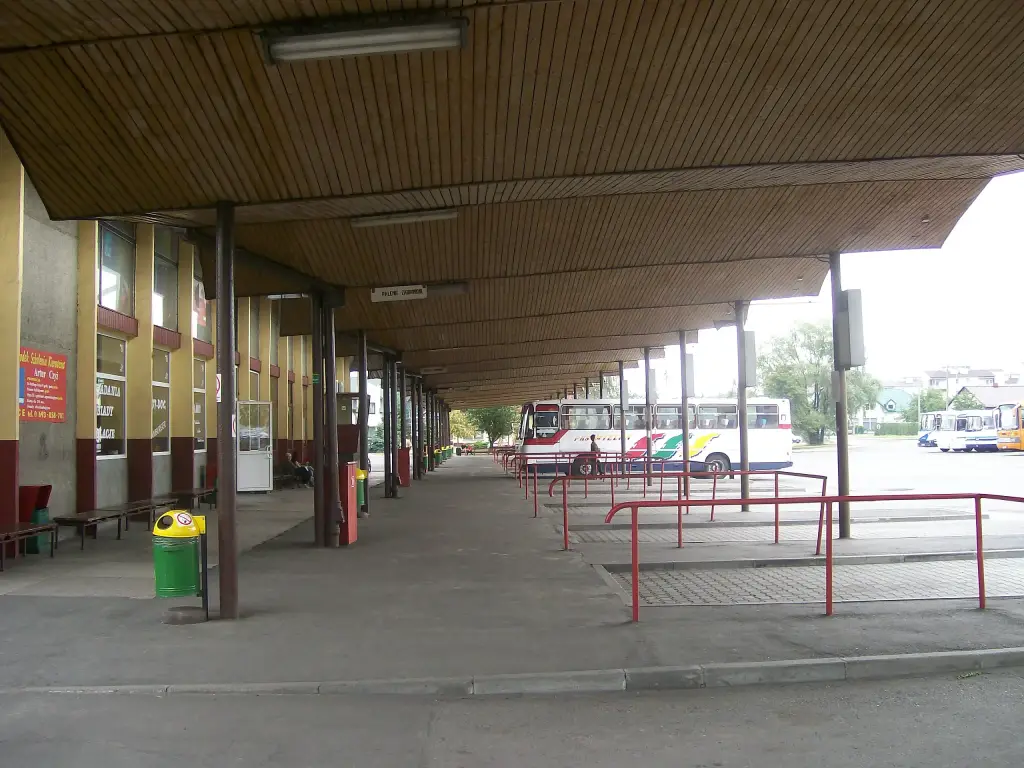
In the second half of the 1970s the Sanok factory offered only the H9 series, developed in the late 1960s and early 1970s. Its cars were not considered technically advanced enough against competitors, so work began on a new range. The first result was the H9/II city bus of 1978 and its unified intercity counterpart, the H9/III, with a completely new 10-metre body. The city version had four pairs of electro-pneumatic double doors and carried 91 passengers, 23 of them seated; the intercity version had a 2-0-1 door layout and 45 seats. Both used an Andoria 6CT107 engine of 6,540 cm3 and 121 kW (165 hp), mounted transversely with an angular gearbox because of the short rear overhang.
First prototypes
The first member of the H10 series, the H10-20.01, was shown in 1981. Its chassis was largely unified with the H9-20 and H9-21, but it used a turbocharged Andoria 6CT107 of 125 kW (170 hp) and a five-speed S5-45 gearbox, with FSC Star axles on leaf springs. Much of its body hardware, including headlights, rear lights and wipers, came from the Jelcz PR110U. It had a pneumatically operated single-leaf front door and a manually opened rear door, and carried 45 seated passengers.
A year later came the H10-20.02 with double-leaf front doors, a lower final drive and 43 seats; it was the first H10 sold, to ZT Sanok. The H10-21 of 1982 used a Yugoslav TAM F6L-413FR V6 diesel of about 9.5 litres and 141 kW (192 hp) with a Famos 5MS-6024 gearbox. Both were shown at the Poznań International Fair in 1982.
The maxi H10-11 and H10-12
In the first half of the 1980s the plans changed: work continued on maxi-class buses of 11 and 12 metres instead of a midi replacement for the H9. In 1983 two 11-metre intercity prototypes were built, the H10-51 with the TAM engine and TAM axles, and the H10-53 with a Polish Andoria 6CT107, German-style parabolic springs and stabilisers. The design was prepared with the Military University of Technology and the Kraków University of Technology. These maxi models went into production alongside the H9-20 and H9-21 rather than replacing them.
H10-10 and the end of the series
The idea of a midi bus derived from the H10 returned in the late 1980s and produced the H10-10, introduced in 1992. Because it cost considerably more than the older H9-20 and H9-21, it sold in smaller numbers and never replaced them. From the second half of the 1990s the whole H10 series was gradually phased out in favour of the new A10 family, the A1010T and A1012T.
Design and features
- Two size classes: midi prototypes at 10 metres, then maxi production buses of 11 and 12 metres.
- Mixed engines: Polish Andoria and Yugoslav TAM diesels were both used in development.
- Simple chassis: rigid axles on leaf springs from FSC Star and TAM.
- Unified with the H9: the early prototypes shared their chassis with the H9-20 and H9-21.
- Commercial failure of the midi: the H10-10 was too expensive against the older H9.
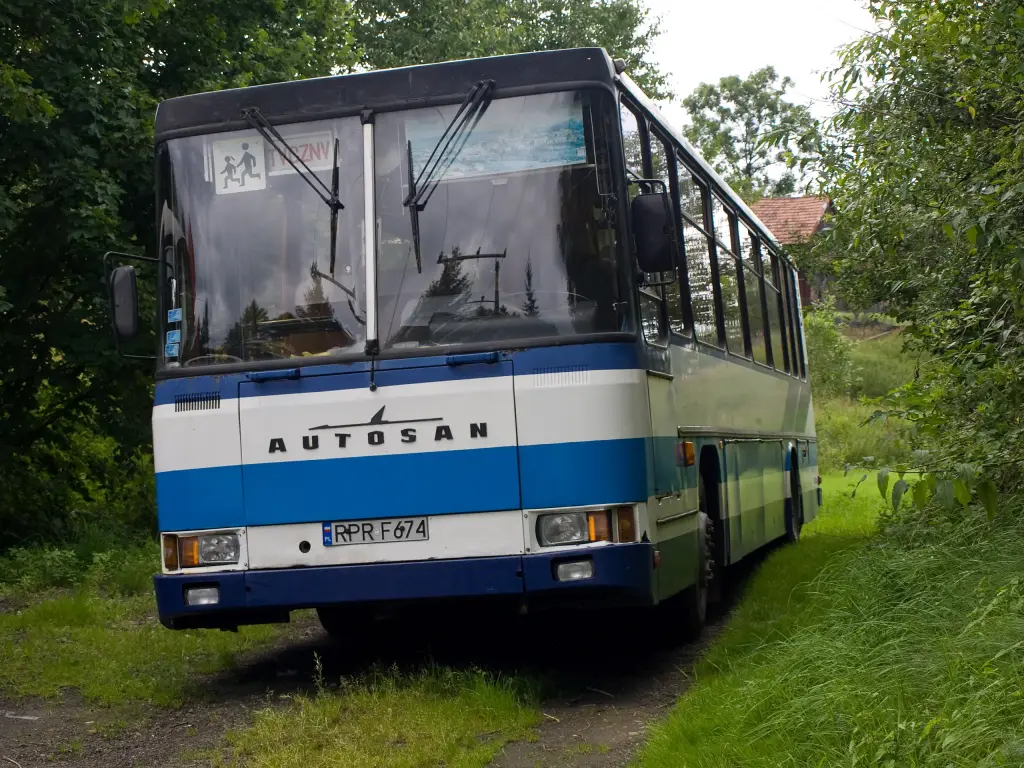
Autosan H10 versions
- H10-20.01 (1981): first prototype, 45 seats, single front door.
- H10-20.02 (1982): double front doors, 43 seats, first H10 sold.
- H10-21 (1982): TAM V6 engine, 192 hp.
- H10-51 and H10-53 (1983): 11-metre intercity prototypes.
- H10-11 and H10-12: production maxi intercity buses.
- H10-10 (1992): midi bus, built in modest numbers.
The H10 was meant to succeed the H9 and was itself replaced by the A10 family, including the A1012T Lider. Other Sanok buses are in the Autosan collection.
Sources
- Autosan H10, English Wikipedia: development, prototypes, production
- Autosan H10, Polish Wikipedia: model history
- Autosan, English Wikipedia: company context