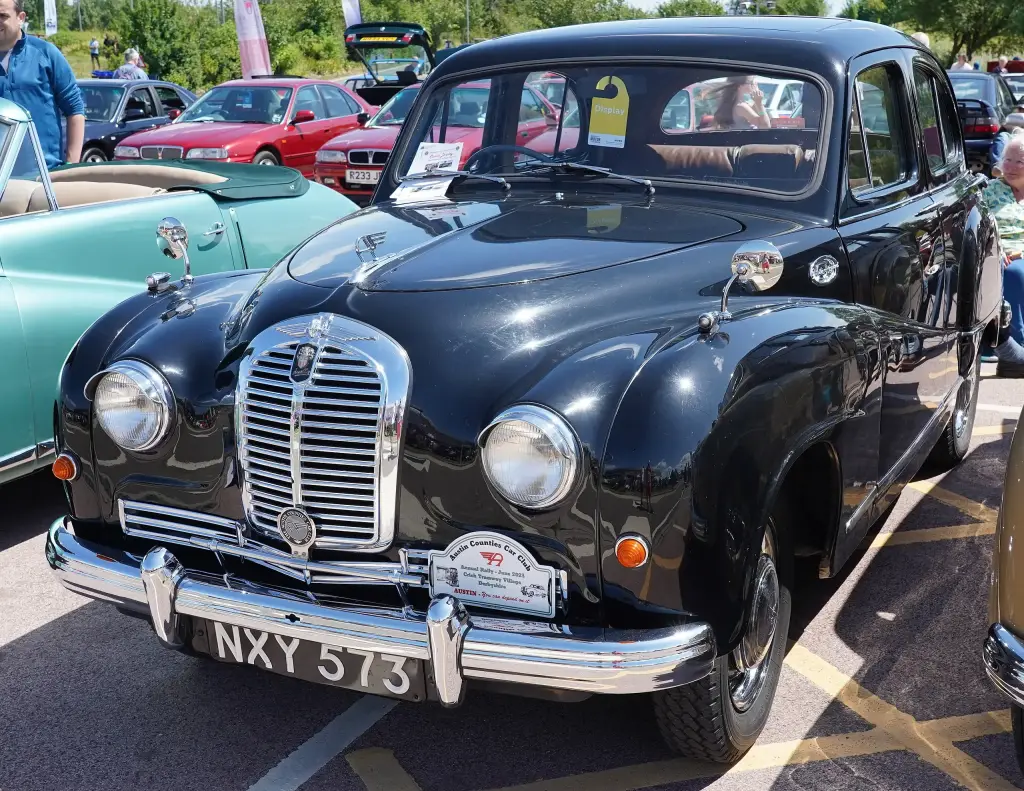
The Austin A70 Hampshire and later Austin A70 Hereford are cars that were produced by Austin of Britain from 1948 until 1954. They were conventional body-on-frame cars with similar styling to the smaller A40 Devon and A40 Somerset respectively, though with an entirely different, larger and wider body on chassis construction. 85,682 were built.
Austin A70 at a glance
| Produced | 1948–1954; 85,682 built |
|---|---|
| Engine | 2.2 L (2,199 cc) straight-four pushrod, 67 bhp (50 kW) |
| Hampshire | 1948–1950; 35,261 built; 83.3 mph (134.1 km/h), 0–80 km/h in 14.5 s; £648 in 1950 including heater |
| Hereford | from 1950; wider, longer, wheelbase 3 inches (76 mm) longer; 50,421 built |
| Brakes | Hampshire front-hydraulic and rear-mechanical; Hereford fully hydraulic |
| Special bodies | Countryman, pickup; Hereford coupé (2-door convertible by Carbodies of Coventry) |
| Replaced by | the A90 Westminster in 1954 |
This page is based on English Wikipedia only (a trusted source), so the facts were not cross-checked against a second source.
History of the Austin A70
A70 Hampshire
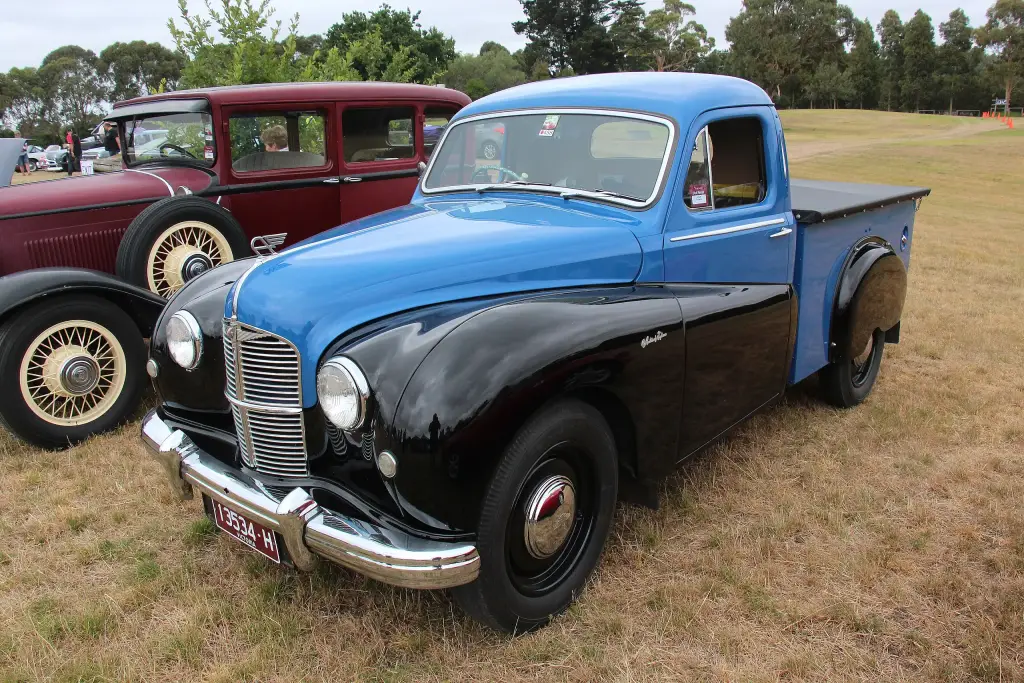
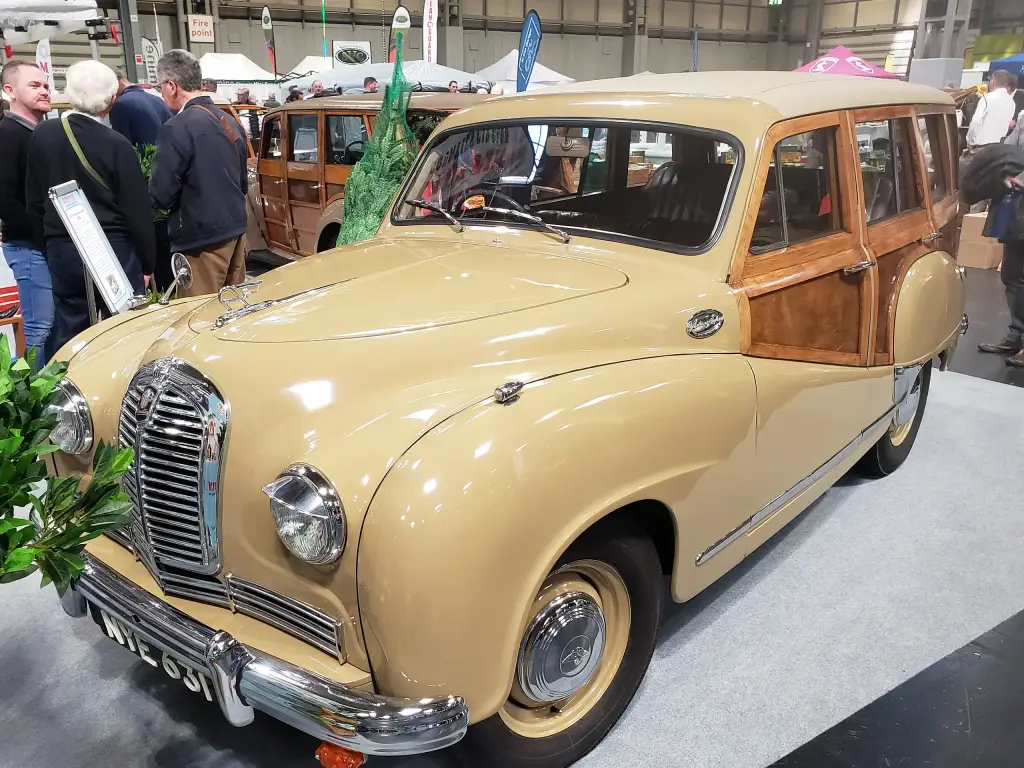
Most first-generation A70s were Hampshire four-door saloons, though some estate and pickup truck versions were also produced, as the A70 Countryman and A70 Pick-up. The 2.2 L straight-four pushrod engine provided the same power output, 67 bhp, as it had when installed in the earlier Austin 16 hp; the new car was lighter, however, so acceleration and top speed were brisker: 0–80 km/h took 14.5 seconds and the maximum speed was 83.3 mph. The Hampshire used Girling hydraulic brakes that operated on the front wheels only, the rears being mechanical, a set-up shared with the earlier A40 Devon. Production ended in 1950 with 35,261 built; the UK price in 1950 was £648 including the heater.
A70 Hereford
The Hereford replaced the Hampshire in 1950 and was wider and slightly longer, with an extra 3 inches in the wheelbase. A new addition to the range was the A70 Coupé, a two-door convertible with coachwork by Carbodies of Coventry. A notable mechanical change was fully hydraulic brakes. The smaller A40 Somerset had similar styling and shared the same doors and rear wings. The car kept the 2,199 cc four-cylinder engine first seen officially in 1945 on the Austin 16.
Performance was adequate for the time, but the car was not particularly quiet; an Autocar road test in 1950 reported a “small vibration at about 40 m.p.h. on the overrun”. Austin had given a lead after the war in equipping its cars with interior heaters at no extra cost, and the Hereford came with “the latest Smiths fresh-air installation” as standard, though the tester found the heater, like the engine and the windscreen wipers, rather noisy. Sales were slow, with 50,421 produced when the A90 Westminster replaced it in 1954. Another rare variant was the A70 Pickup/Ute, which shared the platform of the estate but with fully faired bodywork behind the cab and a full-width bench seat.
Design and features
- Engine: the 2.2 L four of the Austin 16, 67 bhp.
- Construction: body-on-frame, larger and wider than the A40.
- Heater: a Smiths fresh-air heater fitted as standard on the Hereford.
Austin A70 versions
- A70 Hampshire (1948–1950): saloon, Countryman and pickup.
- A70 Hereford (1950–1954): saloon, Countryman, pickup and the Carbodies coupé.
More Austin cars are in our Austin collection, for example the A40 Devon, the A90 Westminster that replaced it and the Cambridge.
Austin A70 questions and answers
When was the Austin A70 built?
From 1948 to 1954.
What engine did it have?
A 2.2 L four of 67 bhp, the same as in the earlier Austin 16.
How many were made?
85,682: 35,261 Hampshires and 50,421 Herefords.
What replaced it?
The A90 Westminster in 1954.
Was there a convertible?
Yes, the Hereford Coupé, a two-door convertible by Carbodies of Coventry.
Sources
- Austin A70, English Wikipedia: Hampshire, Hereford and variants