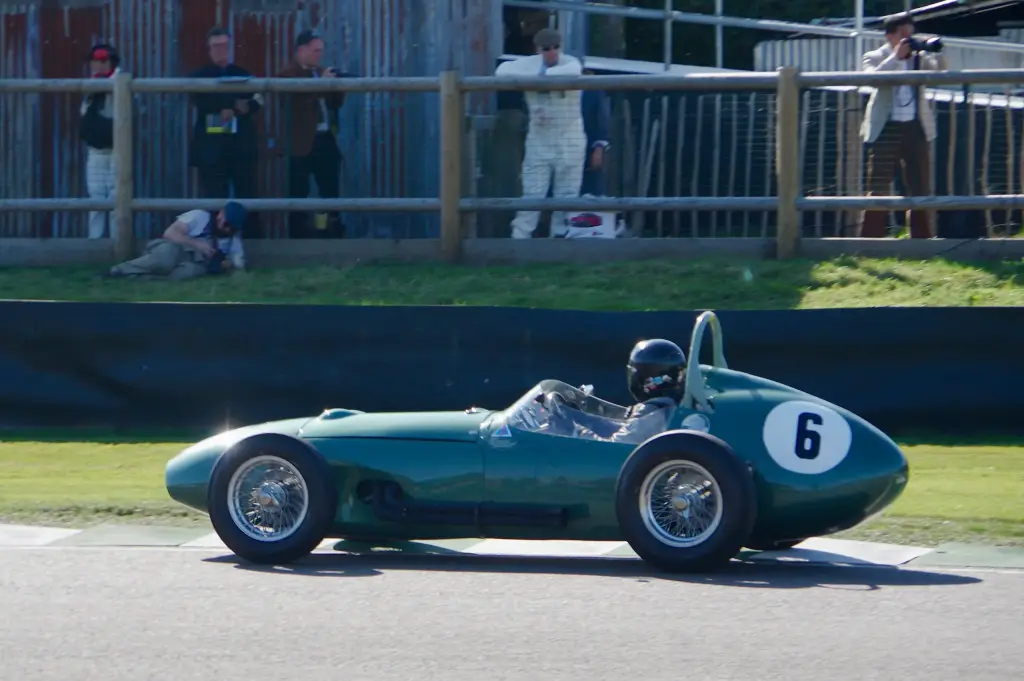
The Aston Martin DBR4/250, commonly called the DBR4, is a Formula One racing car designed by Ted Cutting for the sports car maker Aston Martin. After the successes in sports car racing, ending with the 1959 Le Mans win and the World Sportscar Championship title, the DBR4 was meant to repeat that success in the top tier of open-wheel racing.
Aston Martin DBR4 at a glance
| Designer | Ted Cutting |
|---|---|
| Debut | 1959 Dutch Grand Prix, drivers Roy Salvadori and Carroll Shelby |
| Chassis | conventional spaceframe with aluminium bodywork, related to the DB3S |
| Engine | 2.5 L straight-six, double overhead camshafts, claimed 280 bhp, realistically about 250 bhp |
| Front suspension | double wishbones, coil springs and telescopic dampers |
| Rear suspension | de Dion tube with torsion bars; the last new Grand Prix car to use it |
| Brakes | Girling discs all round |
| Replaced by | the lighter DBR5/250 in early 1960 |
This page is based on English Wikipedia only (a trusted source), so the facts were not cross-checked against a second source.
History of the Aston Martin DBR4
A possible open-wheel Aston Martin was discussed as early as 1955, and a hastily built prototype was tested in the Australian and New Zealand races in early 1956, driven by Reg Parnell. After the successes of this experiment, and although most of the racing department was busy with the sports car programme, Aston Martin decided to enter Formula One in earnest, but attention was often diverted and delays were common.
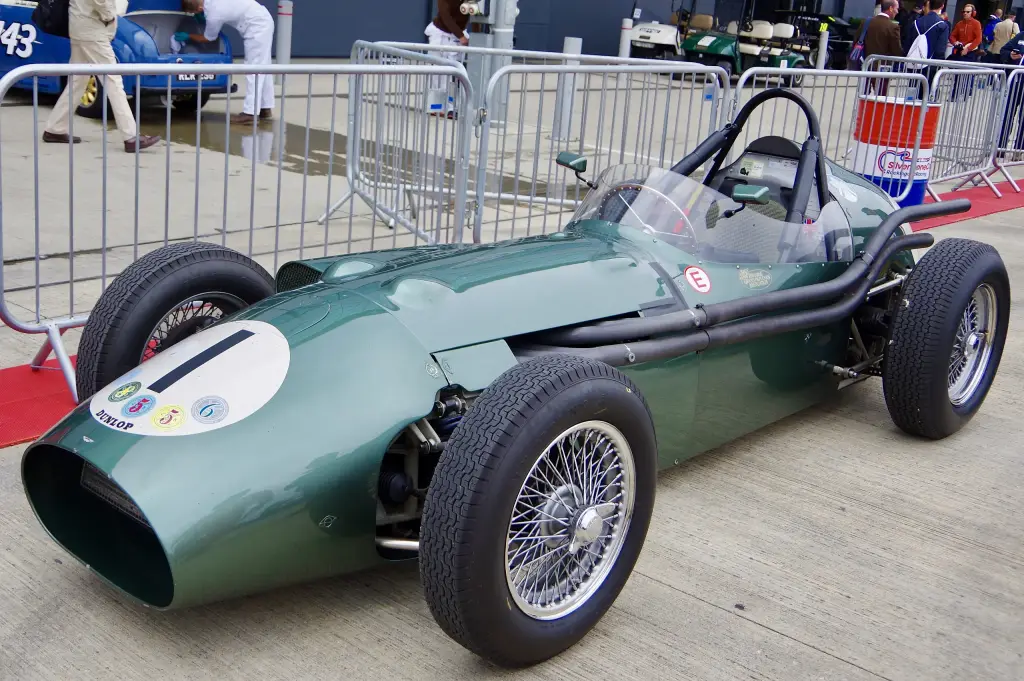
The DBR4 was largely based on the DB3S sports car and borrowed its basic chassis and engine layout. Although tested as early as 1957, it did not make its World Championship debut until the 1959 Dutch Grand Prix, with Roy Salvadori and Carroll Shelby. Its long gestation meant that much of its concept was already superseded, and the car was not a success. It was replaced by the lighter DBR5/250 in early 1960, but when that car also failed Aston Martin abandoned Formula One to concentrate on its more successful sports car projects.
Design
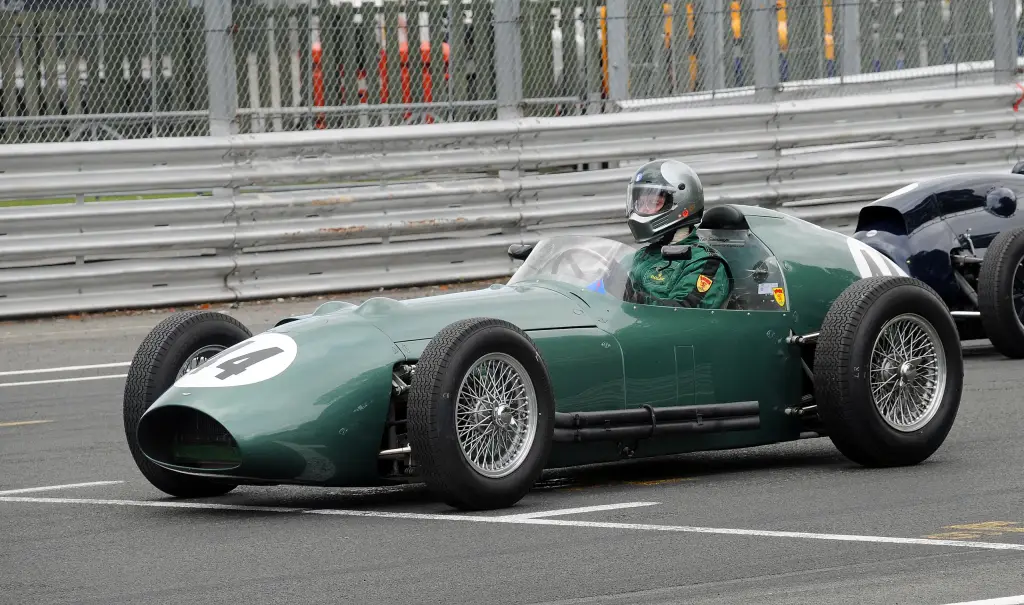
The chassis was a conventional spaceframe skinned with aluminium. Although the bodywork looked svelte and streamlined, the effect was spoiled by a large air intake on the side of the bonnet and a tall, near-vertical windscreen. The suspension had double wishbones at the front and a de Dion tube at the rear with torsion bars; the system had been state of the art in the early 1950s but by 1959 most makers had moved to independent rear suspension, and the DBR4 was the last new Grand Prix car to use the de Dion system. Girling disc brakes were fitted all round.
The engine shared the double overhead camshaft straight-six design of its siblings but was sleeved down to 2.5 litres. Tadek Marek’s design was reliable in its 3.7 L road-car form, but the reduced-capacity racing engine struggled with the heavy chassis and poor aerodynamics, and frequent engine failures marked the DBR4’s brief racing career. Aston Martin claimed 280 bhp, but a more realistic value is nearer 250 bhp, still more than the Coventry Climax four used by Lotus and Cooper, though the Aston engine weighed appreciably more.
Design and features
- Chassis: a spaceframe with aluminium skin, related to the DB3S.
- Engine: a 2.5 L double overhead camshaft straight-six.
- Suspension: double wishbones at the front, de Dion tube at the rear.
- Brakes: Girling discs on all four wheels.
Aston Martin DBR4 versions
- DBR4/250 (1959): the Formula One car.
- DBR5/250 (1960): the lighter successor that also failed.
- DBR3: a sports car developed at the same time that used the same suspension and was judged a failure.
More Aston Martin cars are in our Aston Martin collection, for example the DBR1, the DBR2 and the DB3S on which the DBR4 was based.
Aston Martin DBR4 questions and answers
What is the Aston Martin DBR4?
Aston Martin’s Formula One car of 1959, designed by Ted Cutting.
When did it race?
It debuted at the 1959 Dutch Grand Prix with Roy Salvadori and Carroll Shelby.
Why was it unsuccessful?
A long development, a heavy chassis, old-fashioned rear suspension and engine failures.
What engine did it have?
A 2.5 L double overhead camshaft straight-six, claimed at 280 bhp.
What replaced it?
The lighter DBR5/250 in early 1960; Aston Martin then left Formula One.
Video: Aston Martin DBR4 classic F1 LOUD Warm-up sound – Old Timer GP 2011
Video by TrackandTuner on YouTube.
Sources
- Aston Martin DBR4, English Wikipedia: design and racing history