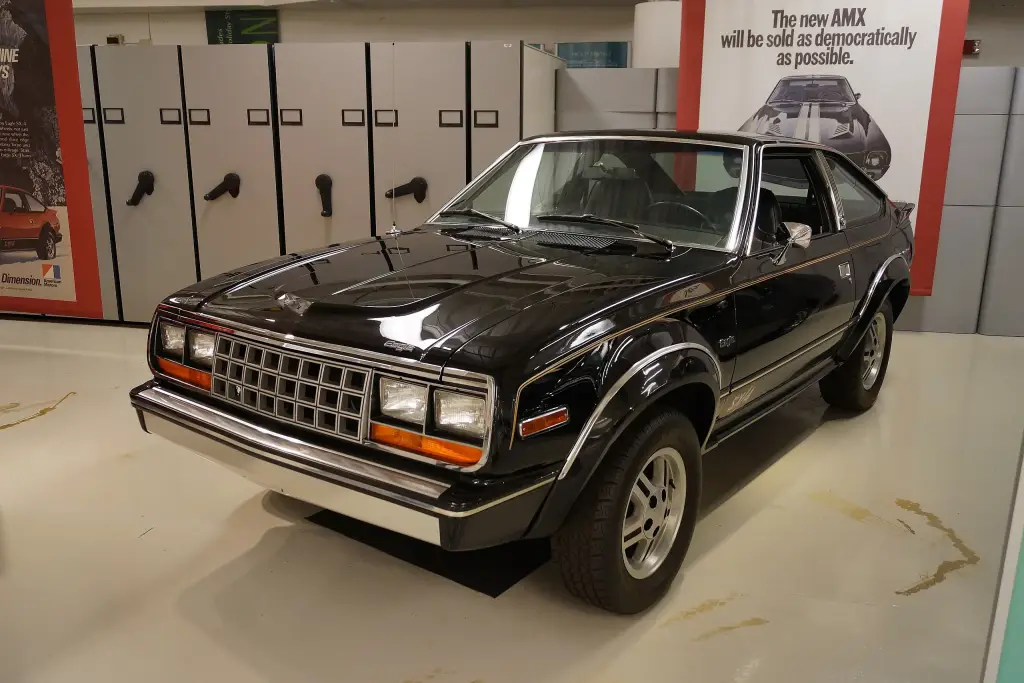
The AMC Eagle was a family car with the traction of a Jeep. Built on the Concord estate and saloon, it used a permanent four-wheel-drive system with a viscous coupling, and its blend of car comfort and all-weather ability makes it widely regarded as the first crossover.
AMC Eagle at a glance
| Maker | American Motors Corporation, then Chrysler |
|---|---|
| Production | 1980–1987 model years; 1988 by Chrysler |
| Class | compact four-wheel-drive passenger car |
| Based on | AMC Concord; Spirit for the SX/4 and Kammback |
| Drive | permanent four-wheel drive with viscous coupling |
| Central differential | single-speed, no low range |
| Body styles | two-door coupe, four-door sedan, four-door wagon |
| Added weight | about 300 lb (136 kg) for the drivetrain |
| Price at launch | US$6,999 two-door, US$7,549 four-door wagon |
| Also known as | the first crossover vehicle |
Based on one source: the English Wikipedia article on the AMC Eagle.
History of the AMC Eagle
Project 8001 plus Four
The idea came from Roy Lunn, chief design engineer for AMC Jeep, who proposed a line of four-wheel-drive vehicles with the ride and handling of a normal rear-wheel-drive car on a unitary platform; his code name was “Project 8001 plus Four”. In February 1977 AMC contracted FF Developments to build a prototype based on a V8 Hornet, with torque split 33 per cent to the front and 66 to the rear. Testing showed that greater ground clearance, larger 15-inch wheels and a split closer to 50/50 worked better, and Lunn recommended the AMC straight-six with an automatic transmission. The Eagle was therefore a Concord body joined to a four-wheel-drive system, a low-cost way of bridging the gap between AMC’s economical passenger cars and its off-road-focused Jeep line.
Launch and reception
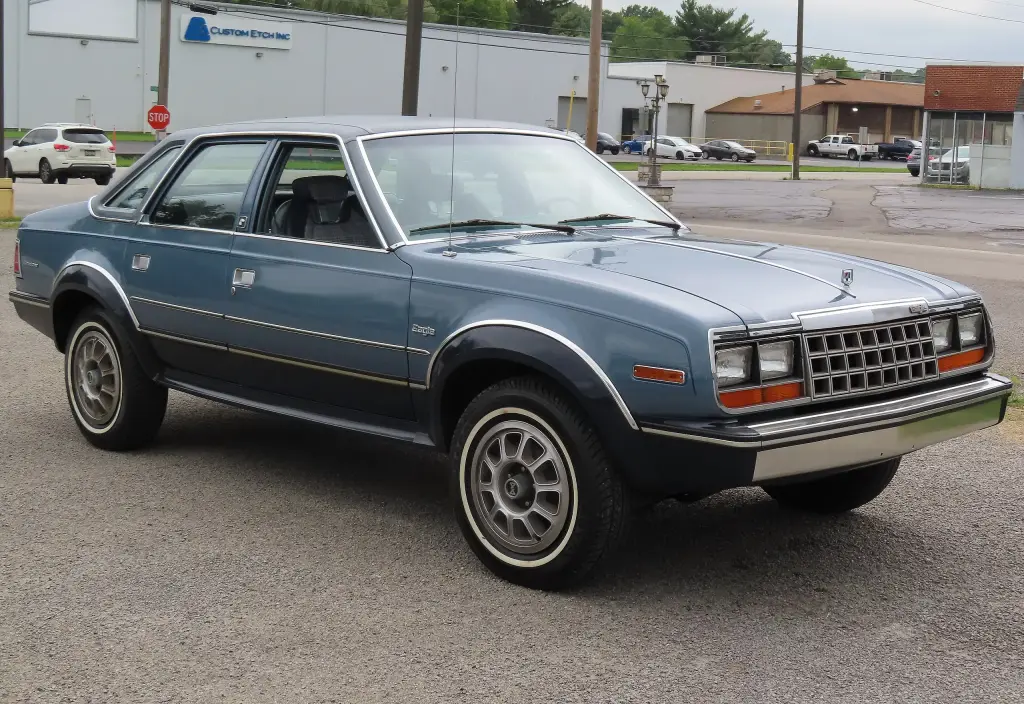
The Eagle arrived in August 1979 for the 1980 model year with coupe, sedan and station wagon bodies, and sales were brisk from the start. It also filled the price gap between small imported four-wheel-drive cars such as the Subaru and large domestic machines such as the Jeep Wagoneer. The early cars had a full-time automatic system working as permanent all-wheel drive, adding about 300 pounds to the kerb weight. They were the first mass-produced American four-wheel-drive cars with independent front suspension. The central differential behind the TorqueFlite automatic gearbox was a single-speed unit without a low range, with closely spaced wavy clutch plates running in a silicone fluid; it acted as a limited-slip coupling between the front and rear axles, sending torque to the axle with more grip on wet or dry roads.
Range and the end
In 1981 the smaller Spirit-based SX/4 and Kammback joined the line, aimed at first-time buyers and fleets, and a Sundancer convertible conversion was offered on the larger two-door in 1981 and 1982. By 1984 only the sedan and wagon remained, and for 1988, its final year under Chrysler, only the station wagon was sold, as the “Eagle Wagon”. Chrysler kept the Eagle name as a brand of cars until 1998, but the four-wheel-drive Eagle itself was not replaced. The car was marketed as offering “passenger-car comfort, plus 4WD security”, and it served in America’s first ice-driving school.
Design and features
- Permanent four-wheel drive: a viscous-coupling centre differential shared torque between the axles automatically.
- Car comfort: the Concord body brought saloon ride quality and equipment to a four-wheel-drive vehicle.
- Independent front suspension: the first mass-produced American four-wheel-drive car with it.
- Higher ride height: larger 15-inch wheels and more ground clearance than the Concord.
AMC Eagle versions
- Eagle coupe, sedan and wagon 1980: the original range on the Concord platform.
- SX/4 1981: a shorter, sportier two-door on the Spirit platform.
- Kammback 1981: the Spirit-based two-door estate.
- Sundancer 1981–82: a convertible conversion of the larger two-door.
- Eagle Wagon 1988: the final Chrysler-built model, wagon only.
The Eagle was developed from the Concord, which itself grew out of the Hornet. More cars are in the AMC collection.
Sources
- AMC Eagle, English Wikipedia: development, drivetrain, versions, production