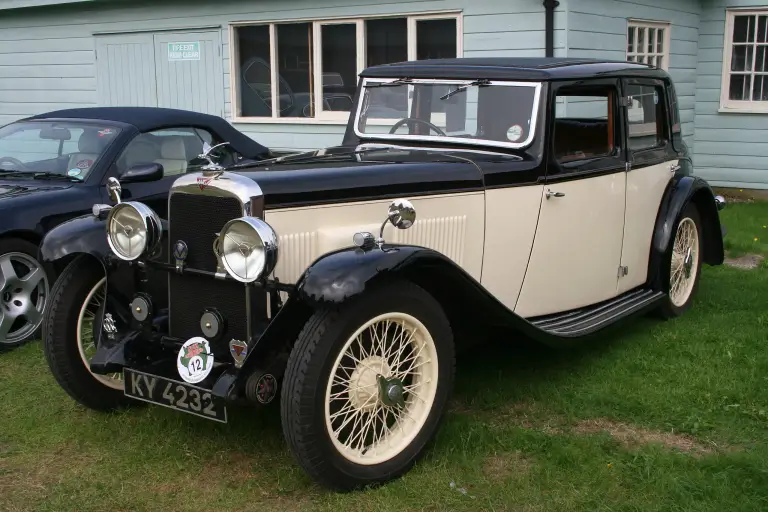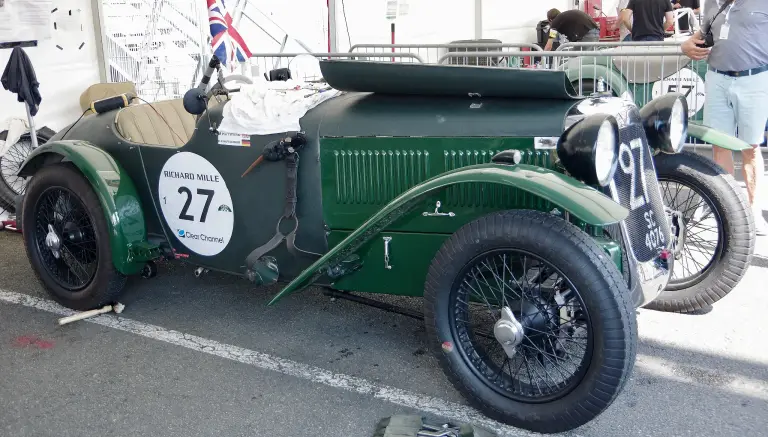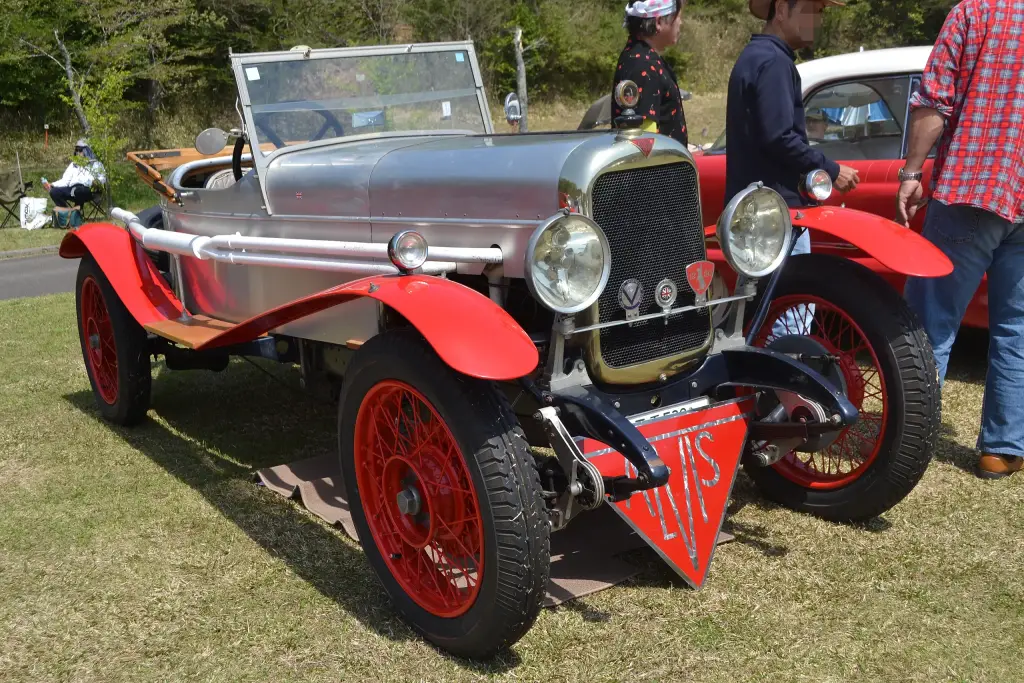
The Alvis 12/50 is a light car with a four-cylinder overhead-valve engine, built by the Alvis Car and Engineering Company of Coventry from 1923 to 1932, with a pause in 1929–1930. It was introduced in 1923, won the Junior Car Club’s 200 Miles Race at Brooklands the same year and became the car that put Alvis on the map.
The 12/50 went through nine versions, from the first SA and SB to the final TJ, with three engine sizes and a long list of factory bodies: the pointed-tail “duck’s back” two-seater, four-seat sports and touring cars, a drophead coupé and saloons.
Alvis 12/50 at a glance
| Maker | Alvis Car and Engineering Company, Holyhead Road, Coventry |
|---|---|
| Production | 1923–1932 (none in 1929–1930), 3,616–3,705 cars |
| Engine | four-cylinder in-line, pushrod overhead valves |
| Capacity | 1,496 cc (68 × 103 mm), 1,598 cc (68 × 110 mm) or 1,645 cc (69 × 110 mm) |
| Power | 50 bhp (37 kW) at 4,000–4,500 rpm |
| Gearbox | four-speed, no synchromesh, right-hand change |
| Clutch | fabric-faced aluminium cone; single plate from the 1926 TE and TF |
| Brakes | rear wheels only on the first cars; four-wheel brakes optional on the SC, standard from the TE and TF |
| Wheelbase | 2,756 mm (SA); 2,845–2,858 mm (other versions) |
| Length and width | 3,886–4,013 mm long, 1,524 mm wide |
| Speed | Super Sports of 1925: guaranteed 70 mph, capable of about 80 mph |
| Price | £550 (Super Sports, 1925); £495 (TE drophead coupé, 1926) |
| Bodies | two- and four-seat, open and closed; factory bodies mostly by Carbodies and Cross & Ellis |
| Predecessors | Alvis 10/30 and the side-valve 12/40 |
Sources differ on the total: Grace’s Guide gives 3,616 cars, English Wikipedia 3,705. The engine speed for the 50 bhp rating is given as 4,000 rpm for the first 1,496 cc engine and 4,500 rpm for the 1,645 cc engine of the TE. The speed figures come from a 1925 Motor Sport test of the Super Sports.
History of the Alvis 12/50
Before the 12/50: T. G. John and the 10/30
Alvis began in 1919 as T. G. John, a Coventry firm that made stationary engines, carburettor bodies and motor scooters. Its owner, Thomas George John, was approached by Geoffrey de Freville with the design of a 1,498 cc four-cylinder engine with aluminium pistons and pressure lubrication. De Freville also owned the name Alvis and the red triangle trade mark.
The first car, the 10/30 of 1920, was an instant success: by the end of the year the company was building two cars a week, and in 1921 production moved to Holyhead Road in Coventry. In 1922 G. T. Smith-Clarke joined from Daimler as chief engineer and works manager, the man who would later design the Speed 20 and Speed 25. In 1923 the side-valve engine of the 10/30 was developed into an overhead-valve unit, and the 12/50 was born.
Brooklands, 1923: the 200 Miles Race
In 1923 Alvis entered three overhead-valve 12/50s in the Junior Car Club’s 200 Miles Race at Brooklands. Two used standard chassis; the third had a special narrow frame with a high, narrow two-seat body, a high compression ratio and connecting rods machined from solid steel. Harvey, with George Tattersall as his passenger, won at an average of 93.29 mph (about 150 km/h), beating Cushman’s Brescia Bugatti after the dramatic retirement of the two Fiats. The speed was more than 5 mph above the previous year’s record set by a Talbot-Darracq. The winning car was later dismantled by the factory and no longer exists.
The subframe cars: SA, SB and SC (1923–1925)
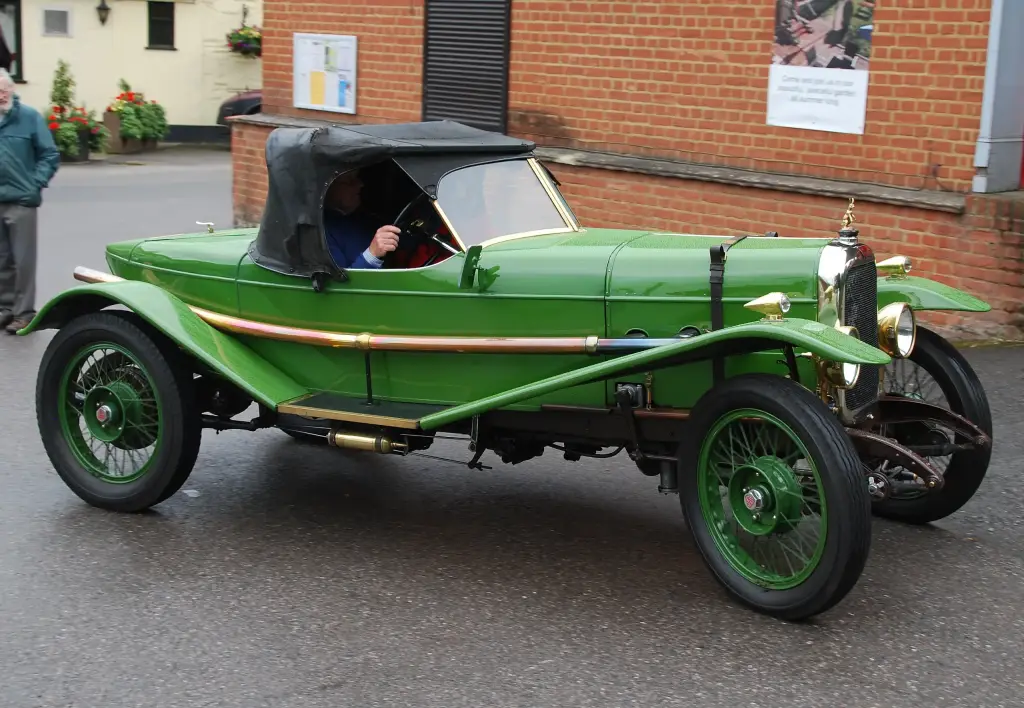
The first production 12/50s were built in late 1923 for the 1924 model year. The SA had the 1,496 cc engine and a 2,756 mm wheelbase and usually carried the two-seat Super Sports body with the pointed “duck’s back” tail. The SB had a longer, 2,858 mm wheelbase; it started with the same engine but soon received the new 1,598 cc version, and most SBs were four-seat Super Sports, with a good number of touring bodies from the standard range. On both, the engine sat in a subframe bolted to a fairly slender ladder chassis, and the brakes, with twin shoes, worked on the rear wheels only.
The SC arrived in the autumn of 1924 for the 1925 model year and also replaced the last side-valve model, the 12/40. It had the 1,598 cc engine as standard, with the 1,496 cc unit still available for competition in the 1½-litre class. Most SCs used the longer chassis, which stayed standard until the end of production. Front-wheel brakes became an option, on a front axle of new design, and the propeller shaft now ran in roller bearings. In 1924 the company built more than 900 car chassis.
The redesign: TE, TF, TG, TH and SD (1926–1929)
For the 1926 model year the 12/50 was redesigned. The TE, introduced in the autumn of 1925, had a stronger chassis and an engine built around a new crankcase and enlarged again to 1,645 cc, still rated at 50 bhp. The TF of the same year used a short-stroke 1,496 cc version for sporting owners. A single-plate clutch with a clutch stop for quicker upward changes replaced the cone, and from now on the engine was bolted directly to the flanged chassis frame, so the subframe disappeared. Four-wheel brakes became standard, with single-shoe drums at the rear.
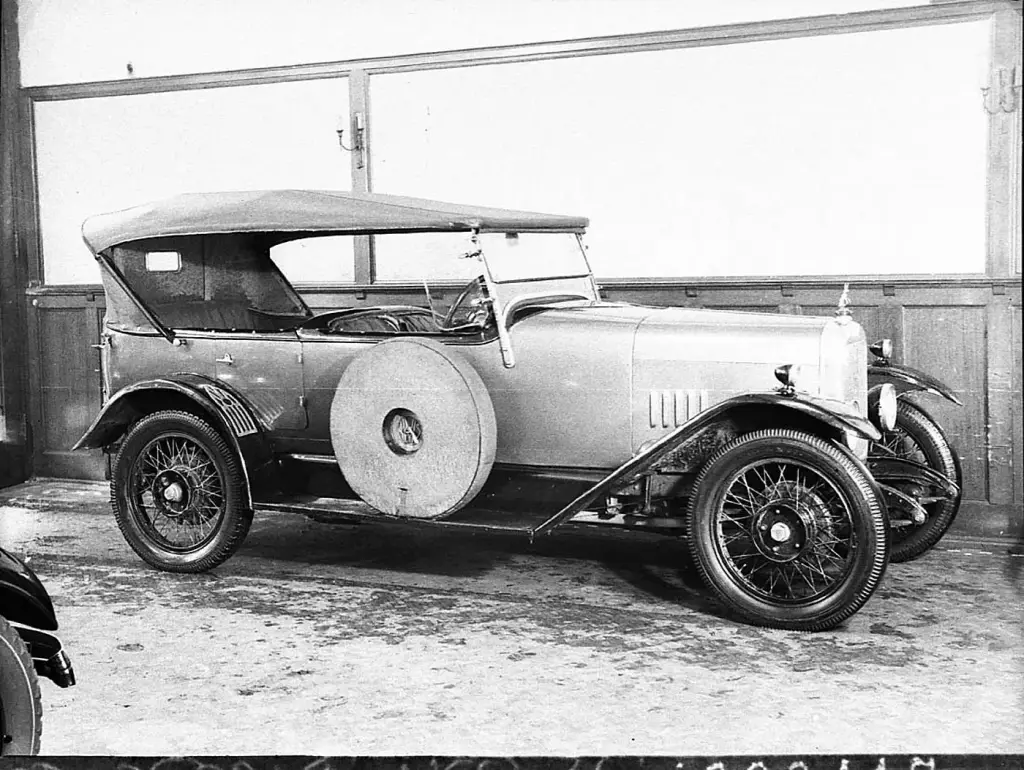
For 1927 the range was rearranged again. The TG became the standard touring model with the 1,645 cc engine, while the SD, confusingly with an “S” prefix, took over the sporting role from the TF: it had the 1,496 cc engine with a large-port cylinder head. The rare TH combined the small engine with the gearbox and rear axle ratios of the touring TG. The TG and SD stayed in the catalogue until 1929. The TG and TH can be recognised by a taller radiator with a deeper top section, and cars of the 1928 and 1929 model years have higher-mounted lamps on a horizontal crossbar, as was the fashion.
How long these cars could last is shown by a 1926 TE drophead coupé recorded by Grace’s Guide: chassis 9508, first registered on 29 March 1926 at a list price of £495, which by the time of the record had covered more than 250,000 miles.
Pause and revival: the TJ (1931–1932)
Between 1929 and 1930 Alvis dropped the 12/50, convinced that the future belonged to its front-wheel-drive cars, the FWD models. When these did not sell in the hoped-for numbers, a last 12/50, the TJ, was announced for the 1931 model year with the 1,645 cc engine. It stayed in production until 1932.
Alvis historians call the TJ years the “revival period”. The TJ differs from the earlier cars in several ways: coil ignition instead of a magneto, a deep chromed radiator shell, and a fuel tank at the rear instead of the scuttle-mounted tank of most older 12/50s. A more sporting car on the same chassis was sold not as a 12/50 but as the 12/60: the TK in 1931 and the TL in 1932. The four-cylinder line then continued with the Alvis Firefly.
The 12/50 in competition
Racing made the 12/50, and the 12/50 stayed in racing long after the 1923 victory. Motor Sport’s history of the Alvis racing team lists, among others:
- 1924: two new 200 Miles cars with dry-sump lubrication and a high-lift camshaft did not finish, but a single-seater set Class F records for three hours and five hours at 85.6 and 83.2 mph.
- 1925: a new front-wheel-drive sprint car used the “faithful 12/50” engine, largely unchanged, and made the fastest 1½-litre climb at Shelsley Walsh.
- 1926: H. W. Purdy’s private 12/50 won two short handicaps on the Brooklands Outer Circuit and averaged 86.77 mph in the Essex Motor Club 100 Mile Handicap.
- 1927: a three-car works team won the team prize and took the first three places in the 1½-litre class of the Essex Motor Club Six-Hour Race; J. Macdonald won the JCC 50 Mile Handicap at 78.92 mph, and Harvey won the JCC Sporting Car Race at 63.2 mph over 254 miles, with Green’s 12/50 second.
- 1932: an old Sports 12/50 still won a race at Brooklands, at 88.15 mph.
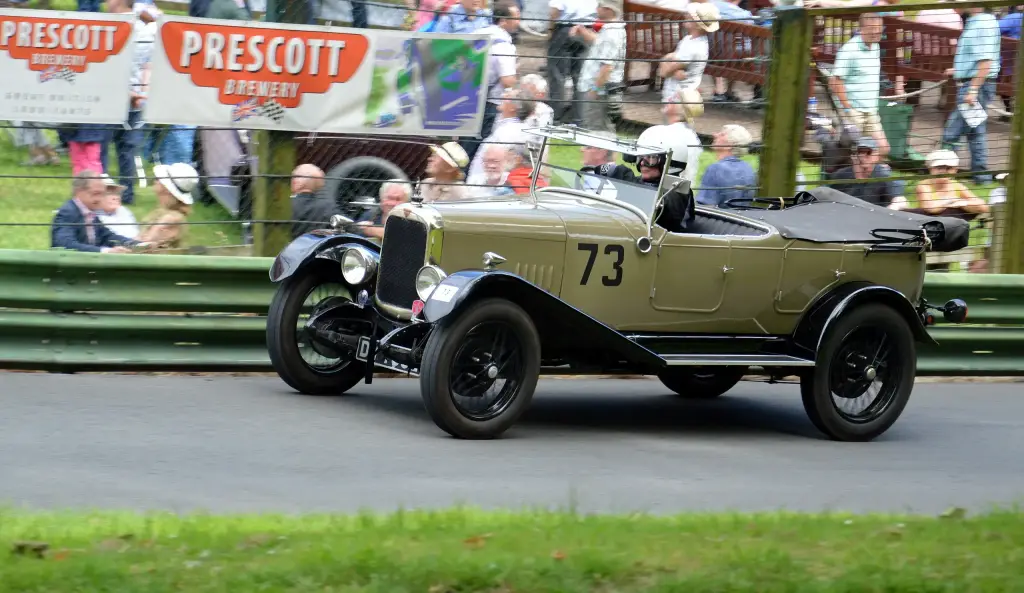
The magazine noted that early 12/50s could be developed into 90 mph cars. They still compete today, for example in Vintage Sports-Car Club hill climbs at Prescott, as in the photograph above.
Design and engineering
- Engine: four cylinders in line, cast in one block, with pushrod-operated overhead valves; 1,496 cc, 1,598 cc or 1,645 cc.
- Mounting: in a subframe bolted to the ladder chassis on the SA, SB and SC; bolted directly to a stronger flanged frame from the TE and TF.
- Transmission: separate four-speed gearbox without synchromesh and with a right-hand lever, a cone clutch on early cars and a single-plate clutch from 1926, an open tubular propeller shaft with roller-bearing joints, and a rear axle with spiral bevel gears in an aluminium casing (as described in 1925).
- Brakes: rear drums only at first, front brakes as an option on the SC, four-wheel brakes as standard from 1926.
- Steering and layout: all 12/50s are right-hand drive.
- Electrics and fuel: magneto ignition and a scuttle tank on most cars; coil ignition and a rear tank on the TJ.
Bodies: duck’s back, tourers and saloons
Alvis offered a range of factory bodies, most of them built by Carbodies and Cross & Ellis, in two- and four-seat form, open or closed. The best known is the Super Sports two/three-seater with a pointed tail, nicknamed the duck’s back because it was said to resemble the back of a duck. Most SB cars carried four-seat Super Sports bodies, and later ranges included tourers, drophead coupés, saloons and the beetleback.
The red and silver roadster on our home page is a 3D model inspired by a 1925 Alvis of this kind.
Alvis 12/50 versions
| Version | Model years | Engine | Notes |
|---|---|---|---|
| SA | 1924 | 1,496 cc | short chassis, engine in a subframe, usually duck’s back two-seater |
| SB | 1924 | 1,496 cc, then 1,598 cc | long chassis, mostly four-seat Super Sports |
| SC | 1925 | 1,598 cc (1,496 cc on request) | front brakes optional |
| TE | 1926 | 1,645 cc | new stronger chassis, single-plate clutch, four-wheel brakes |
| TF | 1926 | 1,496 cc | short-stroke sporting version of the TE |
| TG | 1927–1929 | 1,645 cc | standard touring model, taller radiator |
| SD | 1927–1929 | 1,496 cc | sporting model, large-port cylinder head |
| TH | 1927 | 1,496 cc | rare; small engine with TG gearbox and axle ratios |
| TJ | 1931–1932 | 1,645 cc | revival model: coil ignition, chromed radiator shell, rear tank |
Road test and reputation
The Super Sports tested by Motor Sport in 1925 cost £550 fully equipped and came with a guaranteed 70 mph (about 113 km/h). The tester found it pleasant and comfortable to drive, flexible, with adequate brakes and a reassuring feel for the passenger, and was surprised by how smooth and free of vibration the chassis was. The complaints were minor: an awkward gear lever position, a hand brake that could be easier to reach and an exhaust loud enough to annoy a policeman.
The 12/50 was not a cheap car. It competed with the upper end of British sports cars, was built for endurance and reliability, and won speed trials, hill climbs and races all over Britain. The 1926 TE drophead coupé with more than 250,000 miles, mentioned above, shows how well it was made.
More cars from the same factory are in our Alvis collection, among them the six-cylinder Silver Eagle, the four-cylinder 12/70 of the late 1930s and the front-wheel-drive FWD. If you are thinking of buying a car like this, start with our guide Buying a classic.
Alvis 12/50 questions and answers
When was the Alvis 12/50 made?
From 1923 to 1932. Production stopped in 1929–1930, when Alvis bet on its front-wheel-drive cars, and resumed with the TJ for the 1931 model year.
How many Alvis 12/50s were built?
Between 3,616 and 3,705, depending on the source.
What is a duck’s back Alvis?
A 12/50 with the Super Sports two/three-seat body whose pointed tail was said to look like the back of a duck. Most early SA cars carried it.
How fast was the Alvis 12/50?
A 1925 Super Sports was guaranteed to reach 70 mph and could do about 80 mph. The special racing car that won the 1923 JCC 200 Miles Race averaged 93.29 mph.
How can you tell the versions apart?
The earliest cars (SA, SB, SC) have the engine in a subframe and, at first, rear brakes only; from the 1926 TE the engine is bolted to a stronger frame and all four wheels have brakes. The TG and TH have a taller radiator, 1928–1929 cars have high lamps on a crossbar, and the TJ has a chromed radiator shell and a rear fuel tank.
What came after the 12/50?
The sporting 12/60 (TK and TL) on the TJ chassis, and from 1932 the four-cylinder Alvis Firefly.
Sources
- Alvis 12/50, English Wikipedia: versions, engines, chassis, production total
- Alvis 12/50, German Wikipedia: bore and stroke, power, dimensions, successors
- Alvis, Grace’s Guide: the company’s early history
- Alvis: 12/50, Grace’s Guide: production total, the 1926 TE drophead coupé
- The racing history of the Alvis company, Motor Sport, June 1943: the 1923 race and later results
- Super-Sports Alvis road test, Motor Sport, April 1925: price, speed, driving impressions
- Harvey’s close call in an Alvis, Motor Sport, January 2009: the 1923 200 Miles Race
- 1923 Alvis 12/50, Supercars.net: first engine data