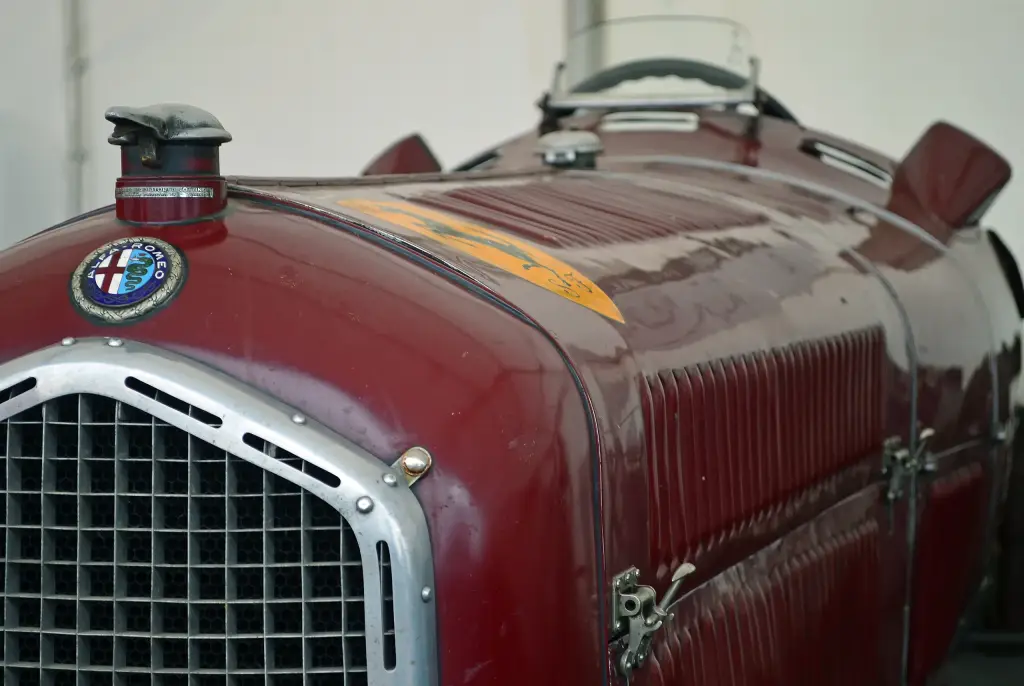
The Alfa Romeo P3, also known as the P3 monoposto or Tipo B, is a classic Grand Prix car designed by Vittorio Jano and considered the world’s first genuine single-seat Grand Prix racing car. Introduced in June 1932, it was powered by a supercharged eight-cylinder engine and won races until 1935.
Alfa Romeo P3 at a glance
| Designer | Vittorio Jano |
|---|---|
| Introduced | June 1932 (European Grand Prix season) |
| Layout | single-seat Grand Prix car, based on the earlier P2 |
| Engine | supercharged eight-cylinder, cast iron block |
| Displacement | bored out to 2.9 L in 1934 and to 3.2 L for the 1935 German Grand Prix |
| Weight | just over 680 kg (1,500 lb) |
| First win | Tazio Nuvolari, 1932; six wins that year |
| 1934 record | won 18 of the 35 Grands Prix held in Europe |
This page is based on English Wikipedia only, so the figures could not be cross-checked against a second source.
History of the Alfa Romeo P3
The P3 was Alfa Romeo’s second monoposto after the Tipo A of 1931 and was based on the successful P2. It was very light for its time, at just over 680 kg despite its cast iron engine block. It won its first race in the hands of Tazio Nuvolari and went on to win six races in 1932, driven by Nuvolari and Rudolf Caracciola, including the Grands Prix of Italy, France and Germany.
In 1933 Alfa Corse had financial difficulties and locked the cars away, so Enzo Ferrari ran his Scuderia Ferrari with older Monzas until the P3 was finally handed to the Scuderia in August; P3s then won six of the last 11 events. For 1934 the engine was bored out to 2.9 litres, and P3s won 18 of the 35 Grands Prix held in Europe, although the German Silver Arrows dominated the European Championship rounds.
By 1935 the car was uncompetitive against the German cars, but it took one more legendary victory: bored out to 3.2 litres, it won the 1935 German Grand Prix at the Nürburgring for Nuvolari, who came through the field after a puncture to win in front of 300,000 spectators when Manfred von Brauchitsch’s Mercedes-Benz W25 suffered a puncture on the last lap.
Design and features
- Single-seater: the first genuine single-seat Grand Prix car.
- Engine: a supercharged eight-cylinder with a cast iron block, enlarged to 2.9 and 3.2 litres in later years.
- Weight: just over 680 kg.
Alfa Romeo P3 versions
- P3 (1932–1933): the original car.
- 2.9-litre P3 (1934): bored out under the new bodywork rules.
- 3.2-litre P3 (1935): the special car for the German Grand Prix.
More Alfa Romeo racing cars are in our Alfa Romeo collection, for example the Alfa Romeo P2 and the Tipo 308.
Alfa Romeo P3 questions and answers
Who designed the Alfa Romeo P3?
Vittorio Jano.
Why is the P3 important?
It is considered the world’s first genuine single-seat Grand Prix racing car.
What engine did it have?
A supercharged eight-cylinder, later bored out to 2.9 and 3.2 litres.
What was its greatest victory?
The 1935 German Grand Prix at the Nürburgring, won by Tazio Nuvolari against the faster German cars.
Sources
- Alfa Romeo P3, English Wikipedia: design, history, results