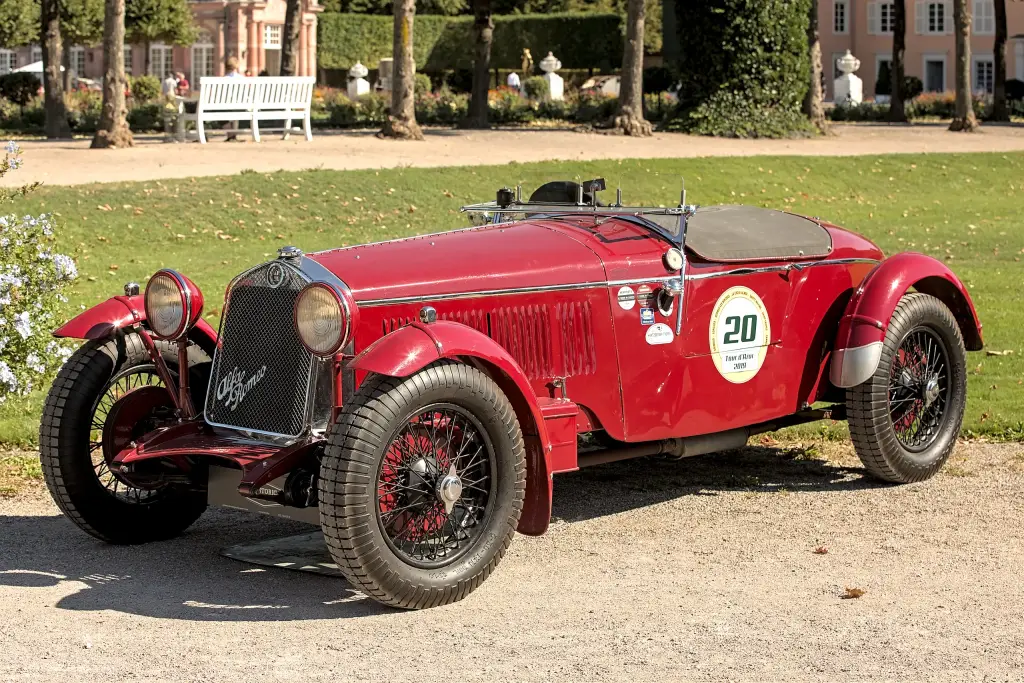
The Alfa Romeo 6C name was used on road, race and sports cars produced by Alfa Romeo between 1927 and 1954; the “6C” refers to the six cylinders of the straight-six engine. Bodies were made by coachbuilders such as James Young, Zagato, Touring Superleggera, Castagna and Pinin Farina, and from 1933 there was also a 6C with an Alfa factory body, built in Portello.
Alfa Romeo 6C at a glance
| 6C 1500 (1927–1929) | introduced at the 1925 Milan Motor Show, series production from 1927, with the P2 Grand Prix car as a starting point; 3,000 built (200 with DOHC engines); ten supercharged Super Sport cars |
|---|---|
| 6C 1500 Sport (1928) | dual overhead-camshaft engine; won the 1928 Mille Miglia |
| 6C 1750 (1929–1933) | 1,752 cc (65 × 88 mm), introduced in 1929 in Rome; top speed 153 km/h; six series; 2,635 built |
| 6C 1750 versions | base model with single overhead cam; Super Sport and Gran Sport with double overhead cam |
| 6C 1900 (1933) | final derivative of the 6C 1500; 197 examples; Gran Turismo only with a 2,920 mm wheelbase |
| Successor | 6C 2300, introduced in 1934 |
This page is based on English Wikipedia only, so the figures could not be cross-checked against a second source.
History of the Alfa Romeo 6C
6C 1500
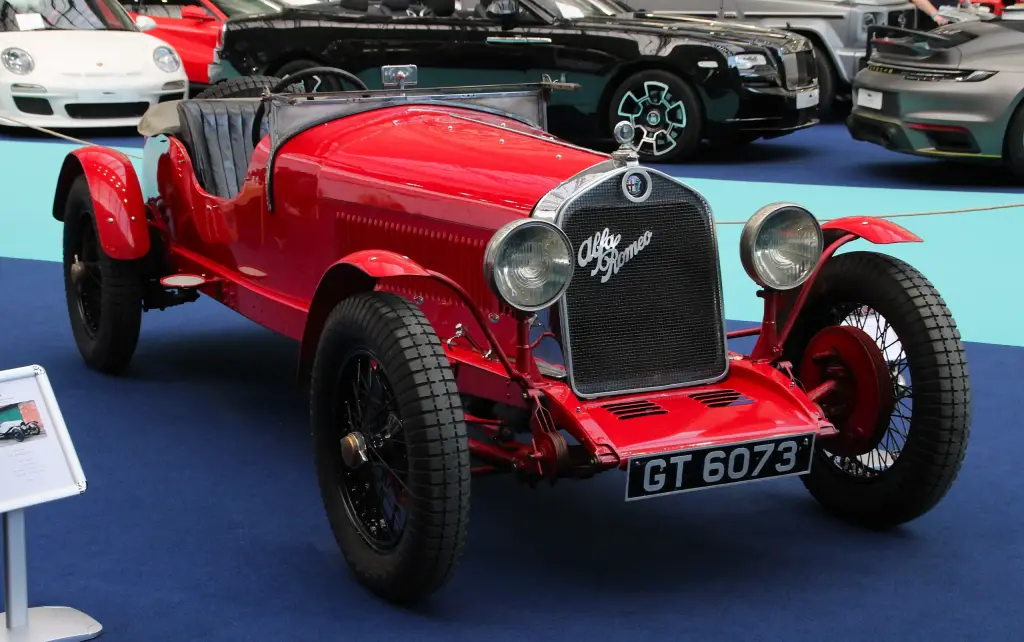
In the mid-1920s Alfa’s RL was considered too large and heavy, so a new development began. The 2-litre formula that had led to Alfa Romeo winning the Automobile World Championship in 1925 changed to 1.5 litres for 1926, and the 6C 1500 was introduced at the Milan Motor Show in 1925 with series production starting in 1927. In 1928 the 6C Sport appeared with a dual overhead-camshaft engine, and its sport version won many races including the 1928 Mille Miglia.
6C 1750
The more powerful 6C 1750 was introduced in 1929 in Rome with a top speed of 153 km/h, a chassis designed to flex over uneven surfaces and sensitive geared-up steering. In 1929 the 6C won every major race it entered, including the Grands Prix of Belgium, Spain, Tunis and Monza; the Mille Miglia was won by Giuseppe Campari and Giulio Ramponi, and the car also won the Brooklands Double Twelve and the Ulster TT. In 1930 it again won the Mille Miglia and the Spa 24 Hours.
6C 1900
The 6C 1900 was the final derivative of the 6C 1500, made in 197 examples during 1933 as a transitional model before the 6C 2300 arrived the following year.
Design and features
- Engine: a straight-six, with single overhead cam on the base models and double overhead cam on the Super Sport and Gran Sport.
- Coachbuilders: James Young, Zagato, Touring Superleggera, Castagna and Pinin Farina, plus factory bodies from Portello after 1933.
Alfa Romeo 6C versions
- 6C 1500 (1927): the first series.
- 6C 1750 (1929–1933): six series.
- 6C 1900 (1933): the transitional model.
- 6C 2300 and 6C 2500: later models up to 1954; see also the 6C 2500.
More prewar Alfa Romeos are in our Alfa Romeo collection, for example the Alfa Romeo P2, the Alfa Romeo P3 and the Alfa Romeo RL.
Alfa Romeo 6C questions and answers
What does 6C mean?
Six cylinders: the straight-six engine of these Alfa Romeos.
When was the 6C built?
From 1927 to 1954 in several models.
Which 6C won the Mille Miglia?
The 6C 1500 Sport in 1928, and the 6C 1750 in 1929 (Campari and Ramponi) and 1930.
How many 6C 1750 were built?
2,635.
What came after the 6C 1900?
The 6C 2300, introduced in 1934.
Sources
- Alfa Romeo 6C, English Wikipedia: models, production, results