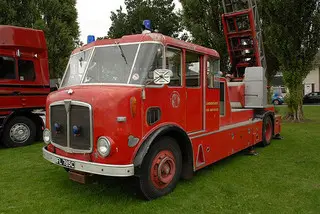
The AEC Merryweather is a fire appliance that pairs an AEC Regent chassis with bodywork by Merryweather & Sons, the London firm that built steam fire engines and fire appliances from the 19th century. This page follows the maker’s history, since there is no separate article on the appliance itself.
AEC Merryweather at a glance
| Vehicle | London Fire Brigade appliance on an AEC Regent chassis |
|---|---|
| Body | Merryweather & Sons |
| Maker’s works | Clapham, later Greenwich, London |
| Founder | Moses Merryweather (1791–1872) |
| Joined by | his son Richard Moses Merryweather (1839–1877) |
| Boiler | vertical boiler designed with the engineer Edward Field |
| Pump sizes | about 100 to 2,000 gallons per minute |
| Common size | double vertical boiler, 250–450 gallons per minute |
| First self-propelled | 1899 steam fire engine Fire King |
| First motorised in London | 1904, for the Finchley Fire Brigade |
| Tram engines | about 174 built between 1875 and 1892 |
There is no separate Wikipedia article on the AEC Merryweather appliance; the maker’s history is used here, and the AEC connection comes from the London Fire Brigade appliance shown in the video.
History of the AEC Merryweather
Merryweather & Sons of Clapham, later Greenwich, were builders of steam fire engines and steam tram engines. The founder was Moses Merryweather (1791–1872) of Clapham, who was joined by his son Richard Moses (1839–1877).
The Merryweathers worked with the engineer Edward Field to fit his design of a vertical boiler onto a horse-drawn platform, and applied it successfully to their steam fire engine, improving water pressure and making the machine easier to use once steam had been raised. It was reckoned that an engine could get up enough pressure to pump within ten minutes of a call, and the fire could be lit before leaving the station, so pressure would be there on arrival. Appliances ranged from small sizes for country houses, pumping about 100 gallons a minute, to large dockyard models rated at 2,000 gallons a minute; a common size with borough brigades was the double vertical boiler, pumping 250 to 450 gallons a minute. Merryweather also supplied hydrants and mains water supplies for vulnerable sites such as theatres, where a strong enough supply could be a problem. Dock fires were a particular challenge, and after demonstrating steam-powered appliances at Antwerp docks Merryweather’s machines, with crews in their distinctive Merryweather helmets, became synonymous with firefighting in Britain and abroad alongside their rivals Shand, Mason. The firm also built specialist fireboats, including a steam-powered barge for the port of Alexandria designed to pump 1,200 gallons a minute to a height of 200 feet.
In 1899 Merryweather produced the world’s first successful self-propelled steam fire engine, the Fire King, the first of which went to Port Louis on Mauritius. The first motorised fire engine in London was a Merryweather appliance delivered to the Finchley Fire Brigade in 1904; it was commemorated by a Royal Mail stamp in April 1974 and is preserved in the reserve collection of the Science Museum at Wroughton. Another notable survivor is the UK’s oldest known aerodrome fire and crash tender, a 1937 Merryweather with a Commer engine and chassis, kept in running order at Brooklands Museum in Surrey. At the end of 1909 the municipality of Bombay bought a Hatfield-based fire engine from Merryweather & Sons, powered by a 50 hp engine with a top speed of 30 mph, together with an escape tender with a 50-foot sliding carriage. As motor appliances replaced steam, Merryweather bodies were mounted on chassis from specialist makers, and the London Fire Brigade appliance shown here uses an AEC Regent chassis.
Design and features
- AEC Regent chassis: the London appliance in the video pairs AEC’s double-decker bus chassis with Merryweather bodywork.
- Vertical boiler: Edward Field’s boiler design gave steam pressure within about ten minutes of a call.
- Range of sizes: from 100-gallon pumps for country houses to 2,000-gallon dockyard machines.
- Merryweather helmets: the firm also made the distinctive fire helmets used by its crews.
AEC Merryweather versions
- Horse-drawn steam engines: the original Merryweather appliances, with vertical boilers.
- Fire King (1899): the first successful self-propelled steam fire engine.
- 1904 motor appliance: the first motorised fire engine in London, for the Finchley Fire Brigade.
- Steam tram engines: about 174 built between 1875 and 1892.
- AEC Regent appliance: a London Fire Brigade motor appliance on AEC chassis.
The chassis came from the AEC Regent bus family, and more AEC vehicles are in the AEC collection.
Video: AEC Regent Merryweather London Fire Brigade
Video by paddingtonfire on YouTube.
Sources
- Merryweather & Sons, English Wikipedia: company history, appliances, Fire King, 1904 engine