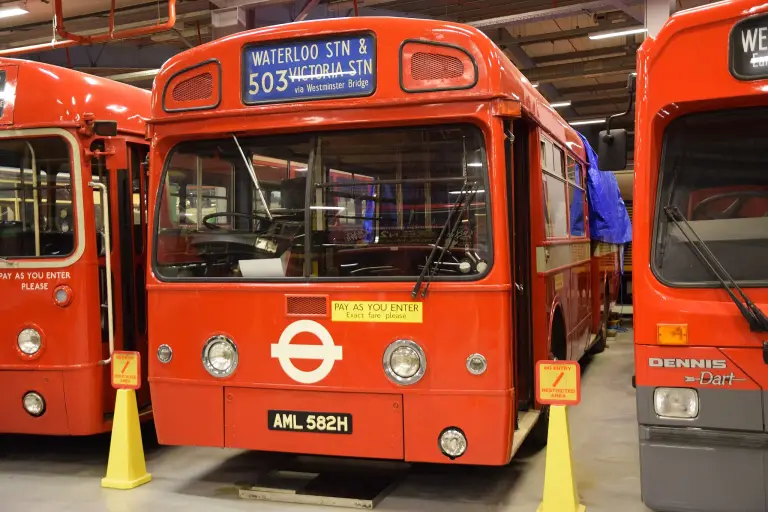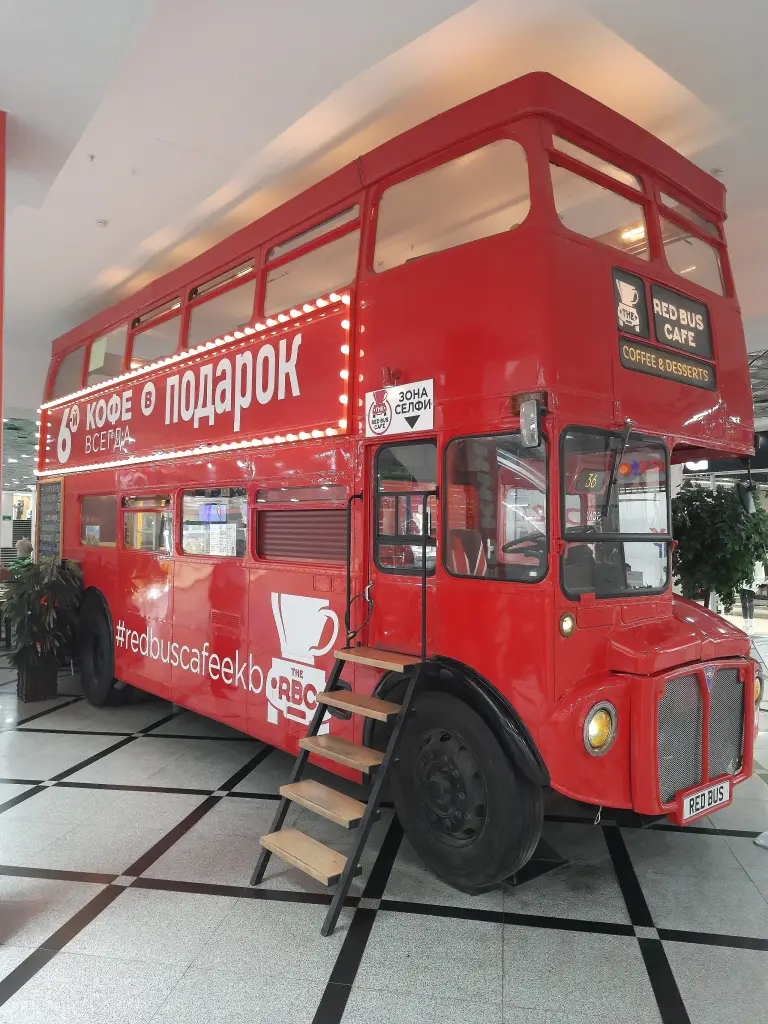
The AEC Routemaster is a front-engined double-decker bus designed by London Transport and built by the Associated Equipment Company and Park Royal Vehicles. The first prototype was completed in September 1954, the last bus was delivered in 1968, and Routemasters stayed in regular London service until December 2005.
AEC Routemaster at a glance
| Designed by | London Transport |
|---|---|
| Built by | AEC and Park Royal Vehicles |
| First prototype | September 1954 |
| In service | February 1956 – December 2005 |
| Heritage routes | until 2019 |
| Layout | half-cab, front-mounted engine, open rear platform |
| Seating | 64, against 56 in the RT family |
| Construction | integral: steel A and B sub-frames joined by an aluminium body |
| Innovations | independent front suspension, power steering, automatic gearbox, power-hydraulic brakes |
| Built | 2,876, of which 1,230 existed in September 2024 |
History of the AEC Routemaster
The Routemaster was developed between 1947 and 1956 by a team directed by AAM Durrant and Colin Curtis, with vehicle styling by Douglas Scott. The brief was to produce a bus that was lighter, hence more fuel-efficient, easier to operate and maintainable with the practices at the recently opened Aldenham Works, but with easier and lower-cost servicing. The result seated 64 passengers despite being three-quarters of a long ton lighter than buses of the RT family, which seated 56.
The first task on delivery was to replace London’s trolleybuses, themselves replacements for trams, and to begin replacing older diesel buses. London Transport designed the bus and Park Royal Vehicles built it, with running units from its sister company AEC; both were owned by Associated Commercial Vehicles, taken over by Leyland Motors in 1962. The design used lightweight aluminium and techniques developed in aircraft production during the war. It was one of the first integral buses, with an “A” steel sub-frame carrying engine, steering and front suspension and a rear “B” sub-frame carrying the rear axle and suspension, joined by an aluminium body. It also introduced independent front suspension, power steering, a fully automatic gearbox and power-hydraulic braking on a bus, which surprised early drivers used to heavier chassis.
London Transport placed four prototype Routemasters in service between 1956 and 1958: two built at Chiswick, one by Weymann at Addlestone and one experimental Green Line coach by Eastern Coach Works at Lowestoft, the last two with Leyland engines and mechanical units. The bus was first shown at the Earls Court Commercial Motor Show in 1954 and entered public service on 8 February 1956. In 1961, 24 longer Routemaster Lengthened buses of 30 ft were built as a test, going into production from 1965; the front-entrance RMF followed in 1962 and a small number of RMF and Routemaster Airways buses were produced. In 1966 AEC completed the front-entrance, rear-engined FRM1, nicknamed the Fruitmaster, which served in London and was donated to the London Transport Museum in 1983.
Most Routemasters were built for London Transport, with small numbers for British European Airways and the Northern General Transport Company. A total of 2,876 were built, of which 1,230 still existed in September 2024. The type outlasted several of its intended replacements, survived the privatisation of London Transport’s bus operators and was used by other operators around Britain. Its open platform allowed boarding away from official stops and the conductor kept boarding times short, but the high floor was inaccessible for disabled passengers and awkward with heavy luggage or pushchairs. In 2006 the Routemaster was voted one of Britain’s top ten design icons, and in 2009 it appeared in the Royal Mail’s British Design Classics stamps; the New Routemaster inspired by it entered service in February 2012.
Design and features
- Integral construction: steel sub-frames and an aluminium body, lighter than the RT family despite seating eight more.
- Modern running gear: independent front suspension, power steering, automatic gearbox and power-hydraulic brakes.
- Open rear platform: fast boarding with a conductor, but a high floor and no access for wheelchairs.
- Long life: regular service from 1956 to 2005, with heritage routes until 2019.
AEC Routemaster versions
- RM: the standard 27 ft 6 in Routemaster.
- RML: lengthened 30 ft version, 24 built in 1961 as a test and in production from 1965.
- RMF: front-entrance version based on the trial RMLs.
- RMA: Routemaster Airways buses for British European Airways.
- FRM1: front-entrance, rear-engined prototype of 1966, nicknamed the Fruitmaster.
The Routemaster succeeded the Regent III RT in London and shared its era with the rear-engined Merlin. More buses are in the AEC collection.
Video: (Preserved) Arriva London AEC Routemaster WLT901 RML901
Video by Chris on YouTube.
Sources
- AEC Routemaster, English Wikipedia: design, prototypes, production, service life