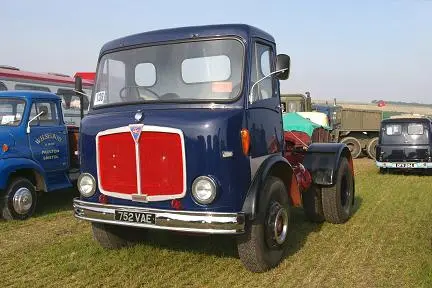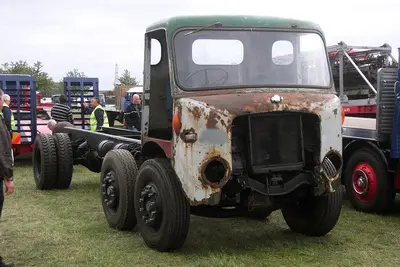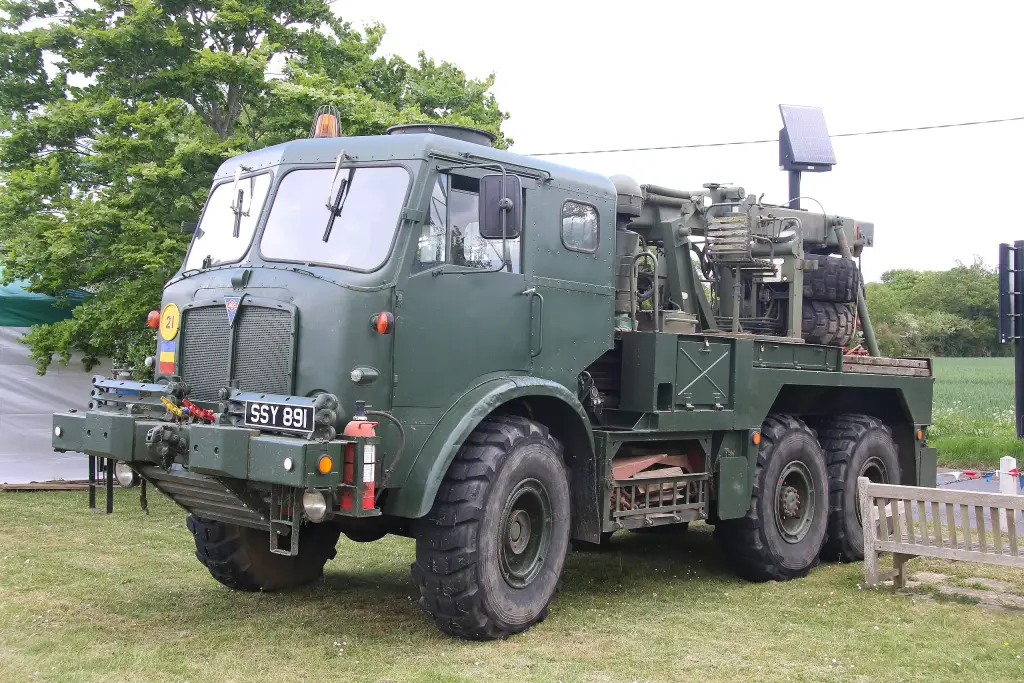
The AEC Militant, nicknamed Milly, was AEC’s post-war development of the wartime Matador artillery tractor. Unlike the Matador it was built only as a six-wheeler, with a considerably enlarged cab and a larger 11.3-litre six-cylinder diesel engine; military crews also knew it as the Knocker.
AEC Militant at a glance
| Maker | Associated Equipment Company (AEC), Southall |
|---|---|
| Also known as | Milly, Knocker |
| Predecessor | AEC Matador |
| Militant Mk 1 | models O859 and O860, 1952–1966 |
| Militant Mk 3 | models O870 and O880, 1966–1979 |
| Drive | Mk 1 in 6×4 or 6×6; Mk 3 in 6×6 only |
| Engine | 11.3-litre six-cylinder diesel |
| Cab | enlarged, steel frame instead of the Matador’s ash frame |
| Winch | chassis-mounted, driven through the gearbox |
| Steering | no power steering on the Mk 1; power-assisted ram on the Mk 3 |
| Last in service | Mk 1 until 1985; Mk 3 until 1990 |
History of the AEC Militant
The Militant was AEC’s post-war replacement for the Matador. Externally the most noticeable change was the cab, considerably enlarged, and unlike the Matador only six-wheel versions were produced. Other differences were a larger 11.3-litre six-cylinder diesel engine and a steel frame for the cab in place of the Matador’s ash wood structure. The Militant Mk 1 was built in 6×4 and 6×6 form, the Mk 3 only as a 6×6.
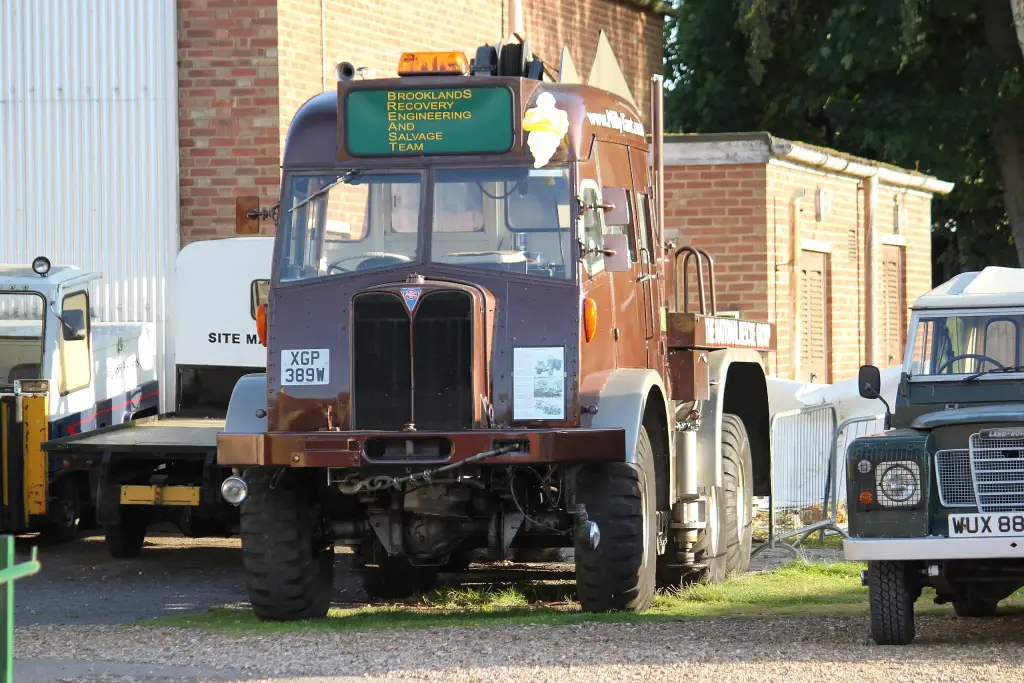
Although intended primarily as an artillery tractor, the Militant was also offered as an articulated lorry tractor unit, a General Service cargo lorry on a longer wheelbase, and a chassis for cranes, usually supplied by Coles. Most variants carried a chassis-mounted winch driven through the gearbox, intended for handling the towed field gun and for self-recovery; it proved extremely strong and reliable. The nickname Knocker may have come from the rhythmic sound of the slow-revving engines.
The type served with the British Army and other armies in most parts of the world. It was meant as an improved artillery tractor, but after the war large artillery pieces were gradually dropped in favour of rockets and missiles, so the role became largely redundant during the Militant’s service life. Crews had mixed views: with no power steering it took considerable effort to turn the wheel at low speed and in difficult conditions, although it had good cross-country performance and was often used to recover Alvis Stalwart amphibious lorries that had bogged down. In the 1970s many were sold off and bought as heavy recovery vehicles or for forestry, where they were less popular than the Matador because the extra length and axle made them less manoeuvrable; some users shortened the chassis and removed an axle, in effect creating a more powerful Matador. The Mk 1 lasted in service until 1985 and the Mk 3 until 1990.
Design and features
- Six wheels only: the Militant was never built as a four-wheeler, unlike its Matador predecessor.
- Bigger diesel: an 11.3-litre six-cylinder engine and a steel-framed cab replaced the Matador’s smaller unit and ash frame.
- Strong winch: a gearbox-driven chassis winch for gun handling and self-recovery.
- Mixed reputation: good cross-country, but heavy steering without power assistance on the Mk 1.
AEC Militant versions
- Militant Mk 1 (1952–1966): 6×4 and 6×6 artillery tractor and lorry, models O859 and O860.
- Militant Mk 2: 6×6 cabover prototypes only, using the Park Royal Mk.V type cab.
- Militant Mk 3 (1966–1979): 6×6, models O870 and O880, with power-assisted steering; the last vehicles to use a variant of the AEC/Park Royal cab.
- Militant Mk 3 recovery: 6×6 medium recovery vehicle with a Coles dual-section extensible jib crane.
The Militant replaced the Matador and shared its six-wheel thinking with the Marshal. More vehicles are in the AEC collection.
Video: 1955 AEC Militant Mk1 first run after 8 years
Video by Stuart & Kim Hart on YouTube.
Sources
- AEC Militant, English Wikipedia: development, variants, service, nicknames