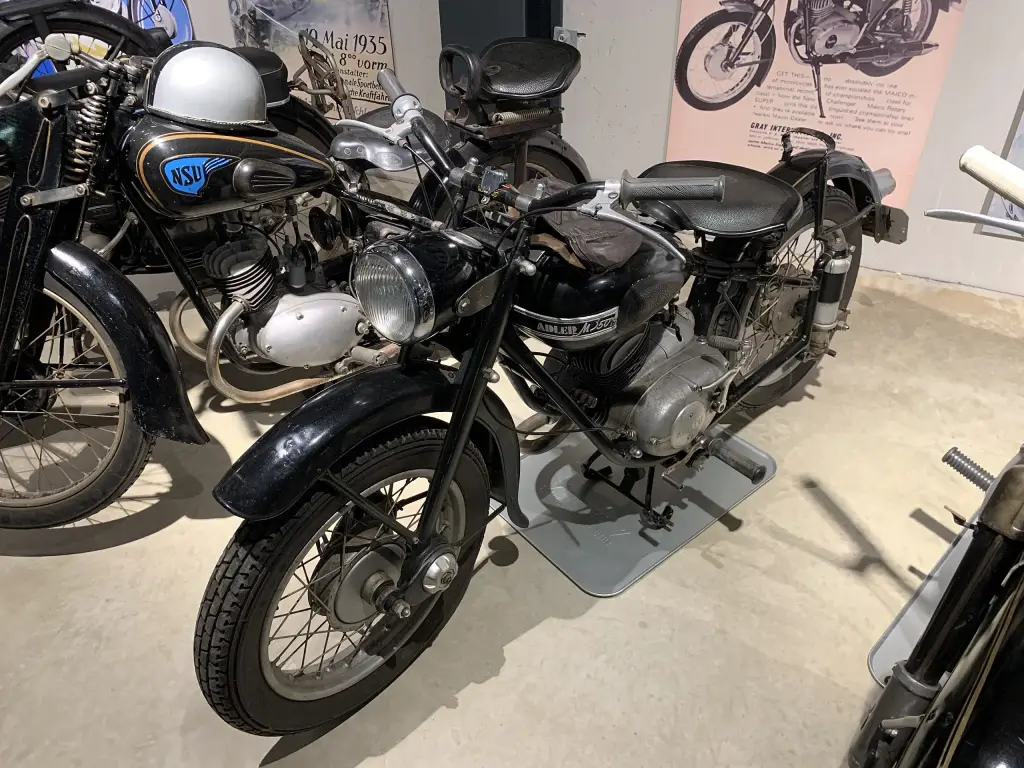
The Adler M 250 was a motorcycle made by the Frankfurt company Adlerwerke, which is better known for its cars. It was the starting point for a family of 250 cc two-stroke twins that continued through the MB 250 to the Favorit and Sprinter of 1957, after which Adler’s motorcycle production ended in 1958.
Adler M 250 at a glance
| Maker | Adlerwerke, Frankfurt am Main |
|---|---|
| Type | 250 cc motorcycle |
| Engine | air-cooled two-stroke parallel twin |
| Bore and layout | two cylinders, 180° crank offset, loop scavenging |
| Power | 16 PS; 18 PS in the MB 250 S |
| Compression | 5.75:1; 6.6:1 in the MB 250 S |
| Gearbox | four-speed, foot shift, 0-1-2-3-4 |
| Wheelbase | 1,225 mm M 250; 1,260 mm MB 250 |
| Brakes | drum, 180 mm diameter |
| Production end | Favorit and Sprinter in 1957; Adler stopped making motorcycles in 1958 |
Based on one source: the German Wikipedia article on the Adler M 250. The English Wikipedia has no article on this motorcycle.
History of the Adler M 250
From M 200 to M 250
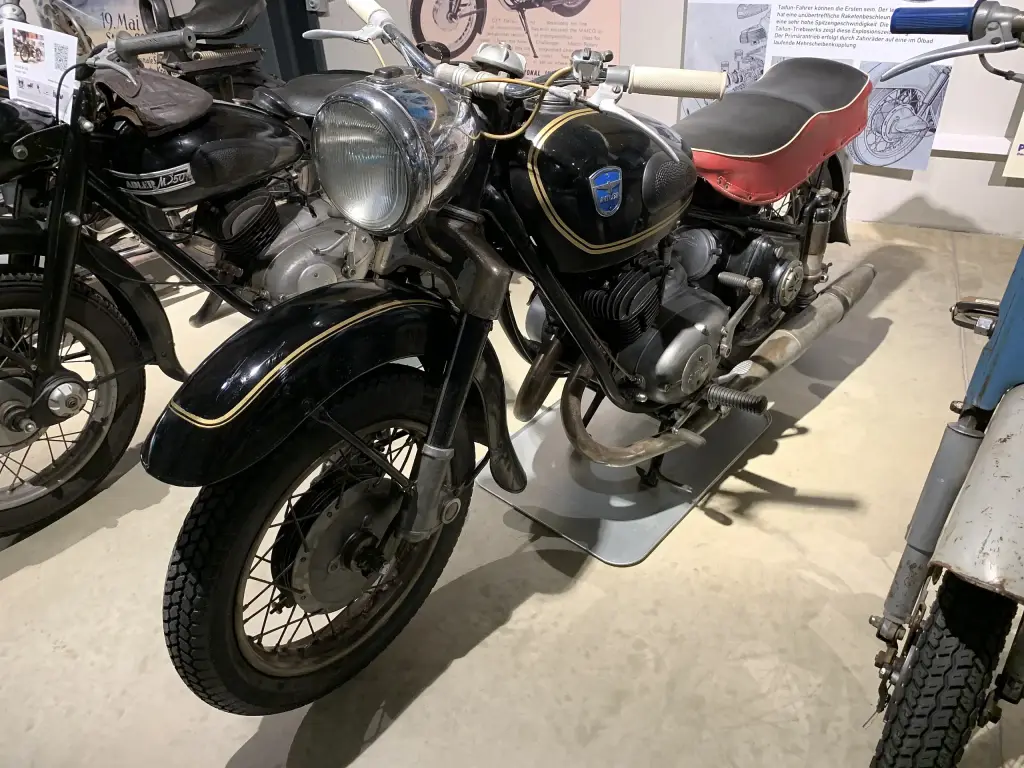
The M 250 followed the Adler M 200, which was built in parallel until 1955. The last models of the M 250 and MB 250 line were the 1957 Favorit and Sprinter, and in 1958 Adlerwerke ended motorcycle production altogether. Beyond road machines, Adler built the 250 as the Sixdays for reliability trials, the Motocross special with initially 20 PS at 6,400 rpm, and the RS 250 racing motorcycle with 26 PS at first. The RS was later developed outside the factory by race mechanics and riders, ending with 36 PS at 8,700 rpm.
Engine and electrics
The engine was a transversely mounted air-cooled two-stroke twin with a 180-degree crank offset and loop scavenging. Its compression ratio of 5.75:1 was raised to 6.6:1 in the MB 250 S, whose 18 PS engine had revised exhaust ports and forged pistons 16 grams lighter than the 206-gram cast three-ring pistons of the 16 PS engine; the S used two piston rings. Oil was mixed with petrol at 1:25. The MB 250 had a six-volt electrical system, with spark plugs of heat rating 225 to 240 and a 0.6 to 0.7 mm gap, while the 18 PS engine needed 280-grade plugs. The alternator, ignition with two sets of contact breakers, condensers and coils were enclosed, and the regulator sat on the right.
Chassis and equipment
Engine, clutch, gearbox and alternator shared one casing on the M 250 through Favorit. The clutch sat on the crankshaft, so it needed little spring pressure, and the dog-engaged gearbox had a helical primary drive. The M 250 used a double-tube frame suitable for a sidecar, a front fork with leading-link short swing arm, and at the rear until 1956 a straight-path suspension with hydraulic damping and 50 mm of travel. From late 1953 Adler fitted the MB fork designed by Jan Friedrich Drkosch, with coil springs and hydraulic damping. All M and MB models had an adjustable friction steering damper, and the brake anchor plate was braced to the fork to reduce the bike standing up under braking. The Favorit and Sprinter introduced a rear swing arm with shock absorbers; the wheelbase grew from 1,260 mm on the MB 250 to 1,335 mm, while the M 250 measured 1,225 mm. Finishes were black or green, later also blue, and a raised exhaust was optional on the M 250, MB 250 and MB 250 S.
Design and features
- Two-stroke twin: air-cooled 250 cc with a 180-degree crank.
- Unit construction: engine, clutch, gearbox and alternator in one casing.
- Sidecar-ready frame: a double-tube chassis on the road models.
- MB fork: coil-sprung and hydraulically damped from late 1953.
- Competition versions: Sixdays, Motocross and the RS 250 racer.
Adler M 250 versions
- M 250: the original road model with 16 PS.
- MB 250 and MB 250 S: later road models, the S with 18 PS.
- MB 280: a 280 cc export version for Austria with 18 PS.
- Favorit and Sprinter (1957): final models with rear swing-arm suspension.
- Sixdays: a trials version with more ground clearance and a 19-inch front wheel.
- Motocross and RS 250: works off-road and racing machines.
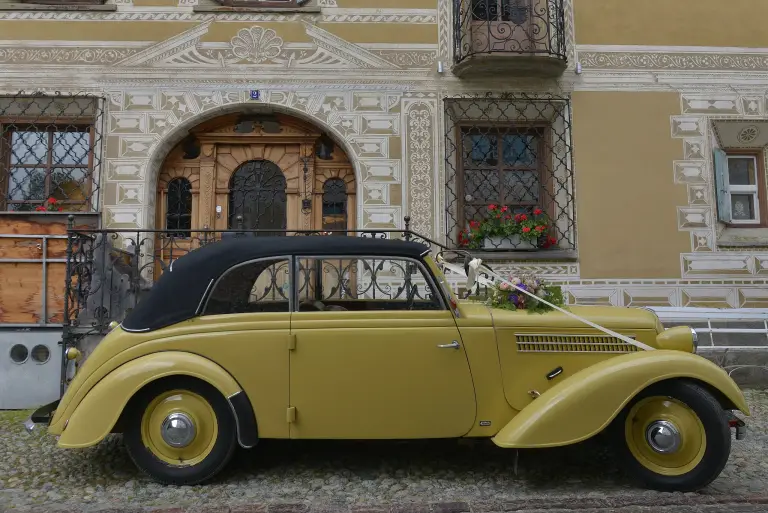
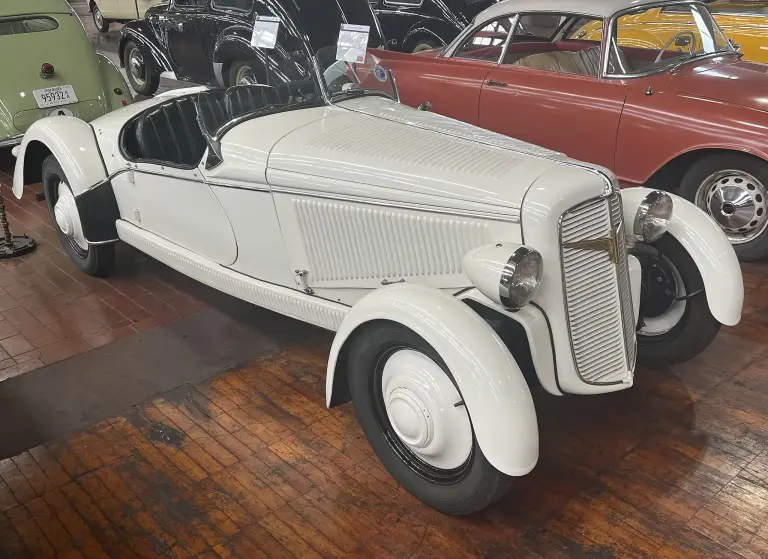
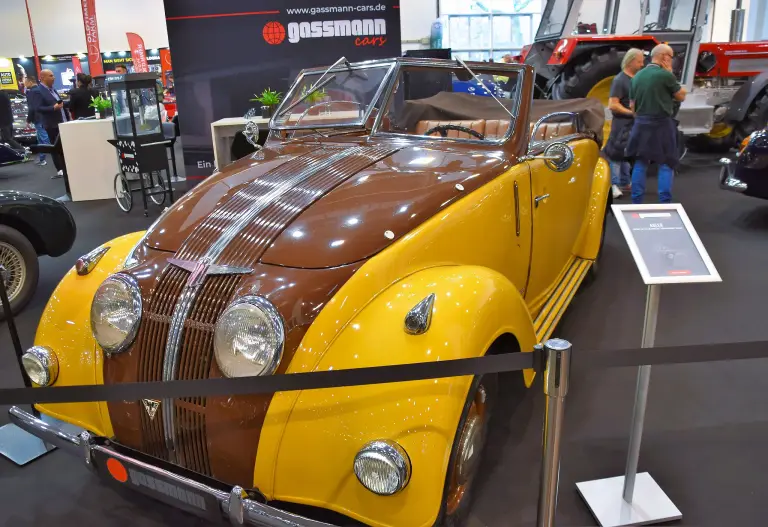
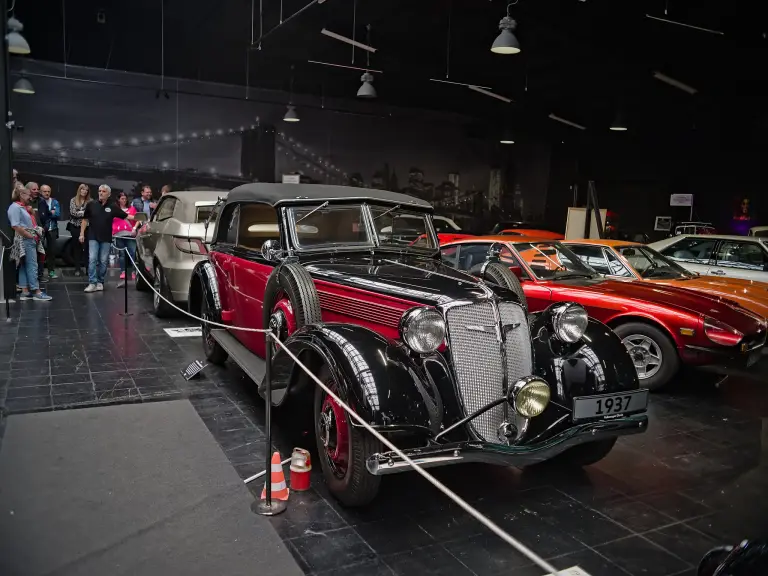
Adler is better known for cars such as the Adler 2.5-litre and the small Adler Trumpf Junior. More vehicles from the marque are in the Adler collection.
Sources
- Adler M 250, German Wikipedia: model history, engine, gearbox, chassis, equipment