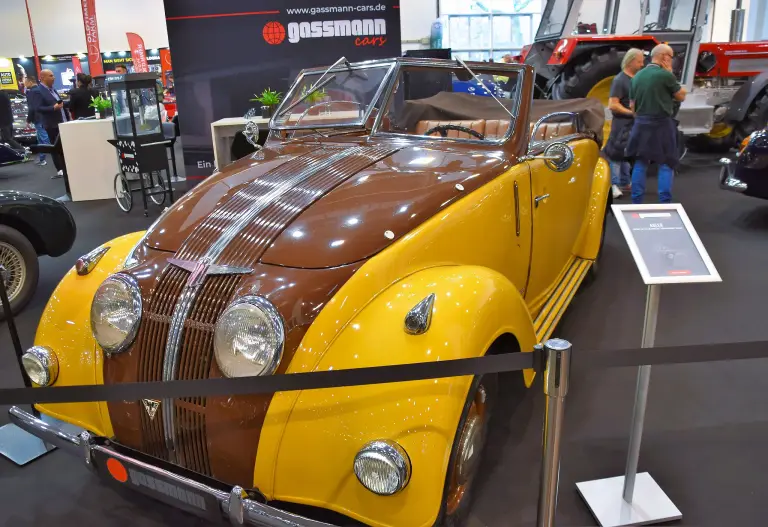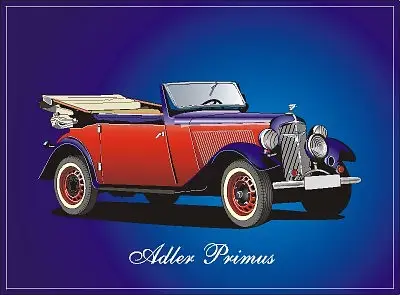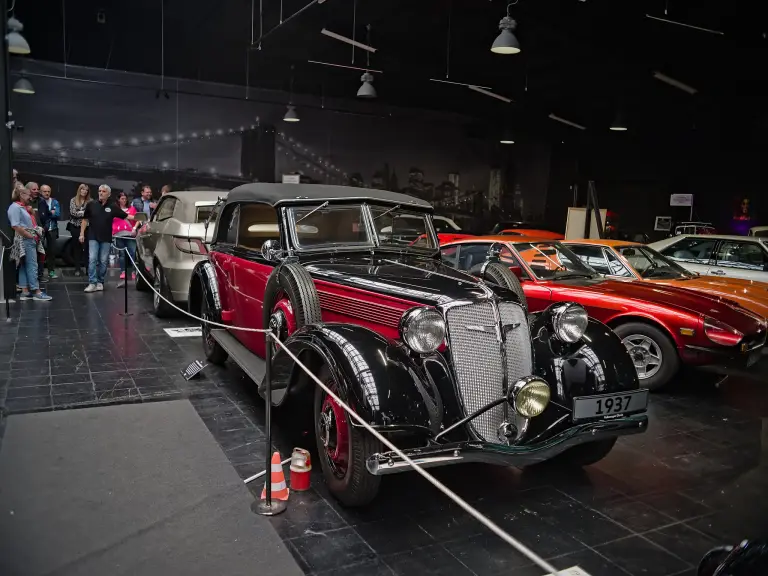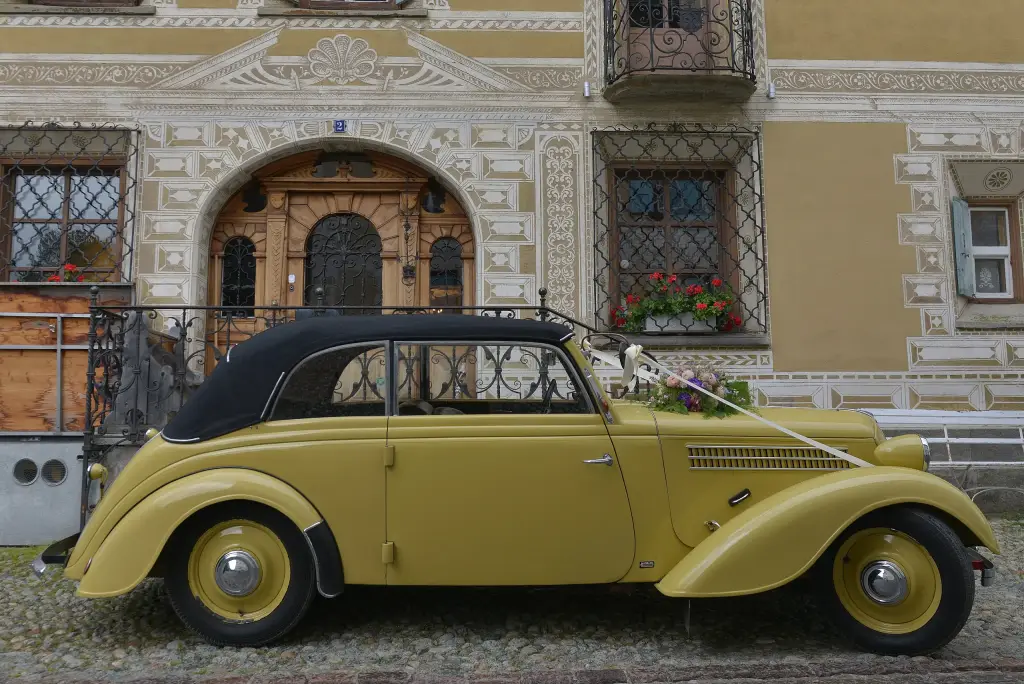
The Adler Trumpf was a small family car launched by Adler of Frankfurt in March 1932, with full production from the late summer. It was one of two similarly sized Adler models that year: the Primus kept conventional rear-wheel drive, while the Trumpf adopted front-wheel drive and independent suspension. The design was the work of Hans Gustav Röhr.
Adler Trumpf at a glance
| Maker | Adlerwerke, Frankfurt am Main |
|---|---|
| Production | 1932–1936; 1.7 EV from 1936 to 1938 |
| Designer | Hans Gustav Röhr |
| Engine | 1,504 cc or 1,645 cc four-cylinder |
| Power | 32 PS at 3,500 rpm; 38 PS at 3,800 rpm |
| Drive | front-wheel drive |
| Gearbox | four-speed manual, column-mounted lever |
| Wheelbase | 2,825 mm, 2,920 mm on the 1.7 EV |
| Length | 4,150 mm, 4,540 mm on the 1.7 EV |
| Price in 1932 | 3,750 Marks for the two-door Limousine |
| Built | 18,600 Trumpf; 7,003 Trumpf 1.7 E |
History of the Adler Trumpf
Two small Adlers for 1932
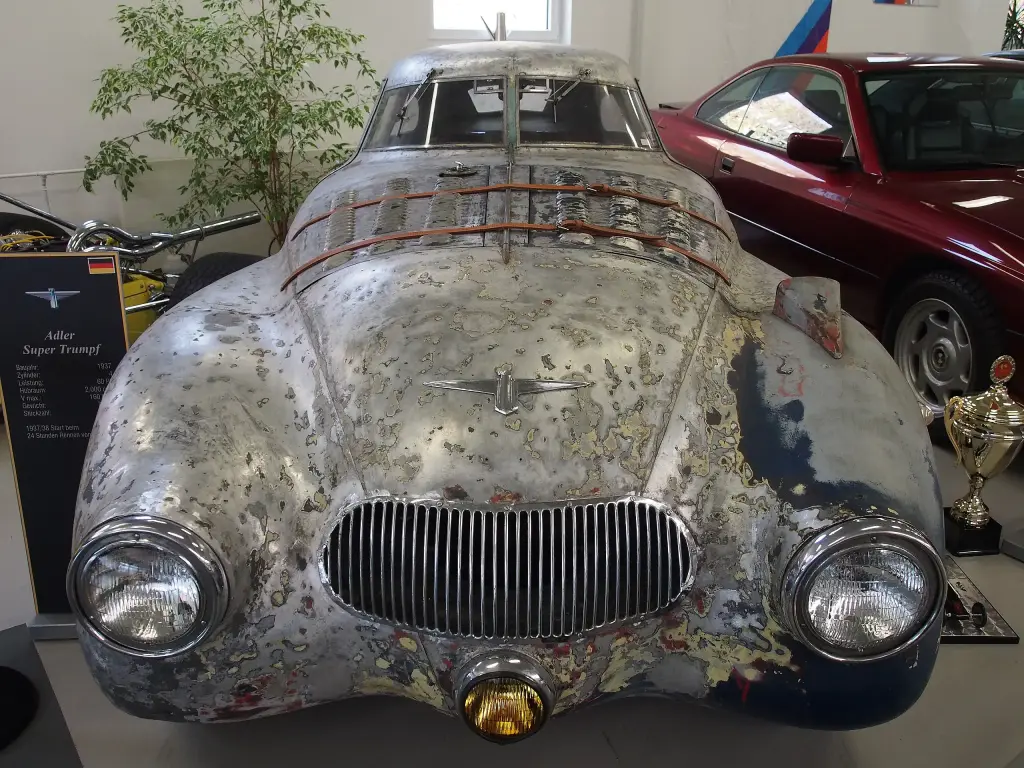
Adler launched two cars of similar size in 1932. The Primus followed the conventional rear-wheel-drive layout still used by market leader Opel, while the Trumpf copied the front-wheel-drive principle that DKW had made popular with the F1. The Trumpf reached volume production at the end of the summer of 1932 and was the more advanced of the pair, with independent suspension as well as front-wheel drive.
Engine and transmission
At launch the Trumpf used a 1,504 cc four-cylinder engine rated at 32 PS at 3,500 rpm and a top speed of 95 km/h. The block was shared with the Primus but turned through 180 degrees so that the gearbox sat directly behind the front axle, which made the Trumpf 150 mm longer than the Primus in both wheelbase and overall length. Power went to the front wheels through a four-speed manual gearbox without synchromesh, operated by a column-mounted lever rather than the Primus’s floor lever.
Bodies and the 1933 range
Ambi-Budd of Berlin supplied the two standard all-steel bodies, a two-door Limousine and a cabriolet, both on a 2,825 mm wheelbase and 4,150 mm long. The saloon cost 3,750 Marks and the cabriolet 4,500. A grille over the radiator distinguished the Trumpf from the early Primus. For 1933 an optional 1,645 cc engine arrived with 38 PS and a 100 km/h top speed, and Ambi-Budd produced a more modern body with a slightly raked windscreen and rear-hinged front doors. From 1934 to 1936 these Ambi-Budd saloons were known as “Jupiter” bodies; cabriolets and an open Sport two-seater were also added.
The 1.7 EV and the end of the line
In May 1936 the Trumpf 1.7 was replaced by the Trumpf 1.7 EV. The 1,645 cc engine and its 38 PS carried over, but the wheelbase grew by 220 mm to 2,920 mm and the more streamlined body, now 4,540 mm long, gained a longer rear overhang and a four-door six-light saloon body from Ambi-Budd. Karmann of Osnabrück built the standard cabriolets, and top speed rose to 102 km/h. The 1.7 E cost 4,400 Marks in 1936, reduced to 4,100 in 1937. Adler built 7,003 of the 1.7 E in just under two years, while the original Trumpf accounted for 18,600 cars, a market share of three to four per cent. Together with the smaller Trumpf Junior it kept Adler among the top four German passenger-car makers between 1932 and 1936.
Design and features
- Front-wheel drive: the advanced alternative to the rear-driven Primus.
- Independent suspension: a modern chassis for a small family car.
- Two engine sizes: 1,504 cc with 32 PS, then 1,645 cc with 38 PS.
- Column gear lever: a consequence of the front-wheel-drive layout.
- Jupiter bodies: Ambi-Budd steel saloons of 1934–1936.
Adler Trumpf versions
- Trumpf 1.5 (1932–1934): 1,504 cc, two-door Limousine or cabriolet.
- Trumpf 1.6 (1933–1936): optional 1,645 cc engine with 38 PS.
- Jupiter saloon: the 1934–1936 Ambi-Budd four-door body.
- Sport two-seater: open model added in 1934.
- Trumpf 1.7 EV (1936–1938): longer wheelbase and streamlined body.
The Trumpf was the front-wheel-drive twin of the rear-driven Adler Primus, and its smaller stablemate was the Adler Trumpf Junior. Above it in the range sat the six-cylinder Adler Diplomat. More cars are in the Adler collection.
Sources
- Adler Trumpf, English Wikipedia: history, engines, bodies, prices, production
- Adler Trumpf, German Wikipedia: model history, production totals, successor