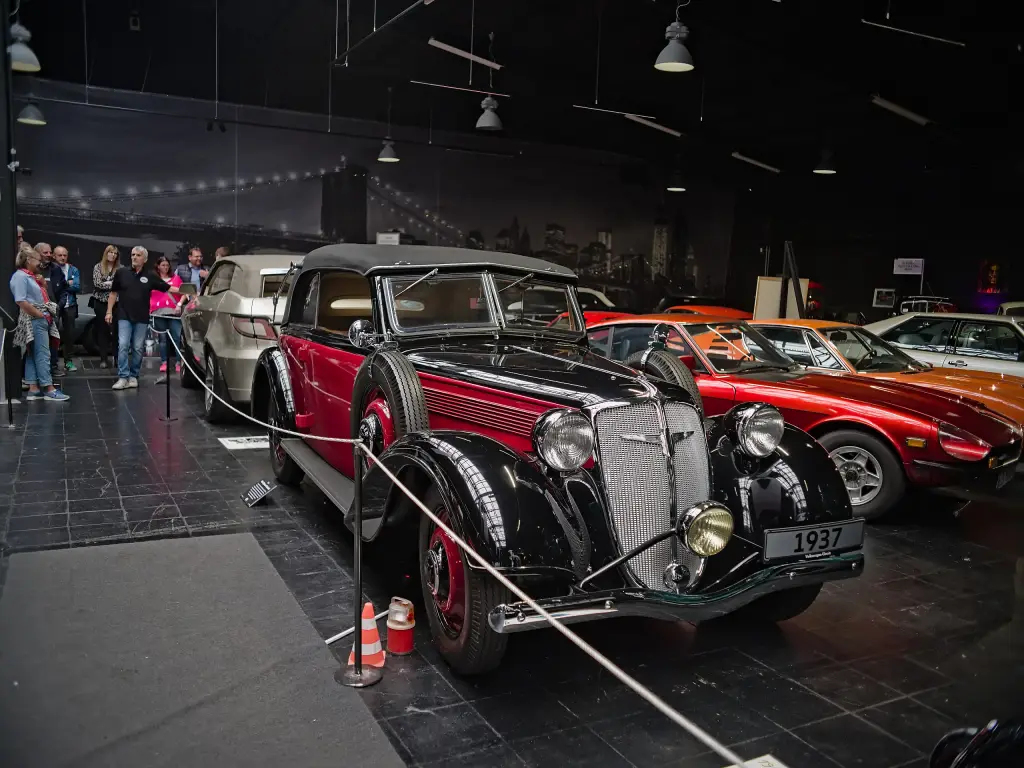
The Adler Diplomat was a six-cylinder saloon introduced by the Frankfurt maker Adler in March 1934. It replaced the Standard 6 and, less directly, the discontinued eight-cylinder Standard 8. The new name was chosen because “Standard” sounded too ordinary for a car of the advancing 1930s.
Adler Diplomat at a glance
| Maker | Adlerwerke, Frankfurt am Main |
|---|---|
| Production | 1934–1938, a few cars in 1939–1940 |
| Predecessor | Adler Standard 6 and Standard 8 |
| Body | four-door Limousine, Pullman-Limousine, two cabriolets |
| Engine | 2,916 cc straight-six, side valves |
| Power | 60 PS at 3,000 rpm; 65 PS from 1937 |
| Wheelbase | 3,200 mm four-seater, 3,350 mm six-seater |
| Price in 1934 | 6,750 Marks for the Limousine |
| Built | 3,205 |
| Military derivative | Adler Typ 3 Gd Kübelwagen, about 4,300 built |
History of the Adler Diplomat
A lower chassis for 1934
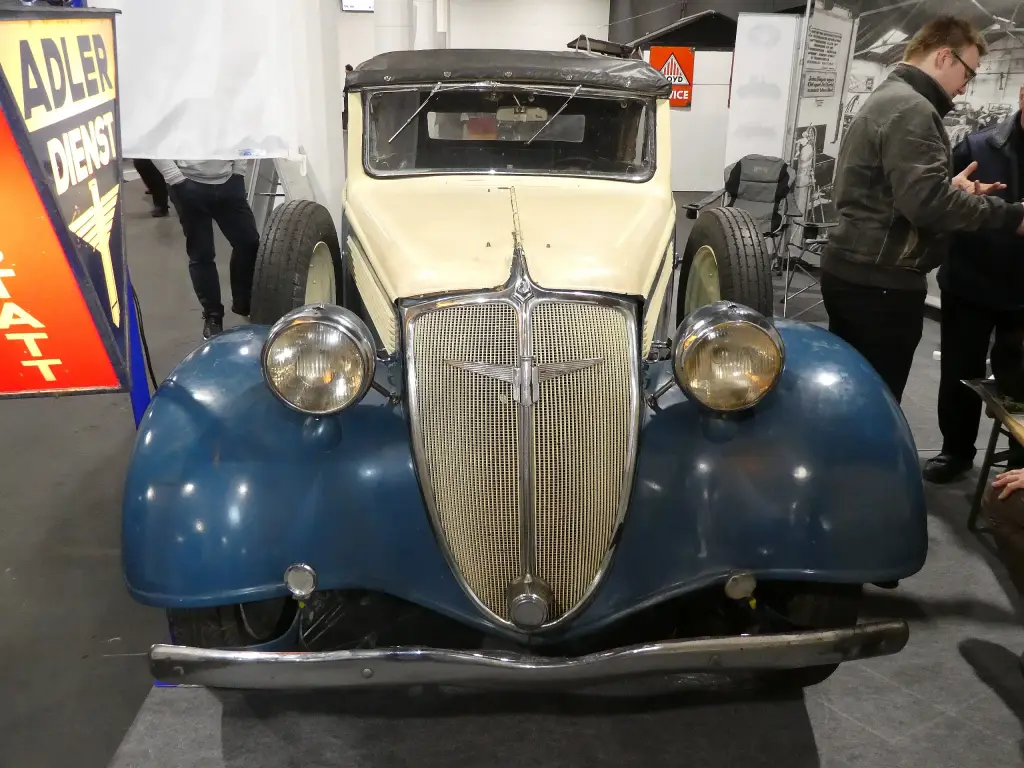
The Diplomat took over the body of the previous year’s Standard 6, but underneath it used an underslung chassis in which the axles ran above the main frame members. That gave a lower centre of gravity and a lower body than the older overslung arrangement, which had left the Standard 6 looking tall by the early 1930s. The 1934 car can be told from the final Standard 6 mainly by redesigned fender aprons.
Bodies from Ambi-Budd
The four-door Limousine came with an all-steel body from Ambi-Budd of Berlin, then Germany’s largest specialist steel body producer. A longer six-light Pullman-Limousine with six seats was also offered, probably also bodied by Ambi-Budd, and there were two cabriolet versions. For 1935 the range received a bulging, more streamlined grille and shapelier wings; the tail of the closed cars became more streamlined, although the six-light limousine kept a fairly vertical rear. The 1935 changes added 150 mm to the length but left the two wheelbases unchanged. From 1938 Karmann of Osnabrück also supplied bodies closely resembling the Ambi-Budd style.
Engine and commercial fortunes
The engine was a 2,916 cc side-valve straight-six rated at 60 PS at 3,000 rpm, with a slightly higher compression ratio and seven camshaft bearings instead of the Standard 6’s four. From 1937 it gained a light-metal cylinder head and a higher compression ratio, raising claimed output to 65 PS. At 6,750 Marks the 1934 Limousine was competitive against the Mercedes-Benz 290, which had cost 7,950 Marks in 1931, but the Adler sold in smaller numbers: 3,205 cars over four years. The model was no longer listed in 1939, though a few were built in 1939 and 1940, presumably for military use or export. From 1936 Adler also built the Typ 3 Gd Kübelwagen on the Diplomat base for the Wehrmacht, nearly 4,300 of them up to 1940.
Design and features
- Underslung chassis: axles above the frame gave a lower body than the Standard 6.
- Ambi-Budd steel body: the four-door Limousine was an all-steel design from Berlin.
- Six-cylinder engine: 2,916 cc and 60 PS, raised to 65 PS in 1937.
- Long Pullman body: a six-seat, six-light version on a 3,350 mm wheelbase.
- Military career: the Typ 3 Gd Kübelwagen used the Diplomat chassis.
Adler Diplomat versions
- Limousine (1934–1938): four-door steel saloon on the 3,200 mm wheelbase.
- Pullman-Limousine: long six-seat, six-light body on the 3,350 mm wheelbase.
- Cabriolet: two open bodies offered alongside the saloons.
- 1935 update: new grille, wings and a 150 mm longer body.
- Karmann-bodied cars: from 1938, styled like the Ambi-Budd cars.
- Typ 3 Gd Kübelwagen: military open car built from 1936 to 1940.
The Diplomat sat above the smaller Adler Trumpf and Adler Primus, and it was replaced in 1937 by the streamlined Adler 2.5-litre. More Adler cars are in the Adler collection.
Sources
- Adler Diplomat, English Wikipedia: history, body, engine, prices, production
- Adler Diplomat, German Wikipedia: model history, Kübelwagen production