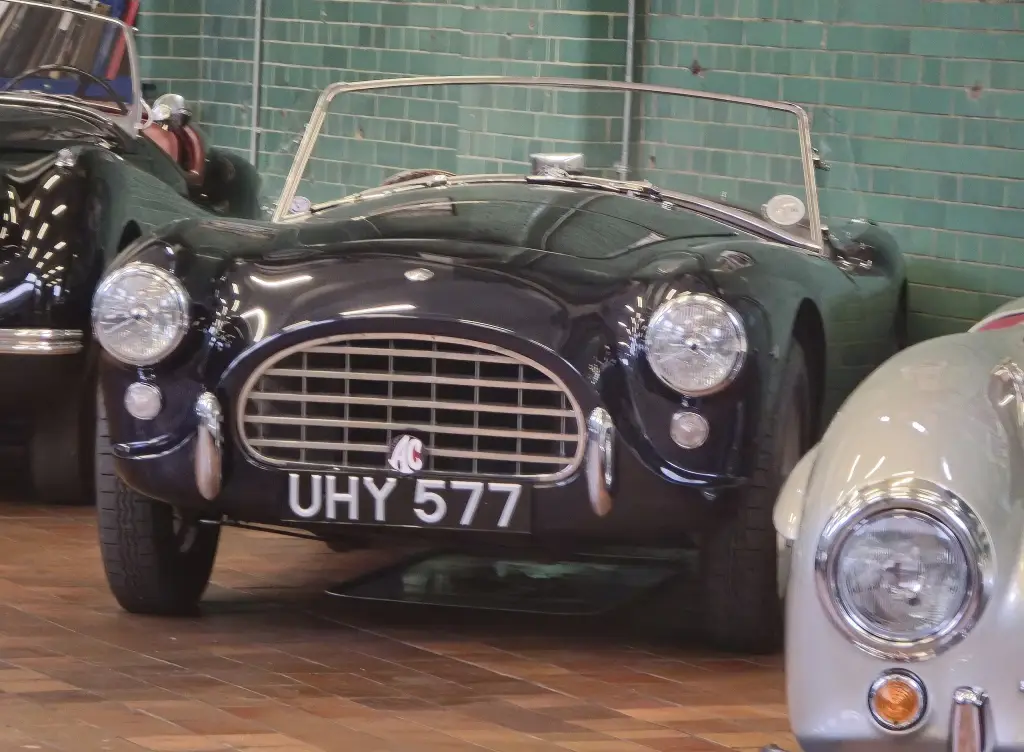
The AC Ace is a sports car produced by AC Cars of Thames Ditton, England, from 1953 until 1963. There were three main versions, the original AC Ace, the Ace Bristol and the Ace 2.6, differing by their engine. About 220 AC Aces and 466 Ace-Bristol cars were built, and it was the base car from which the original AC Cobra was developed.
AC Ace at a glance
| Produced | 1953 to 1963 |
|---|---|
| Builder | AC Cars, Thames Ditton, England |
| Built | about 220 AC Aces and 466 Ace-Bristols |
| Designer | John Tojeiro |
| Frame | light ladder-type tubular frame with all-independent transverse leaf spring suspension |
| AC engine | 2.0-litre overhead-cam six, 100 bhp; 103 mph (166 km/h) |
| Bristol engine (from 1956) | 2.0-litre six, 120 bhp; 116 mph (187 km/h) |
| Ruddspeed 2.6 (1961) | 2,553 cc Ford Zephyr six, up to 170 bhp; 130 mph (209 km/h); 37 made |
| Coupé | the Aceca hard top, from 1954 |
This page is based on English Wikipedia only (a trusted source), so the facts were not cross-checked against a second source.
History of the AC Ace
AC resumed civilian production after the Second World War with the 2-Litre range of cars in 1947, but it was the Ace of 1953 that really made its reputation. Looking for a replacement for the ageing 2-Litre, AC took up a design by John Tojeiro: a light ladder-type tubular frame, all-independent suspension on transverse leaf springs and an open two-seater alloy body, possibly inspired by the Ferrari 166 MM barchetta. The Aceca, a hard-top coupé with an early form of hatchback rear door and a timber-framed alloy body, joined it in 1954.
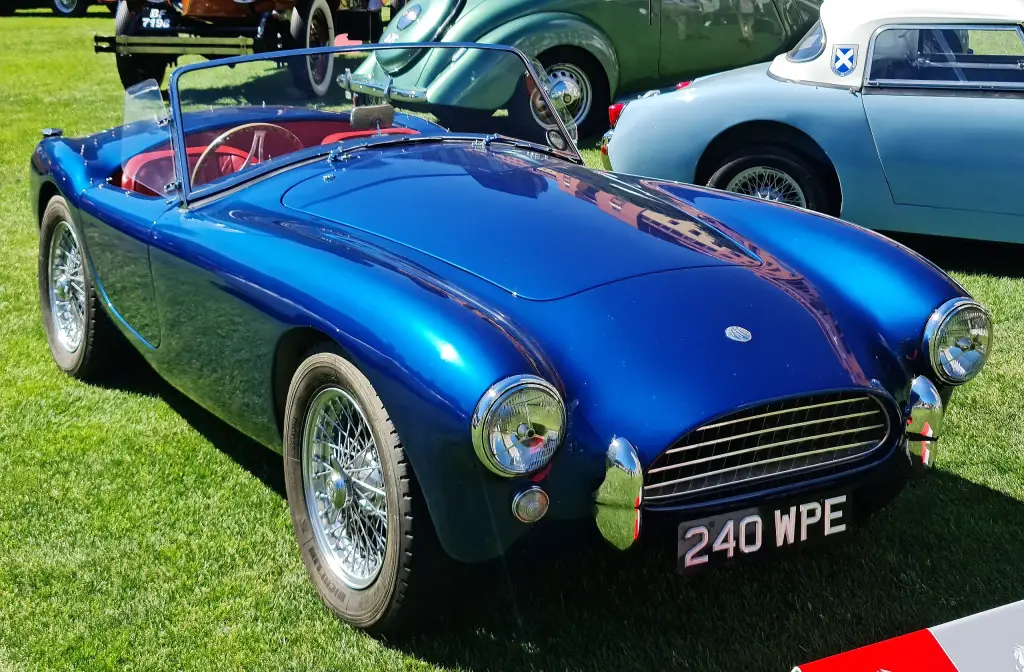
Early cars used AC’s own 100 bhp two-litre overhead-cam straight-six, an engine first seen soon after the First World War. According to a 1954 road test by Motor magazine it gave a top speed of 103 mph and 0–60 mph in 11.4 seconds. It was hardly a sporting engine, so from 1956 Bristol’s 2-litre 120 bhp six with three downdraught carburettors and a Bristol four-speed gearbox was offered, taking the top speed to 116 mph and 0–60 mph to under ten seconds. Front disc brakes became an option in 1957 and standard for 1958.
The 2.6 and the road to the Cobra
A 2.6-litre “Ruddspeed” option became available in 1961, a Ford Zephyr six tuned by Ken Rudd with three Weber or SU carburettors, some versions making 170 bhp and 130 mph. The lower Ford engine let AC change the nose of the car completely, with a lower bonnet and a smaller grille, changes that were carried over to the Cobra and are often mistakenly attributed to Carroll Shelby. It was not long before the Cobra drew buyers away, so only 37 of the 2.6 cars were made.
In 1961 the Texan Carroll Shelby approached AC’s owner, Charles Hurlock, with a proposal to fit a Ford V8 to the Ace chassis. AC agreed and adapted an Ace 2.6; Shelby arranged two engines from Ford and shipped a 3.6-litre one to Thames Ditton. The car, chassis CSX2000, was tested in January 1962, then shipped to the United States, where Shelby’s crew installed a new 260 cu in version of the V8. CSX2000 is considered the very first AC Cobra. Ace production ended one year after the Cobra’s debut.
Specials
The one-off AC Ace LM prototype of 1958, designed by Tojeiro for AC to run at Le Mans, weighed only 737 kg, with a lightweight tubular chassis and a lower aluminium body; it ran at Le Mans and the RAC Tourist Trophy in 1958, but a regulation change left it ineligible for later events. Zagato built an Ace Bristol Zagato with a fixed-head coupé body in 1958.
Design and features
- Frame: a light tubular ladder frame by John Tojeiro.
- Suspension: all-independent, on transverse leaf springs.
- Engines: AC, Bristol and Ford-based units over its ten years.
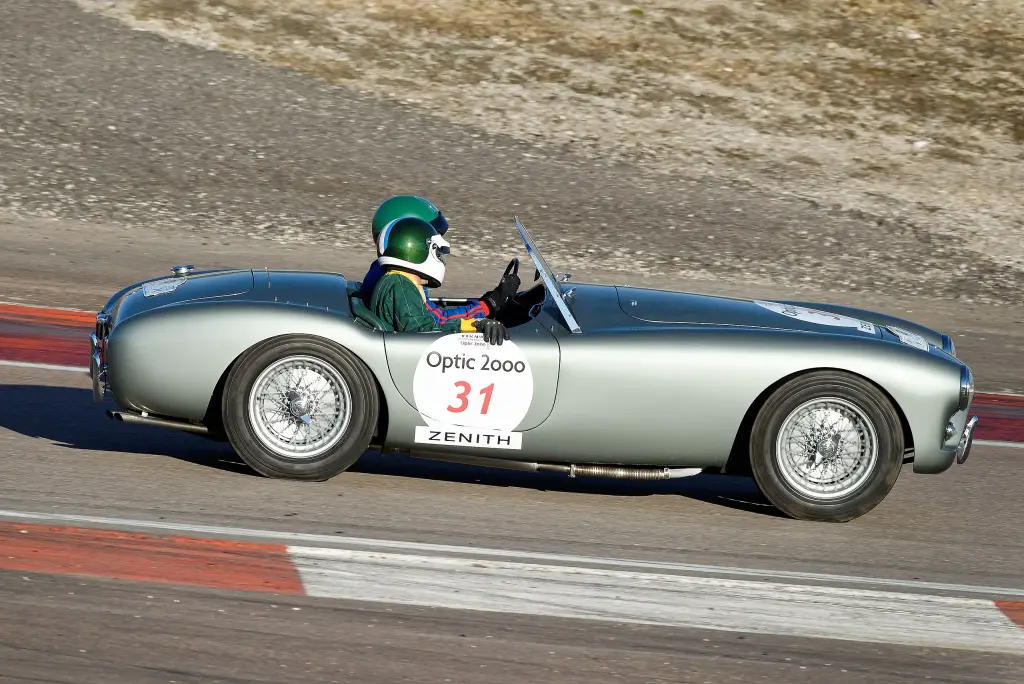
AC Ace versions
- AC Ace (1953): with the AC two-litre six.
- Ace Bristol (from 1956): 120 bhp, the most numerous version.
- Ace 2.6 (1961): the Ruddspeed Ford six; 37 made.
- Aceca: the coupé version.
The Ace led directly to the Shelby Cobra and its racing offspring the Shelby Daytona Coupe. More cars are in our AC collection.
Sources
- AC Ace, English Wikipedia: history, engines, the Cobra link and specials