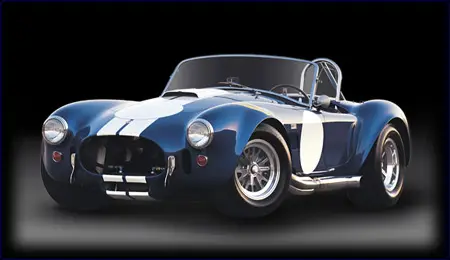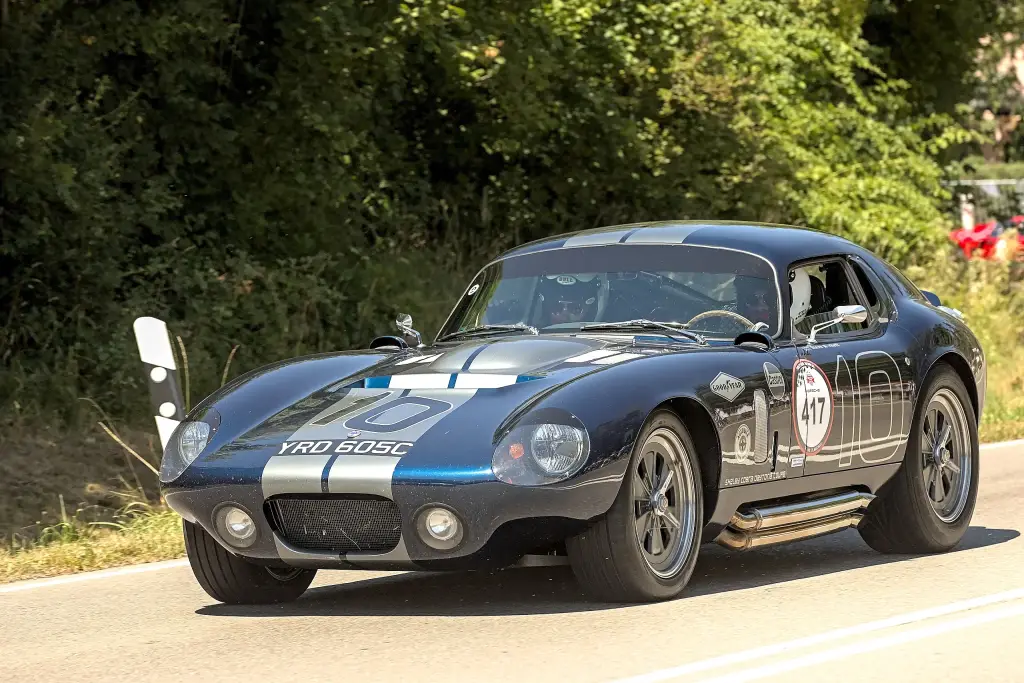
The Shelby Daytona Coupe, also called the Shelby Cobra Daytona Coupe, is an American sports coupé related to the Shelby Cobra roadster. It was loosely based on the Cobra’s chassis and drive-train, developed into an advanced evolution, and built purpose-made for racing to take on Ferrari and its 250 GTO in the GT class.
Shelby Daytona Coupe at a glance
| Built | six, between 1964 and 1965 |
|---|---|
| Basis | Shelby Cobra roadster chassis and drive-train |
| Designer | Pete Brock (body); Bob Negstad (suspension) |
| Engine | Ford 289 cu in V8 |
| First car | chassis CSX2287, built at Shelby American in Venice, California |
| Other five | built at Carrozzeria Gransport in Modena, Italy |
| Debut | Daytona Continental 2000 km, 16 February 1964, pole position for Dave MacDonald |
| Le Mans 1964 | GT class win and fourth overall, Dan Gurney and Bob Bondurant; 196 mph (315 km/h) on the Mulsanne Straight |
| 1965 title | International Championship for GT Manufacturers, won by 19 points |
| Records | 25 speed records at Bonneville, November 1965 |
History of the Shelby Daytona Coupe
Carroll Shelby, after winning Le Mans in 1959, wanted to return to Europe and beat Enzo Ferrari there with a car of his own design. He had made the AC Cobra into a successful GT racer, but the open-cockpit car was held back at Le Mans by drag: on the 3.7-mile Mulsanne Straight it was limited to about 157 mph, nearly 30 mph less than the Ferrari 250 GTO, which could hold about 186 mph. Over the length of the straight that meant a loss of more than 10 seconds a lap.
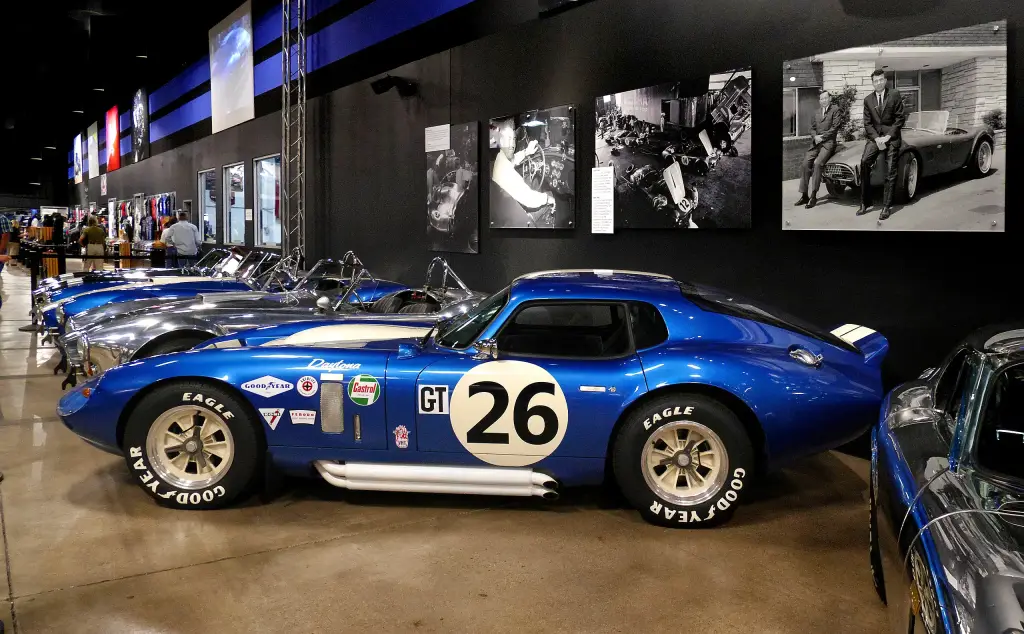
Shelby asked his employee Pete Brock to design the aerodynamic bodywork and Bob Negstad the suspension. Starting from the roadster chassis that had crashed at Le Mans in 1963, Brock sketched the design on the workshop floor, put the driver Ken Miles in the bare car and shaped the windscreen from scrap wood and gaffer tape, then made the aluminium body by hand around wooden formers. An aerodynamics consultant from Convair, Ben Howard, said the tail needed to be at least three feet longer, but Brock stood by his design. Miles took the car to Riverside Raceway and reached 186 mph on the one-mile straight, after the car had been found to have almost flown at speeds above 160 mph. After another 30 days of development it was clocked at over 190 mph.
Racing, 1964 and 1965
The first car, CSX2287, made its debut at Daytona on 16 February 1964, with Dave MacDonald on pole position. It won the GT class at the 12 Hours of Sebring in March, the coupe’s first win. In June CSX2299 won the GT class at Le Mans and finished fourth overall in the hands of Dan Gurney and Bob Bondurant, clocking over 196 mph on the Mulsanne Straight. The Daytona coupes finished second to Ferrari in GT III by six points in 1964, and won the class by 19 points in 1965.
During 1964 and 1965 the six cars were entered by the British Alan Mann Racing Ford team and temporarily sold or leased to others, such as the French Tri-Colore team and Switzerland’s Scuderia Filipinetti. Their 1965 wins included the 24 Hours of Daytona, Sebring, Monza, the Nürburgring 1000 km, Reims and Enna. The Reims 12 Hours on 3–4 July 1965, won by Bondurant and Jo Schlesser in CSX2601, clinched the championship. Shelby thus became the first American constructor to win a title on the international scene at the FIA World Championships. Shelby himself was then reassigned to the Ford GT40 project, and the Daytona programme ended with six cars.
The first car
CSX2287 ended its racing career by setting 25 USAC and FIA world records at the Bonneville Salt Flats in November 1965 during a Goodyear tyre test. It was sold to a slot-car magnate, then to the music producer Phil Spector, and appeared in a 1968 episode of The Monkees. All trace was lost by the mid-1970s and historians feared it destroyed, until it was found in a rental storage unit in California in 2001. It was bought by Dr Frederick A. Simeone and is now in the Simeone Foundation Automotive Museum in Philadelphia. In January 2014 it became the first vehicle on the Historic Vehicle Association’s National Historic Vehicle Register, the first car documented to the Interior Secretary’s Heritage Documentation standards and held in the Library of Congress, and in November 2014 it won the International Historic Motoring Awards Car of the Year.
Prices and continuation
CSX2300 was sold by RM Auctions for $4.4 million in August 2000, and CSX2601 for $7.25 million in August 2009. In July 2015 Shelby American announced a limited run of 50 continuation Daytonas to honour the 50th anniversary of the 1965 championship, some aluminium-bodied and others with cheaper fibreglass bodies.
Design and features
- Body: a streamlined aluminium coupé shape by Pete Brock, with a long tail that cut drag on straights such as Mulsanne.
- Chassis: evolved from the Cobra roadster; Bob Negstad’s suspension was later reused on the GT40 and the coil-spring Cobra.
- Construction: the first car in Venice, California; the other five by the coachbuilder Gransport in Modena.
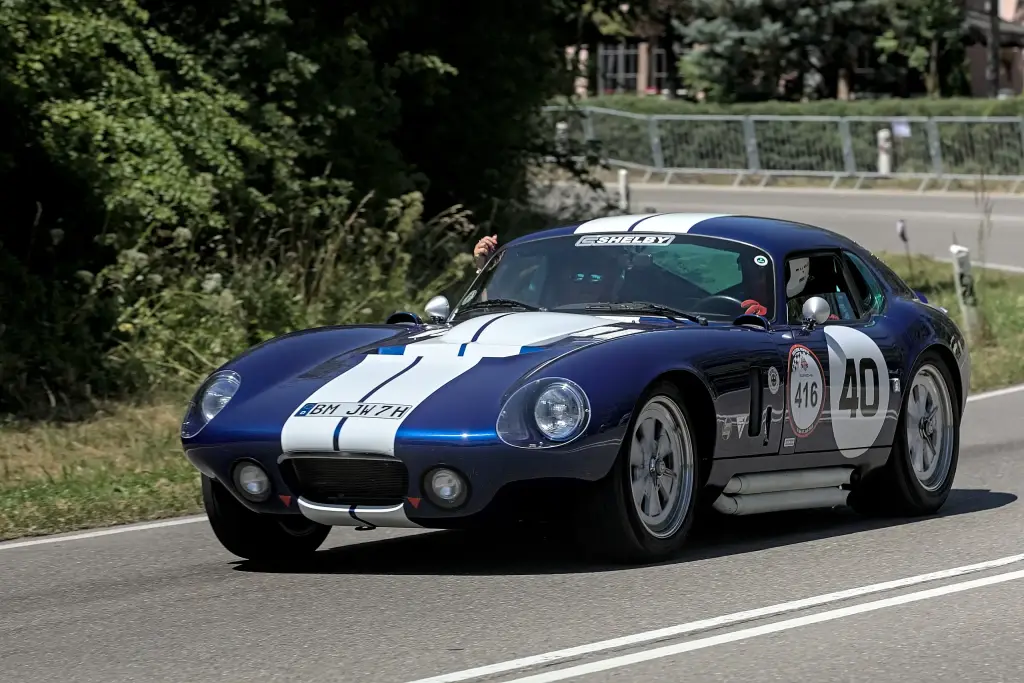
Shelby Daytona Coupe versions
- CSX2287: the original prototype, now in the Simeone museum.
- CSX2299: the 1964 Le Mans class winner, shown in the Shelby American Collection.
- CSX2300, CSX2601, CSX2602: the Italian-built cars raced by Tri-Colore, Alan Mann and Scuderia Filipinetti.
- Continuation cars (2015): 50 cars announced for the 50th anniversary of the title.
The Daytona Coupe grew out of the Shelby Cobra and raced against the Ferrari 250 GTO; Carroll Shelby’s next project was the Ford GT40. More cars are in our Shelby collection.
Shelby Daytona Coupe questions and answers
How many Shelby Daytona Coupes were built?
Six, between 1964 and 1965.
Why was it built?
To beat the Ferrari 250 GTO in the GT class, especially at Le Mans where the open Cobra lost speed on the Mulsanne Straight.
What did it win?
The 1965 International Championship for GT Manufacturers, making Shelby the first American constructor to win an international title.
Who designed the body?
Pete Brock, an employee of Carroll Shelby.
What happened to the first car?
It was lost for decades and found in a storage unit in 2001; it is now in the Simeone Foundation Automotive Museum in Philadelphia.
Sources
- Shelby Daytona, English Wikipedia: design, racing success, chassis histories
- Shelby Daytona, Italian Wikipedia: cross-check of the results list