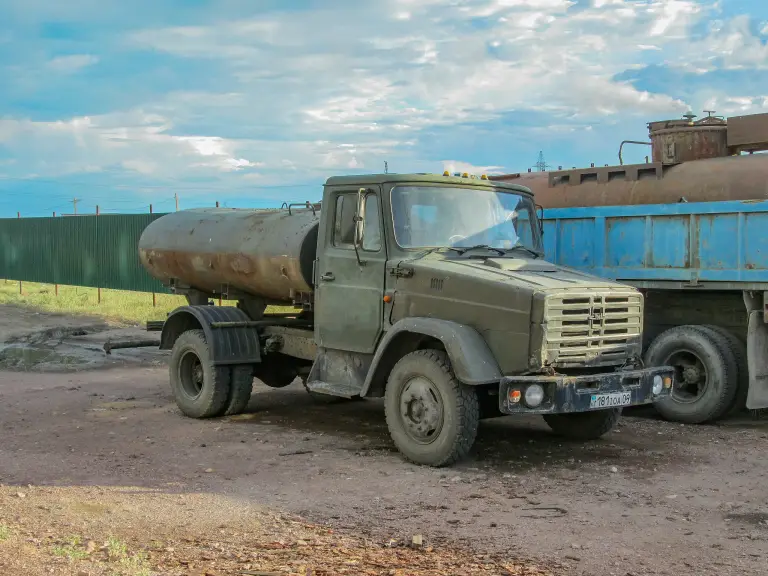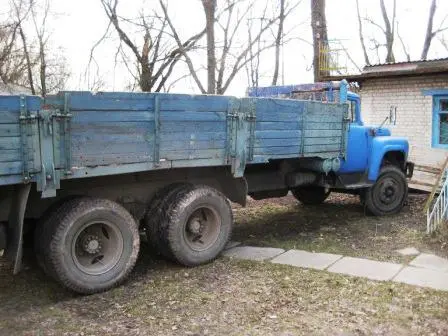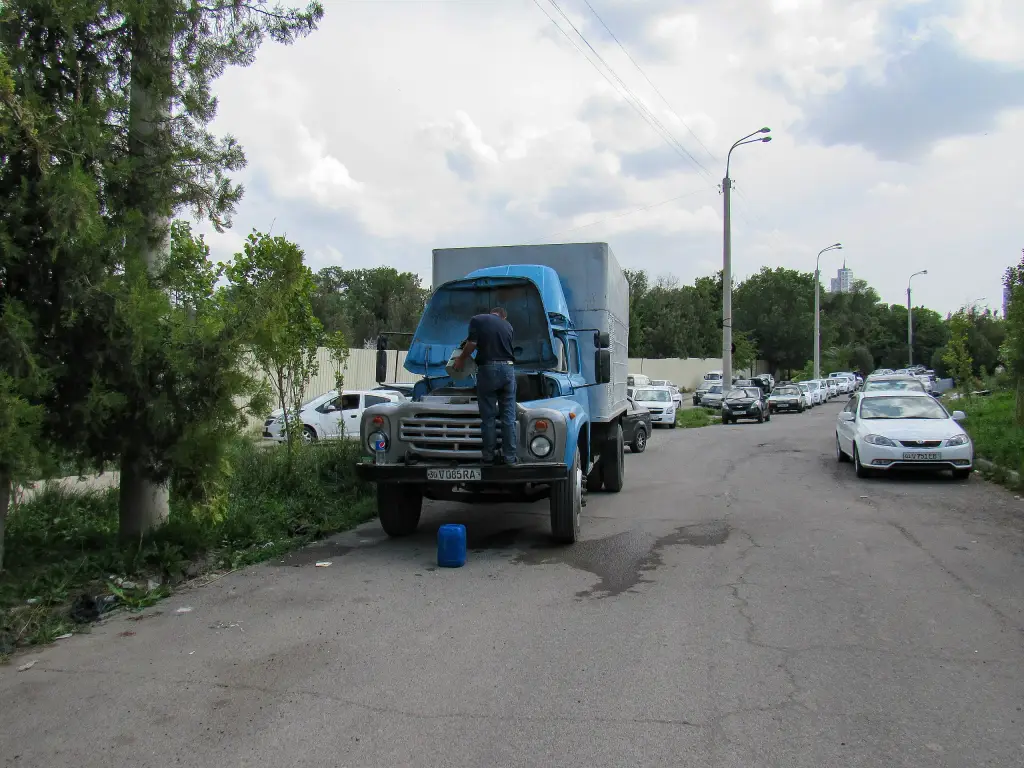
The ZIL-130 was a 5–6 tonne truck built by ZiL in Moscow from 1962 to 1994. It became one of the most numerous cargo trucks in the Soviet Union, and its chassis served as the basis for the ZIL-131 army truck and the three-axle ZIL-133.
ZIL-130 at a glance
| Maker | ZiL, Moscow |
|---|---|
| Production | 1962–1994 at ZIL |
| Class | medium-duty cargo truck, 5–6 t |
| Engine | 5,969 cc V8, 150 hp |
| Gearbox | five-speed manual, synchronised |
| Cab | three-seat, forward engine |
| Mass production | from 1 October 1964 |
| Renamed | ZIL-431410 from 1 January 1986 |
| Built at ZIL | 3,366,503 by December 1994 |
| Later production | UamZ-43140 and AMUR-531350 until 2012 |
History of the ZIL-130
Replacing the ZIS-150
Work on a replacement for the ZIS-150 began at the plant in 1953 under A. M. Kriger, with Georgy Festa as leading designer; the final styling was by T. P. Kiselyova. The project was known first as the ZIS-125 and ZIS-150M before becoming the ZIL-130. The first prototype was completed in December 1956, the truck was shown at the All-Union Agricultural Exhibition in 1959, the design brief was approved in February 1961 and the first five trucks went into trial service at the Yaroslavl tyre plant in September 1962. Mass production began on 1 October 1964 after the plant was rebuilt, and the ZIL-164 was dropped that December.
Design
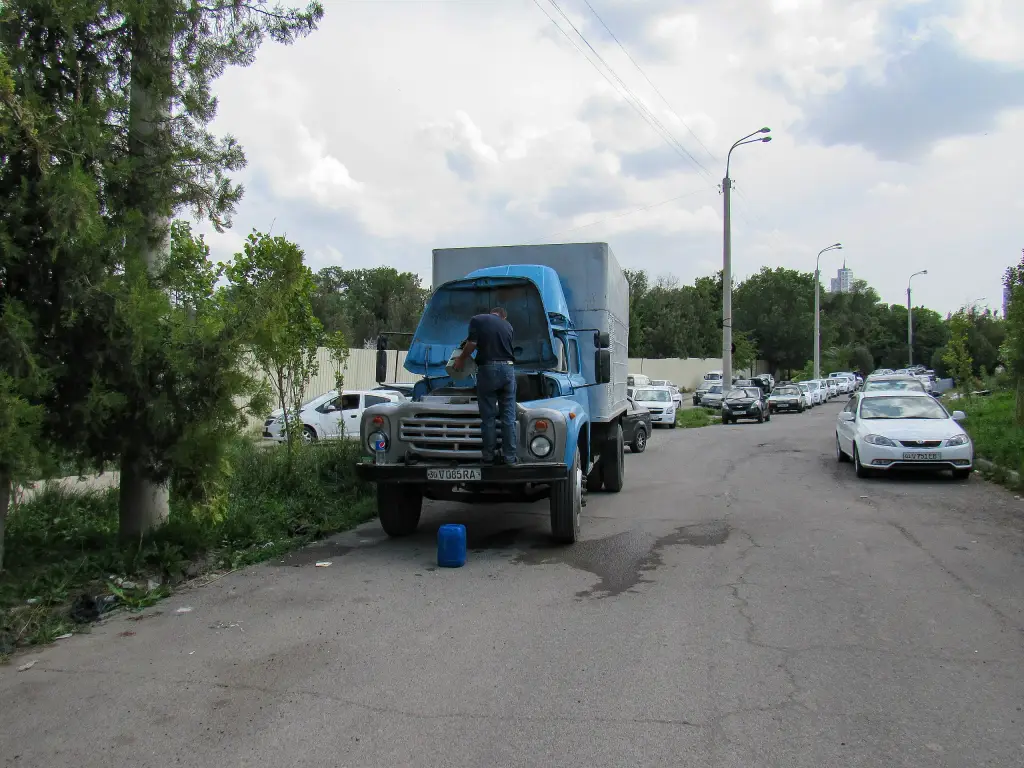
The ZIL-130 had a new cab with a wider, wraparound windscreen and a 5,969 cc V8 of 150 hp at 3,200 rpm, with a compression ratio of 6.5 for A-76 petrol and a two-barrel carburettor. The gearbox was a five-speed manual, the steering had power assistance, and the cab seated three. The truck was slightly shorter in wheelbase than the ZIL-164 and used a stronger frame. Through its life it received transistor ignition, an alternator and a revised instrument panel, and the platform sides were lowered from 685 to 575 mm after 1970. There were two modernisations, in 1966 and 1977.
The family
The basic layout produced a whole family. The 6×6 ZIL-131 army truck entered production in 1965 and the 6×4 ZIL-133 followed, both heavily based on the 4×2 ZIL-130. There were long-wheelbase versions, tractor-trailer models, northern and tropical export variants, and the ZIL-138 running on LPG or dual fuel. The one-millionth ZIL-130 was built in June 1974 and the two-millionth in August 1982; in 1973 the truck received the State Quality Mark. Under the branch standard OST 37.001-269-83 the range took new indexes from 1 January 1986: the ZIL-130 became the ZIL-431410, the ZIL-130G the ZIL-431510 and the ZIL-138 the ZIL-431810. Only the paperwork changed; the truck looked the same.
After the USSR
ZIL built 3,366,503 ZIL-130s by December 1994, not counting those assembled elsewhere; with the Chita assembly plant the total reached 3,383,312. In 1995 the tooling went to the Ural Motor Plant, which built the truck as the UamZ-43140 and later the AMUR-531350 until 2012, often with the ZIL-131 cab and a four-cylinder MMZ D-240 diesel.
Design and features
- V8 petrol engine: 5,969 cc and 150 hp, related to the ZIL-111 car engine but built for A-76 fuel.
- Modern cab: three seats behind a wide wraparound windscreen, with power steering.
- Huge production: 3.4 million built at ZIL alone, making it one of the most common Soviet trucks.
- Whole family: the basis of the ZIL-131, ZIL-133 and a long list of variants and conversions.
ZIL-130 versions
- ZIL-130 (1962–1986): the standard 4×2 cargo truck.
- ZIL-130G: long-wheelbase version, later ZIL-431510.
- ZIL-130V1: tractor-trailer version.
- ZIL-138: LPG and dual-fuel versions, later ZIL-431810.
- ZIL-431410 (1986–1994): the new official designation of the same truck.
- UamZ-43140 / AMUR-531350: post-Soviet production to 2012.
The army version was the ZIL-131, and the three-axle derivative the ZIL-133. Earlier trucks are in the ZiL collection.
Sources
- ZIL-130, English Wikipedia: prototype, production, modifications, later production
- ЗИЛ-130, Russian Wikipedia: history dates, engine data, production totals